Bondi ##k##-factor concept from first principles

  • Context: Undergrad 
  • Thread starter Thread starter Shirish
  • Start date Start date
  • Tags Tags
    Concept
Click For Summary

Discussion Overview

The discussion revolves around the derivation and understanding of Bondi's ##k##-factor in the context of special relativity, specifically how time separations between events are perceived by observers in relative motion. Participants explore the implications of linear transformations of worldlines and the relationship between time measurements in different inertial reference frames (IRFs).

Discussion Character

  • Exploratory
  • Technical explanation
  • Debate/contested
  • Mathematical reasoning

Main Points Raised

  • One participant presents a derivation suggesting that the time separation measured by observer ##B## is proportional to that measured by observer ##A##, with a factor ##k## defined as ##k=rb##.
  • Another participant questions the validity of only considering time coordinates, suggesting that both time and space coordinates should be analyzed to establish the linear relationship properly.
  • A different participant emphasizes the importance of using a general linear formula for coordinate transformations and suggests using a prime notation for clarity in distinguishing between frames.
  • Some participants express uncertainty about the adequacy of the proposed methods, suggesting that a more rigorous kinematic or geometric analysis might be necessary to substantiate the claims.
  • There is a discussion about the assumption that linear relationships hold between worldlines in different IRFs, with some participants agreeing that this is a reasonable assumption based on the nature of inertial motion.
  • One participant proposes that the reasoning based on geometry is valid but acknowledges that a more thorough proof would be preferable.

Areas of Agreement / Disagreement

Participants do not reach a consensus on the correctness of the derivation presented. There are competing views on whether the analysis is sufficient or if a more detailed approach is necessary to validate the claims about the ##k##-factor.

Contextual Notes

Some participants note that the discussion relies on assumptions about linear transformations and the nature of inertial frames, which may not be fully explored in the initial derivations. The potential limitations of the analysis are acknowledged, particularly regarding the treatment of time and space coordinates.

Shirish
Messages
242
Reaction score
32
I'm studying Core Principles of Special and General Relativity by Luscombe. In the section on Bondi's ##k##-factor, it says:
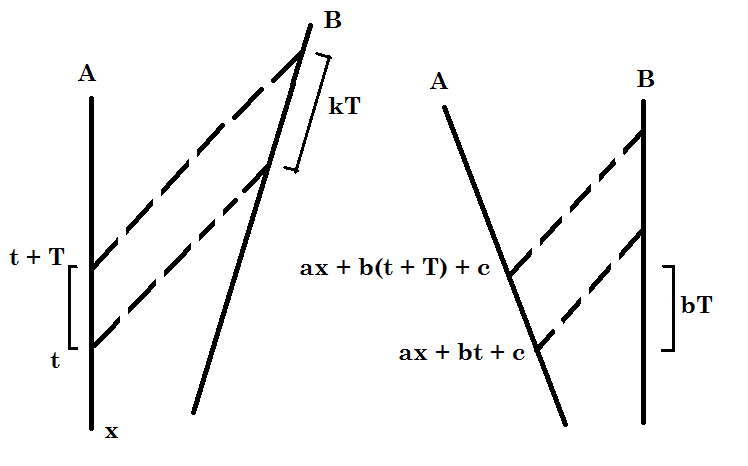
Let inertial observers ##A## and ##B## in relative motion carry identical clocks. ##A## sends two flashes of light to ##B##, a time ##T## apart. What time separation does ##B## measure? ... We know that worldlines of free particles are straight in IRFs, and that spacetime coordinates in different IRFs are related by a linear mapping. The time difference measured in B must therefore be proportional to ##T##, call it ##kT##.

1bjfo.png


I want to clarify if my derivation of the above claim is correct. The image on the left is what's included in the text and referred to by the above paragraph. I made the image on the right to understand what's going on with linear transformation of worldlines.

Let ##E_S## and ##E'_S## be the events corresponding to ##A## sending the two light signals, and let ##E_R## and ##E'_R## be those corresponding to ##B## receiving them. The claim is that if the time separation between ##E_S## and ##E'_S## is ##T## in ##A##'s frame, then the time separation between ##E_R## and ##E'_R## is ##kT## in ##B##'s frame.

Following the reasoning given in the bold line of the above paragraph, suppose I switch from ##A##'s frame to ##B##'s frame. Then the worldline of ##A## will undergo some linear transformation ==> I can assume that the time coordinate of ##E_S## will become ##ax+bt+c## and the time coordinate of ##E'_S## will be ##ax+b(t+T)+c##.

The time separation between ##E_S## and ##E'_S## will then be ##bT## in ##B##'s frame. Finally, from this we can get the time separation between ##E_R## and ##E'_R## in ##B## frame as being proportional to ##bT##, say ##r(bT)##, using simple geometry. The overall effect is that separation b/w ##E_R## and ##E'_R## in ##B##'s frame is proportional to that between ##E_S## and ##E'_S## in ##A##'s frame, with ##k=rb##.

Does that seem correct? Or is there a flaw in the derivation?
 
Physics news on Phys.org
Shirish said:
I'm studying Core Principles of Special and General Relativity by Luscombe. In the section on Bondi's ##k##-factor, it says:
View attachment 257474

I want to clarify if my derivation of the above claim is correct. The image on the left is what's included in the text and referred to by the above paragraph. I made the image on the right to understand what's going on with linear transformation of worldlines.

Let ##E_S## and ##E'_S## be the events corresponding to ##A## sending the two light signals, and let ##E_R## and ##E'_R## be those corresponding to ##B## receiving them. The claim is that if the time separation between ##E_S## and ##E'_S## is ##T## in ##A##'s frame, then the time separation between ##E_R## and ##E'_R## is ##kT## in ##B##'s frame.

Following the reasoning given in the bold line of the above paragraph, suppose I switch from ##A##'s frame to ##B##'s frame. Then the worldline of ##A## will undergo some linear transformation ==> I can assume that the time coordinate of ##E_S## will become ##ax+bt+c## and the time coordinate of ##E'_S## will be ##ax+b(t+T)+c##.

The time separation between ##E_S## and ##E'_S## will then be ##bT## in ##B##'s frame. Finally, from this we can get the time separation between ##E_R## and ##E'_R## in ##B## frame as being proportional to ##bT##, say ##r(bT)##, using simple geometry. The overall effect is that separation b/w ##E_R## and ##E'_R## in ##B##'s frame is proportional to that between ##E_S## and ##E'_S## in ##A##'s frame, with ##k=rb##.

Does that seem correct? Or is there a flaw in the derivation?

I'm not familiar with the k-calculus, so I'm not sure what one can assume. I would say that to see the linear relationship you would have to work out kinematically both the time and space coordinates of the receiving events in A's frame, then transform these to B's frame using a general linear formula for coordinate transformations.

I don't believe you can just consider the time coordinates. If you want to work it all out, that is.

In general, unless your book does things differently, using a prime ##'## for coordinates in B's frame would be better and the four events would be ##S_1, S_2, R_1, R_2## in A's frame and ##S'_1, S'_2, R'_1, R'_2## in B's frame. I.e. you have four events with two coordinates in each frame.

PS I suspect the book expects you just to accept that linear + linear = linear without working out all the details. If you do undertake a kinematic analysis, then you'd be better off using ##t_1, t_2 = t_1 + T## for the times of ##S_1, S_2##. And use ##t## as a variable in your kinematic equations.
 
Last edited:
  • Like
Likes   Reactions: Shirish
PeroK said:
I'm not familiar with the k-calculus, so I'm not sure what one can assume. I would say that to see the linear relationship you would have to work out kinematically both the time and space coordinates of the receiving events in A's frame, then transform these to B's frame using a general linear formula for coordinate transformations.

I don't believe you can just consider the time coordinates. If you want to work it all out, that is.

In general, unless your book does things differently, using a prime ##'## for coordinates in B's frame would be better and the four events would be ##S_1, S_2, R_1, R_2## in A's frame and ##S'_1, S'_2, R'_1, R'_2## in B's frame. I.e. you have four events with two coordinates in each frame.

PS I suspect the book expects you just to accept that linear + linear = linear without working out all the details. If you do undertake a kinematic analysis, then you'd be better off using ##t_1, t_2 = t_1 + T## for the times of ##S_1, S_2##. And use ##t## as a variable in your kinematic equations.

The postulate is that a straight worldline implies inertial motion, and combine that with the fact that a free particle remains free in any inertial frame of reference. This means that if a particle has a straight worldline in one inertial frame, then it'll continue to have a straight worldline in any other IFR. So you can assume the linear relationship between worldlines.

Your notation is certainly more sensible. As for considering the time coordinates, basically the way to measure time between events in a certain IFR is to record the difference between their time coordinates in that IFR. So I'm guessing that should be sufficient to work out the relationship between the time difference between ##S_1, S_2## and the time difference between ##R'_1, R'_2##?

Considering all of the above, does my method seem to make sense (as I described in the OP)?
 
Shirish said:
Considering all of the above, does my method seem to make sense (as I described in the OP)?

I don't know. On balance, I'd say it doesn't prove anything. Rather than the kinematic analysis I suggested above, you could do some plane geometry instead.

The book says: look at the geometry, assume coordinates are related linearly, conclude ##T' = kT##.

You say: change the geometry somewhat, assume coordinates are related linearly, conclude ##T' = kT##.

On the one hand I'd say that sounds reasonable. On the other, if someone asked me to prove it, I'd work out the whole thing properly, either kinematically or geometrically.
 
PeroK said:
I don't know. On balance, I'd say it doesn't prove anything. Rather than the kinematic analysis I suggested above, you could do some plane geometry instead.
...
On the other, if someone asked me to prove it, I'd work out the whole thing properly, either kinematically or geometrically.

Fair enough, but I thought what I said was a geometric argument. As in, the book just provides the diagram on the left, which is essentially a spacetime diagram as drawn by someone in ##A##'s frame. Even using any sort of geometry arguments, if I only use that spacetime diagram, I'll only get quantities as measured in ##A##'s frame.

My reasoning for referring to the spacetime diagram in ##B##'s frame (the one on the right) was so that I can calculate ##T'##, which is a quantity measured in ##B##'s frame.

So instead of
PeroK said:
You say: change the geometry somewhat, assume coordinates are related linearly, conclude ##T′=kT##.
what I'm saying is:
consider ##T##, which is a quantity measured in ##A## frame, use the linear mapping postulate to relate it to a quantity ##bT## in ##B## frame, and then finally use geometrical argument (this time only confined to the ##B## frame) to relate that to ##T'##. Transitively conclude that ##T'=kT##.

Not looking to stubbornly convince anyone or argue (you probably know much better than I do), but I am looking to make clear my thought process.

Of course, there might still be potential holes in the argument, but that's the best I can do given what the book says. I really dislike taking things at face value and just assuming stuff without working it out.
 
I'd say that to do it properly, the argument is something like this. Starting in A's frame:

First, without loss of generality, we take A's worldline to be the line ##x = 0##. B's worldine to be the line ##x = vt## (where ##v < 1##). The first sending event to be at ##(t_1, 0)##, the second sending event to be at ##(t_1 + T, 0)##. And, the paths of the light signals to be defined by ##x = t - t_1## and ##x = t - t_1 - T## respectively.

Then, we find the coordinates of the receiving events, which are where these light signals intersect the worldline of B. This involves solving the equations:

##x = vt = t - t_1## and ##x = vt = t - t_1 - T##

If we label these two events as ##3## and ##4##, we get:

##t_3 = \frac{t_1}{1-v}, \ x_3 = \frac{vt_1}{1-v}##

##t_4 = \frac{t_1 + T}{1-v}, \ x_4 = \frac{v(t_1+T)}{1-v}##

Now we can see that ##t_4 = t_3 + aT## and ##x_4 = x_3 + bT##, where ##a = \frac{1}{1-v}## and ##b = \frac{v}{1-v}## are constants.

Finally, we can transform to get the time coordinates in B's frame:

##t'_3 = \alpha t_3 + \beta x_3## and ##t'_4 = \alpha t_4 + \beta x_4##

And, we see that:

##T' = t'_4 - t'_3 = \alpha (t_4 - t_3) + \beta (x_4 - x_3) = \alpha (aT) + \beta (bT) = kT##

For some constant ##k##.

Now that we've done this, we can laugh and see that there was nothing to worry about. The relationship between ##T'## and ##T## had to be linear all along! Just like the book says. :smile:
 
  • Like
Likes   Reactions: Shirish
PeroK said:
I'd say that to do it properly, the argument is something like this. Starting in A's frame:

First, without loss of generality, we take A's worldline to be the line ##x = 0##. B's worldine to be the line ##x = vt## (where ##v < 1##). The first sending event to be at ##(t_1, 0)##, the second sending event to be at ##(t_1 + T, 0)##. And, the paths of the light signals to be defined by ##x = t - t_1## and ##x = t - t_1 - T## respectively.

Then, we find the coordinates of the receiving events, which are where these light signals intersect the worldline of B. This involves solving the equations:

##x = vt = t - t_1## and ##x = vt = t - t_1 - T##

If we label these two events as ##3## and ##4##, we get:

##t_3 = \frac{t_1}{1-v}, \ x_3 = \frac{vt_1}{1-v}##

##t_4 = \frac{t_1 + T}{1-v}, \ x_4 = \frac{v(t_1+T)}{1-v}##

Now we can see that ##t_4 = t_3 + aT## and ##x_4 = x_3 + bT##, where ##a = \frac{1}{1-v}## and ##b = \frac{v}{1-v}## are constants.

Finally, we can transform to get the time coordinates in B's frame:

##t'_3 = \alpha t_3 + \beta x_3## and ##t'_4 = \alpha t_4 + \beta x_4##

And, we see that:

##T' = t'_4 - t'_3 = \alpha (t_4 - t_3) + \beta (x_4 - x_3) = \alpha (aT) + \beta (bT) = kT##

For some constant ##k##.

Now that we've done this, we can laugh and see that there was nothing to worry about. The relationship between ##T'## and ##T## had to be linear all along! Just like the book says. :smile:

Many thanks! So essentially you've started with time coordinate difference between ##S_1, S_2##, then used geometry to get the time coordinate difference between ##R_1, R_2## and then finally used linear transformation to get time coordinate difference between ##R'_1, R'_2##. In a nutshell, ##(S_1, S_2) \implies (R_1,R_2)\implies (R'_1,R'_2)##. What I'd described was ##(S_1,S_2)\implies(S'_1,S'_2)\implies(R'_1,R'_2)##.

I'll do the calculations and put them in a subsequent post in this thread. Again, thanks so much.
 
  • Like
Likes   Reactions: PeroK
Shirish said:
Many thanks! So essentially you've started with time coordinate difference between ##S_1, S_2##, then used geometry to get the time coordinate difference between ##R_1, R_2## and then finally used linear transformation to get time coordinate difference between ##R'_1, R'_2##. In a nutshell, ##(S_1, S_2) \implies (R_1,R_2)\implies (R'_1,R'_2)##. What I'd described was ##(S_1,S_2)\implies(S'_1,S'_2)\implies(R'_1,R'_2)##.

I'll do the calculations and put them in a subsequent post in this thread. Again, thanks so much.

Yeah, or just ask yourself how any non-linear terms are going to arise when everything is linear?
 
PeroK said:
Yeah, or just ask yourself how any non-linear terms are going to arise when everything is linear?
I see your point. The transformation from the time coordinate difference between ##(S_1, S_2)## to that between ##(R_1,R_2)## turns out to be linear, as you've shown geometrically. The other between-frame transformation is linear too, so it'll be linear in the end regardless of the order.
 
  • #10
I think k-calculus can be understood in a very simple way as with the usual argument to derive the Lorentz transformations from Einstein's "two postulates" (special principle of relativity and independence of the speed of light on the relative velocity between source and detector). Take the case that an inertial frame ##\Sigma'## moves relative to the inertial frame ##\Sigma## with the constant velocity ##\vec{v}=\beta c \vec{e}_1##. Since there's only one vector in the game we must have ##x^{\prime 2}=x^2## and ##x^{\prime 3}=x^3##. Then we must have a linear transformation between ##(x^0,x^1)## and ##(x^{\prime 0},x^{\prime 1})## such that the Minkowski product
$$(x^0)^2-(x^1)^2=(x^{\prime 0})^2 - (x^{\prime 1})^2.$$
This you can simplify by introducing the light-cone coordinates
$$X^{\pm}=x^0 \pm x^1 \; \Rightarrow \; X^{\prime +} X^{\prime -}=X^+ X^-.$$
This implies that the transformation must be such that
$$X^{\prime +}=k X^+, \quad X^{\prime -}=1/k X^-.$$
This leads to
$$x^{\prime 0}=\frac{1}{2} (X^{\prime +}+X^{\prime -}) = \frac{1}{2} (k X^+ +1/k X^-)$$
and
$$x^{\prime 1}=\frac{1}{2} (X^{\prime +}-X^{\prime -}) = \frac{1}{2} (k X^+ -1/k X^-).$$
Now the origin of ##\Sigma'##, ##x^{\prime 1}=0## moves with ##v=\beta c## in ##\Sigma##, from which after some algebra
$$k=\sqrt{\frac{1-\beta}{1+\beta}}$$
and finally
$$x^{\prime 0}=\frac{x^0-\beta x}{\sqrt{1-\beta^2}}, \quad x^{\prime 1}=\frac{x^1-\beta x^0}{\sqrt{1-\beta^2}}.$$
The entire trick of Bondi's k calculus is thus to express the Lorentz boost in light-cone variables. Some people think it makes some issues in relativity simpler. You can find a series of Insights blogs by @robphy about it, also using "rotated graph paper":

https://www.physicsforums.com/insights/author/robphy/
 
  • #11
Everything that I've read about k-calculus, including Bondi's book, overlooks the fact that k-calculus is an incomplete eigenvector decomposition. The k-factor itself is just an eigenvalue of the Lorentz matrix, and the radar measurements are an integral part of the decomposition, because the eigenvector axes are ct+r=0 and ct-r=0, the worldlines of photons. All coordinates in eigenvector spacetime are determined by light rays. According to Einstein, the speed of light is the same for all observers. So coordinates determined by light rays are invariant for all observers, too. But if I go into more detail, PF moderators will demerit me again for personal opinions. So, I will merely suggest researching the eigenvector decomposition of Minkowski spacetime and the Lorentz Transform matrix.
 
  • #12
tom.capizzi said:
Everything that I've read about k-calculus, including Bondi's book, overlooks the fact that k-calculus is an incomplete eigenvector decomposition. The k-factor itself is just an eigenvalue of the Lorentz matrix, and the radar measurements are an integral part of the decomposition, because the eigenvector axes are ct+r=0 and ct-r=0, the worldlines of photons. All coordinates in eigenvector spacetime are determined by light rays. According to Einstein, the speed of light is the same for all observers. So coordinates determined by light rays are invariant for all observers, too. But if I go into more detail, PF moderators will demerit me again for personal opinions. So, I will merely suggest researching the eigenvector decomposition of Minkowski spacetime and the Lorentz Transform matrix.
You asked me a similar question on the thread on my Insight
and I responded https://www.physicsforums.com/threa...ondi-k-calculus-comments.910850/#post-6546907

It could just be that the author didn't feel the need (or possibly know) that fact.
 
  • #13
I agree that the author was probably unaware of the fact. In fact, I'd wager that most physics "experts" are unaware of that fact. I would go into more detail, but PF moderators seem to think that mathematical analysis is somehow "personal speculation", and gave me non-expiring demerits for posting. I would close my account but their privacy policy won't allow that. So I will continue to post mathematical analysis (not too much in anyone post, however) until they ban me from their conservative site.
 
  • #14
tom.capizzi said:
I agree that the author was probably unaware of the fact. In fact, I'd wager that most physics "experts" are unaware of that fact. I would go into more detail, but PF moderators seem to think that mathematical analysis is somehow "personal speculation", and gave me non-expiring demerits for posting. I would close my account but their privacy policy won't allow that. So I will continue to post mathematical analysis (not too much in anyone post, however) until they ban me from their conservative site.
There are lots of interesting facts around... but some are relevant to some and less relevant to others.
So, it depends on the audience and presenter.

I would think posting "mathematical analysis" or any other comment or analysis is fine as long as
it's directly relevant to the question posed in the thread
and at the appropriate level for those actively participating in the thread.

I think the point is to have a useful conversation--a dialogue [as opposed to a monologue]--
to try to collectively solve a problem
and better understand what is going on,
within the parameters of the website.
 
  • #15
I think the most simple derivation of the Bondi formulation of (1+1)-dimensional Lorentz transformations is in terms of light-cone coordinates. Using units with ##c=1## the light-cone coordinates are
$$L_{\pm}=t \pm x.$$
A Lorentz transformation is a linear transformation of the Minkowski vector components wrt. one inertial frame ##(t,x)## to those wrt. to another inertial frame ##(t',x')## such that the Minkowski product is invariant
$$t^2-x^2=t^{\prime 2}-x^{\prime 2}.$$
In light-cone coordinates this simply reads
$$L_+ L_-=L_+' L_-'.$$
Thut a Lorentz transformation can be characterized by a real number ##k##, describing the transformation as
$$L_-'=k L_-, \quad L_+'=\frac{1}{k} L_+$$
or
$$t'-x'=k(t-x), \quad t'+x'=k^{-1} (t+x).$$
To get the relation to the usual way to formulate the Lorentz transformation, we calculate
$$t'=(L_+'+L_-')/2=(k+k^{-1}) t/2 - (k-k^{-1}) x/2, \quad x'=(L_+'-L_-')/2=(-k+k^{-1}) t/2 + (k+k^{-1}) x/2. \qquad (*)$$
The origin of the primed system ##x'=0## thus moves with the velocity
$$v=\frac{x}{t}=\frac{k-k^{-1}}{k+k^{-1}} \; \Rightarrow \; k=\sqrt{(1+v)/(1-v)}.$$
Plugging this into Eq. (*) you indeed get the usual Lorentz transformation:
$$t'=\gamma(t-v x), \quad x'=\gamma (-v t+x) \quad \text{with} \quad \gamma=\frac{1}{\sqrt{1-v^2}}.$$
For a nice graphical reinterpretation of this Bondi k-calculus, see the Insight by @robphy

https://www.physicsforums.com/insights/relativity-rotated-graph-paper/
 
  • #16
It would be appropriate to note that light-cone coordinates are the eigenvector coordinates. While the symmetry transform specifies the size of the coordinates, it is silent on the physical interpretation. The transform maps the symmetry coordinates back to the same plane. But the representation as light-cone coordinates gives a physical sense to the transform. And it illustrates why it contains different information. The origin of no Minkowski frame is allowed to be on the light-cone. It represents the paths of photons. Now, I wonder, does this mean that a single point on the light-cone represents a photon standing still? That would be a frame that is impossible to reach. It can only exist as an asymptote.
 
  • Like
Likes   Reactions: vanhees71
  • #17
Sure, as I already wrote in the other parallel thread on the subject, you can use the light-cone basis
$$L_1=(1,1), \quad L_2=(1,-1)$$. These are eigenvectors the proper orthochronous Lorentz boosts with eigenvectors ##k=\exp \eta## and ##1/k=\exp(-\eta)## with the rapidity ##\eta## of the boost, related to the velocity by ##v=\tanh \eta##. That makes the light-cone coordinates so convenient when discussing Lorentz boosts in (1+1)-dimensional Minkowski space.
 
  • #18
tom.capizzi said:
It would be appropriate to note that light-cone coordinates are the eigenvector coordinates. While the symmetry transform specifies the size of the coordinates, it is silent on the physical interpretation. The transform maps the symmetry coordinates back to the same plane. But the representation as light-cone coordinates gives a physical sense to the transform. And it illustrates why it contains different information. The origin of no Minkowski frame is allowed to be on the light-cone. It represents the paths of photons. Now, I wonder, does this mean that a single point on the light-cone represents a photon standing still? That would be a frame that is impossible to reach. It can only exist as an asymptote.
I think it is important to come to terms with all of this restlessness concerning light:
photons [or maybe more appropriately, "light signals"] are "restless".

Whereas a massive particle (which thus has a future-timelike 4-velocity) has a "rest frame"
[which one should really nail down in terms of definitions,
as I proposed in this old post of mine
https://www.physicsforums.com/threads/photons-perspective-of-time.107741/#post-899778 ],
it appears that
light-signals do not---at least in terms of the reasonable definitions we use for the massive particle,
and I do not know of a consistent set of definitions for "reference frames for light signals".

In terms of "eigenvectors",
the principle of relativity (Einsteinian or Galilean)
could expressed by saying "there are no timelike eigenvectors"
[since having one would imply a preferred frame among them].

It is the Lorentz boost transformation that allows one of those future-timelike directions to be the one at rest.
However, there is no boost transformation that allows a lightlike or spacelike direction to be
"at rest [in the sense that we use for a future-timelike direction]."
 
  • #19
As I may have mentioned, there is no boost that can transform to eigenvector axes. They are the asymptotes of the hyperbolic grid. I was looking at an earlier post, and there was a graphic of several rectangles in your section on clock diamonds. Each of the rectangles have 3 corners on the axes and 1 floating corner. At 48x3, 36x4, 24x6, 16x9, 12x12, and then 9x16, 6x24, 4x36, 3x48, they all have the same area, uv = 144. If you were to connect all the free floating corners with a single curve, it would be a hyperbola. In hyperbolic geometry, it is the area which is conserved as a hyperbolic rotation is applied. So, this set of corners is a hyperbolic grid line. A hyperbolic rotation would displace a point from one corner to another location. In reality, it is not digitized. The hyperbola is continuous.

While diamonds may illuminate the geometry, it is useful to orient the coordinate system so that the eigenvector axes are horizontal and vertical. Then, the virtual hyperbola is uv = s² = 144. The vertex of this curve is (12,12). The axes are still light-like, and an arbitrary point anywhere on the hyperbola projects light rays to both axes, forming a light-square. This area, 144, is the same area for any rectangular shape generated by a point on this curve. Now, let's take a closer look at the unit hyperbola, uv=1. Its vertex is (1,1), and its invariant area is 1.

The reason for this configuration is the geometric definition of rapidity is the area of a triangular wedge formed by the axis of symmetry, a radius vector from the origin to the curve, and the section of the curve between the radius and the symmetry axis. In order to find this triangular area it is necessary to find the definite integral of the curve. First, however, a little geometric algebra. The area of every rectangle from the curve is 1, so the area of any right triangle from a point on the curve is 1/2. If we add the triangle from (0,0) to (1,0) to (1,1), and subtract the triangle from (0,0) to (u,0) to (u,v), we haven't changed the area, only its shape. Now it is a 4-sided figure which is the perimeter of the definite integral of v du over the interval 1 to u. uv = 1, so v = 1/u, and the integral is du/u = ln(u) + C. Between the limits of 1 and u, ln(u) - ln(1) = ln(u). But this area is already defined to be the rapidity, w. w = ln(u) or e^w = u. Since uv = 1, (e^w)v = 1, and v = 1/e^w. Every point on this hyperbola is of the form, (e^w,1/e^w). Every one of these pairs is a Lorentz squeeze mapping. Not only are they the eigenvalues of the 2x2 Lorentz matrix for Minkowski coordinates, they are also the actual elements of the diagonal matrix that is the form of the Lorentz matrix for eigenvector coordinates. By the way, this also explains why rapidity addition is linear. It is the additive property of the limits of definite integrals, totally unrelated to physics. If c is a point between a and b, the integral from a to b is equal to the integral from a to c plus the integral from c to b.

In Mermin's paper, he drops perpendiculars to the eigenvector axes by specifying both points projecting light-like signals. But he projects these lines from Minkowski coordinates. The result is indeed proportional to the invariant. However, when those light-like lines are projected from eigenspace points to the eigenvectors, the enclosed area is no longer proportional to the invariant, it IS the invariant. Note: when u = ct+r and v = ct-r, the product uv = (ct+r)(ct-r) = c²t²-r² = s², the Einstein Interval.
 
  • #20
tom.capizzi said:
As I may have mentioned, there is no boost that can transform to eigenvector axes. They are the asymptotes of the hyperbolic grid. I was looking at an earlier post, and there was a graphic of several rectangles in your section on clock diamonds. Each of the rectangles have 3 corners on the axes and 1 floating corner. At 48x3, 36x4, 24x6, 16x9, 12x12, and then 9x16, 6x24, 4x36, 3x48, they all have the same area, uv = 144. If you were to connect all the free floating corners with a single curve, it would be a hyperbola. In hyperbolic geometry, it is the area which is conserved as a hyperbolic rotation is applied. So, this set of corners is a hyperbolic grid line. A hyperbolic rotation would displace a point from one corner to another location. In reality, it is not digitized. The hyperbola is continuous.

While diamonds may illuminate the geometry, it is useful to orient the coordinate system so that the eigenvector axes are horizontal and vertical. Then, the virtual hyperbola is uv = s² = 144. The vertex of this curve is (12,12). The axes are still light-like, and an arbitrary point anywhere on the hyperbola projects light rays to both axes, forming a light-square. This area, 144, is the same area for any rectangular shape generated by a point on this curve. Now, let's take a closer look at the unit hyperbola, uv=1. Its vertex is (1,1), and its invariant area is 1.

The reason for this configuration is the geometric definition of rapidity is the area of a triangular wedge formed by the axis of symmetry, a radius vector from the origin to the curve, and the section of the curve between the radius and the symmetry axis. In order to find this triangular area it is necessary to find the definite integral of the curve. First, however, a little geometric algebra. The area of every rectangle from the curve is 1, so the area of any right triangle from a point on the curve is 1/2. If we add the triangle from (0,0) to (1,0) to (1,1), and subtract the triangle from (0,0) to (u,0) to (u,v), we haven't changed the area, only its shape. Now it is a 4-sided figure which is the perimeter of the definite integral of v du over the interval 1 to u. uv = 1, so v = 1/u, and the integral is du/u = ln(u) + C. Between the limits of 1 and u, ln(u) - ln(1) = ln(u). But this area is already defined to be the rapidity, w. w = ln(u) or e^w = u. Since uv = 1, (e^w)v = 1, and v = 1/e^w. Every point on this hyperbola is of the form, (e^w,1/e^w). Every one of these pairs is a Lorentz squeeze mapping. Not only are they the eigenvalues of the 2x2 Lorentz matrix for Minkowski coordinates, they are also the actual elements of the diagonal matrix that is the form of the Lorentz matrix for eigenvector coordinates. By the way, this also explains why rapidity addition is linear. It is the additive property of the limits of definite integrals, totally unrelated to physics. If c is a point between a and b, the integral from a to b is equal to the integral from a to c plus the integral from c to b.

In Mermin's paper, he drops perpendiculars to the eigenvector axes by specifying both points projecting light-like signals. But he projects these lines from Minkowski coordinates. The result is indeed proportional to the invariant. However, when those light-like lines are projected from eigenspace points to the eigenvectors, the enclosed area is no longer proportional to the invariant, it IS the invariant. Note: when u = ct+r and v = ct-r, the product uv = (ct+r)(ct-r) = c²t²-r² = s², the Einstein Interval.
Yes, I pretty much agree with your comments. They underlie my presentation using the diamonds on rotated graph paper and my alternative presentation using rapidities in the context of a unified spacetime trigonometry [a.k.a Cayley-Klein geometry]. In fact, I would say that my presentations are attempts to reveal such facts about Minkowskian spacetime geometry, using geometry and physical intuition.
E.g. why do we care about the causal-diamond area (and not some other areas in the diagram, all of which are also invariant under a boost, since the determinant of the boost is 1). It's not enough to say (to the general audience) "it's because its edges are along the eigenvectors."
Rather, it is easy to calculate with (after one learns how to do so) and has a physical interpretation... not just as the square-interval (a rather abstract concept) but as an invariant-quantity resulting from doing radar measurements.

The hyperbola is indeed continuous, and a glimpse of it is gotten from a sampling using the area factored into integers which can be counted on the rotated graph paper. Counting and geometric reasoning with physical interpretation gets the main idea across... then, if desired, one can use analytic formulas and methods to see the situation and calculate for more general situations. Starting from the formulas, as done in traditional textbooks, appear to leave a lot of folks behind. I feel I could convey many of the ideas of relativity to middle-schoolers using some of my methods, without them first learning algebra and doing analytic geometry.

By the way, I think it is better to say
"hyperbolic trigonometry" (the flat geometry with the hyperbola as the circle and the hyperbola for the angle measure),
rather than
"hyperbolic geometry" (the curved geometry, which still uses a circle for angle measure).
[These are different geometries in the Cayley-Klein classification.]

With reference to the diamonds, many authors say that the area is proportional to the square-interval (which of course is true). Part of that is due to the definition adopted [implicitly or explicitly] of the light cone coordinates. Some have that factor of 1/\sqrt{2} to make the transformation between rectangular and light-cone coordinates appear more symmetrical [similar to the use of that factor in Fourier transforms]. But if you adopt the coordinates that I use [which I motivate using the ratio of areas], then you get agreement (that is, proportionality factor of 1).

By the way, I use "diamonds" (or parallelograms) but not [light-]squares or [light-]rectangles (in early versions of Mermin's approach, he used "rhombi", which is okay). Although to a Euclidean eye those are "rectangles", to a Minkowskian eye they are not--- the lightlike vectors u and v are not Minkowski-perpendicular to each other \tilde u \cdot \tilde v \neq 0 (although of course \tilde u \cdot \tilde u = 0 and \tilde v \cdot \tilde v = 0).
So, these diamonds are not Minkowski-rectangles. A Minkowski-rectangle is formed from an observer's 4-velocity and her x-axis.

So, as I said, I agree with your statements.
 
Last edited:
  • Like
Likes   Reactions: vanhees71
  • #21
robphy said:
Yes, I pretty much agree with your comments. They underlie my presentation using the diamonds on rotated graph paper and my alternative presentation using rapidities in the context of a unified spacetime trigonometry [a.k.a Cayley-Klein geometry]. In fact, I would say that my presentations are attempts to reveal such facts about Minkowskian spacetime geometry, using geometry and physical intuition.
E.g. why do we care about the causal-diamond area (and not some other areas in the diagram, all of which are also invariant under a boost, since the determinant of the boost is 1). It's not enough to say (to the general audience) "it's because its edges are along the eigenvectors."
Rather, it is easy to calculate with (after one learns how to do so) and has a physical interpretation... not just as the square-interval (a rather abstract concept) but as an invariant-quantity resulting from doing radar measurements.

The hyperbola is indeed continuous, and a glimpse of it is gotten from a sampling using the area factored into integers which can be counted on the rotated graph paper. Counting and geometric reasoning with physical interpretation gets the main idea across... then, if desired, one can use analytic formulas and methods to see the situation and calculate for more general situations. Starting from the formulas, as done in traditional textbooks, appear to leave a lot of folks behind. I feel I could convey many of the ideas of relativity to middle-schoolers using some of my methods, without them first learning algebra and doing analytic geometry.

By the way, I think it is better to say
"hyperbolic trigonometry" (the flat geometry with the hyperbola as the circle and the hyperbola for the angle measure),
rather than
"hyperbolic geometry" (the curved geometry, which still uses a circle for angle measure).
[These are different geometries in the Cayley-Klein classification.]

With reference to the diamonds, many authors say that the area is proportional to the square-interval (which of course is true). Part of that is due to the definition adopted [implicitly or explicitly] of the light cone coordinates. Some have that factor of 1/\sqrt{2} to make the transformation between rectangular and light-cone coordinates appear more symmetrical [similar to the use of that factor in Fourier transforms]. But if you adopt the coordinates that I use [which I motivate using the ratio of areas], then you get agreement (that is, proportionality factor of 1).

By the way, I use "diamonds" (or parallelograms) but not [light-]squares or [light-]rectangles (in early versions of Mermin's approach, he used "rhombi", which is okay). Although to a Euclidean eye those are "rectangles", to a Minkowskian eye they are not--- the lightlike vectors u and v are not Minkowski-perpendicular to each other \tilde u \cdot \tilde v \neq 0 (although of course \tilde u \cdot \tilde u = 0 and \tilde v \cdot \tilde v = 0).
So, these diamonds are not Minkowski-rectangles. A Minkowski-rectangle is formed from an observer's 4-velocity and her x-axis.

So, as I said, I agree with your statements.
I was with you up to " (although of course \tilde u \cdot \tilde u = 0 and \tilde v \cdot \tilde v = 0)." In eigenspace, the eigenvectors remain perpendicular to infinity. u dot v = 0, everywhere. Usually, it is u x u = 0 and v x v = 0. Is this a typo, or is it because of the light-cone? These are rectangles in eigenspace, where Mermin's light rectangles become invariant in area, although they can change proportions and perimeter.
 
  • #22
tom.capizzi said:
I was with you up to " (although of course \tilde u \cdot \tilde u = 0 and \tilde v \cdot \tilde v = 0)." In eigenspace, the eigenvectors remain perpendicular to infinity. u dot v = 0, everywhere. Usually, it is u x u = 0 and v x v = 0. Is this a typo, or is it because of the light-cone? These are rectangles in eigenspace, where Mermin's light rectangles become invariant in area, although they can change proportions and perimeter.
Sorry, notational clash... akin to writing a position vector as \vec r =x\hat x +y\hat y,
"x" the coordinate and \hat x the unit vector.

My point is that
the null-vectors that form the diamond edges are not Minkowski-orthogonal to each other
since their minkowski dot product is not zero.
So, "rectangle" or "square" is inappropriate in the context of Minkowskian spacetime geometry.
But "diamond", "parallelogram", or "rhombus" is better.

(See calculation below in the paragraph beginning "
We now specialize to the Minkowski dot-product. In our signature convention,...".)

The area of the diamond can be given by the cross-product, independent of metric. (See calculation below.)

Here is an excerpt from the appendix on my paper
"Relativity on rotated graph paper" American Journal of Physics 84, 344 (2016); https://doi.org/10.1119/1.4943251
(where I've specified my definitions)
https://dx.doi.org/10.1119/1.4943251 said:
1632986211520.png

Without proof some useful vectorial relations
that will help us to write an expression for the area of a causal diamond.
(Refer back to the figure.)
Let \hat t=\vec{OT}, \hat x=\vec{OX}, \vec u=\vec{ON}, \vec v=\vec{OM},
and note the relations
\hat t=\vec u+\vec v, \hat x=\vec u-\vec v,
\hat u=(\hat t+\hat x)/2, and \hat v=(\hat t-\hat x)/2.
Given \vec A=A_t \hat t+A_x \hat x=A_u\vec u+A_v\vec v,
we have A_t=(A_u+A_v)/2, A_x=(A_u-A_v)/2, A_u=A_t+A_x, and A_v=A_t-A_x.

For any two-dimensional vector space [without any need for a dot-product],
we can write <br /> \vec A\times \vec B<br /> =(A_tB_x-A_xB_t)(\hat t\times \hat x)<br /> =(A_uB_v-A_vB_u)(\vec u\times \vec v)<br />,
where we associate (\vec u\times \vec v) with the signed-area of Alice's clock diamond---the causal diamond of OT.
From our definitions of the basis vectors, we have (\hat t \times \hat x)=-2(\vec u \times\vec v).
Thus, <br /> \vec A\times \vec B<br /> =(A_tB_x-A_xB_t)(-2(\hat u\times \hat v))<br /> =(A_uB_v-A_vB_u)(\vec u\times \vec v)<br />.

We now specialize to the Minkowski dot-product.
In our signature convention,
we have \hat t\cdot\hat t=1, \hat x\cdot\hat x=-1, and \hat t\cdot\hat x=0.
This implies that \vec u\cdot\vec u=0, \vec v\cdot\vec v=0, and \vec u\cdot\vec v=1/2.
Thus, \vec A\cdot \vec B=A_tB_t-A_xB_x=(A_uB_v+A_vB_u)/2 .

We can now relate the squared interval of a vector \vec Q (\Delta s^2_{\vec Q}=\vec Q\cdot \vec Q)
with the signed area of the causal diamond whose diagonal is \vec Q.
Let \vec U and \vec V be the pair of lightlike vectors,
along \vec u and \vec v respectively,
that form the edges of that diamond
such that \vec Q=\vec U+\vec V.

We calculate the area of this causal diamond (in units of clock diamonds)
using both rectangular and light-cone coordinates.
Since \vec Q=Q_t\hat t +Q_x\hat x, we have
\vec U=(Q_t+Q_x)(\hat t+\hat x)/2 and \vec V=(Q_t-Q_x) (\hat t-\hat x)/2.
So,
\begin{align*}<br /> {\cal A}(\vec{OQ})=( \vec U \times \vec V)<br /> &amp;= -2(U_t V_x - U_x V_t)\\<br /> &amp;=-2\left(<br /> \left(\frac{Q_t+Q_x}{2}\right)\left(-\frac{Q_t-Q_x}{2}\right)<br /> - \left(\frac{Q_t+Q_x}{2}\right)\left(\frac{Q_t-Q_x}{2}\right)<br /> \right)\\<br /> &amp;=Q_t^2-Q_x^2\\<br /> &amp;=\Delta s^2_{\vec Q} \end{align*}.
In light-cone coordinates,
we have \vec Q=Q_u\vec u+Q_v\vec v
with \vec U=Q_u\vec u and \vec V=Q_v \vec v .
Then, \begin{align*}{\cal A}(\vec{OQ})=( \vec U \times \vec V)=U_uV_v-U_vV_u<br /> &amp;=(Q_u)(Q_v)-(0)(0)\\<br /> &amp;=Q_uQ_v\\<br /> &amp;=\Delta s^2_{\vec Q}\\<br /> \end{align*}.
This is an algebraic proof of the area formula.
 
Last edited:
  • #23
robphy said:
By the way, I use "diamonds" (or parallelograms) but not [light-]squares or [light-]rectangles (in early versions of Mermin's approach, he used "rhombi", which is okay). Although to a Euclidean eye those are "rectangles", to a Minkowskian eye they are not--- the lightlike vectors u and v are not Minkowski-perpendicular to each other \tilde u \cdot \tilde v \neq 0 (although of course \tilde u \cdot \tilde u = 0 and \tilde v \cdot \tilde v = 0).
So, these diamonds are not Minkowski-rectangles. A Minkowski-rectangle is formed from an observer's 4-velocity and her x-axis.

So, as I said, I agree with your statements.
Indeed, the greatest obstacle to read Minkowksi diagrams correctly, and the rotated graph paper approach is just another presentation of Minkowski diagrams using light-cone constructions, that you must force yourself not to think in terms of the Euclidean-plane geometry, which is pretty much impossible, because we all are trained to think in terms of Euclidean geometry since the kindergarten.

Of course there cannot be a basis of orthogonal light-like vectors, because Minkowski orthogonal light-like vectors are parallel to each other: Let ##u## and ##v## be lightlike and orthogonal. Then you have
$$u \cdot u = v \cdot v=u \cdot v=0.$$
Without loss of generality we can assume that ##u^0>0## and ##v^0>0##. If this is not the case we can instead use the vectors ##\tilde{u}=-u## and/or ##\tilde{v}=-v##.

The last equation can be written in (1+3)-notation
$$u^0 v^0=\vec{u} \cdot \vec{v}.$$
From the first two equations you can write this as
$$|\vec{u}| |\vec{v}|=\vec{u} \cdot \vec{v} \; \Rightarrow \; \cos(\angle(\vec{u},\vec{v}))=1 \; \Rightarrow \angle(\vec{u},\vec{v})=0,$$
and thus there's a real number ##\lambda## such that
$$\vec{v}=\lambda \vec{u} \; \Rightarrow \; u^0 v^0=\lambda \vec{u}^2=\lambda (u^0)^2 \; \Rightarrow \; v^0=\lambda u^0 \; \Rightarrow \; v=\lambda u.$$
 
  • #24
vanhees71 said:
Indeed, the greatest obstacle to read Minkowksi diagrams correctly, and the rotated graph paper approach is just another presentation of Minkowski diagrams using light-cone constructions, that you must force yourself not to think in terms of the Euclidean-plane geometry, which is pretty much impossible, because we all are trained to think in terms of Euclidean geometry since the kindergarten.

I don't believe it's pretty much impossible.

We've learned to read position-vs-time graphs, i think.
That has a non-Euclidean geometry, but we don't realize it
because we aren't asked to think about it like that
[although we should if we want to graduate to reading position-vs-time graphs in special relativity].
(Every sloped line representing the worldline of an observer
is Galilean-perpendicular to a line of "constant t" (i.e. "space", an instant of Galilean absolute time)...
although they don't appear to have a 90-degree angle at the intersection.)

The diamonds help one count and reason with Euclidean ideas (really Cayley-Klein geometry ideas) that persist in [with trigonometric modifications] in Minkowski and Galilean geometry.
The string of diamonds shows the tickmarks of a spacetime-ruler, and encode the perpendicularity with its diagonals.

The reasoning is practically the same... it's the details concerning angle-measure, distance-measure, and orthogonality that are different. Parallelism still holds, notions of the "areas on a plane" still hold, vector-algebra still holds.
Orthogonality based on "tangent to a circle being orthogonal to radius" still holds.
[Maybe we should emphasize that notion over the Euclidean-centric "90-degrees".]
Angle based on sector-areas still holds. Angle based on metric-arcLength still holds.
So, yes, it's different but not that different if one is taught to generalize what one learned in kindergarten.

Many of us have learned to generalize dimensionality beyond 2 dimensions
and consistent geometries beyond Euclidean space
[e.g. spherical geometry/trigonometry used in navigation and astronomy].Admittedly, it is not "easy" to read spacetime diagrams.
I have a problem hearing music from sight-reading notes on a musical staff. (I can't sight-read.)
I have a problem understanding a circuit's properties by looking at a circuit diagram.
I have a problem understanding a truss's properties by looking at a diagram of a truss.
For these, I have to sit and decode the information.
 
Last edited:
  • Like
Likes   Reactions: vanhees71
  • #25
In Newtonian mechanics you have a fibre bundle. There's not much interpretation about "lengths" in a space-time diagram as in Minkowski space, where you have a pseudo-Euclidean manifold.
 
  • #26
vanhees71 said:
In Newtonian mechanics you have a fibre bundle. There's not much interpretation about "lengths" in a space-time diagram as in Minkowski space, where you have a pseudo-Euclidean manifold.
That may be true, looking at Newtonian mechanics in isolation.
But when seen as a stepping stone on the way to special-relativity and general-relativity,
where we learn that proper-time is the arc-length in the appropriate metric,
then we look back at say, ah... the Newtonian spacetime metric looks like a pair of degenerate metrics.

Looking back (i.e. the correspondence principle) suggests that
our more modern formulation reduces
to the non-relativistic formulation in that limit.
This suggests that we didn't get it completely wrong...
but we just got stuck in a limiting case
and we have had trouble understanding the actual case.
 
  • Like
Likes   Reactions: vanhees71
  • #27
robphy said:
Sorry, notational clash... akin to writing a position vector as \vec r =x\hat x +y\hat y,
"x" the coordinate and \hat x the unit vector.

My point is that
the null-vectors that form the diamond edges are not Minkowski-orthogonal to each other
since their minkowski dot product is not zero.
So, "rectangle" or "square" is inappropriate in the context of Minkowskian spacetime geometry.
But "diamond", "parallelogram", or "rhombus" is better.

(See calculation below in the paragraph beginning "
We now specialize to the Minkowski dot-product. In our signature convention,...".)

The area of the diamond can be given by the cross-product, independent of metric. (See calculation below.)

Here is an excerpt from the appendix on my paper
"Relativity on rotated graph paper" American Journal of Physics 84, 344 (2016); https://doi.org/10.1119/1.4943251
(where I've specified my definitions)
"A(OQ→)=(U→×V→)=−2(UtVx−UxVt)=−2((Qt+Qx2)(−Qt−Qx2)−(Qt+Qx2)(Qt−Qx2))=Qt2−Qx2=ΔsQ→2."
The second line was clipped in the post. I see it now after pasting it. There is still a problem, however. Trying to refer to the paper in the link, and it says I don't have access unless I buy it.
 
Last edited:
  • #29
vanhees71 said:
There's something wrong with your formula. The "rotated graph" paper by @robphy is freely available on the arXiv too:

https://arxiv.org/abs/1111.7254
That is an earlier draft of the published paper.
Most of the ideas were there.

The published version involved some rearrangement of sections
and some tidying up of some arguments...
and yes, one has to be a subscriber or make a purchase to read that journal.
 
Last edited:
  • #30
Sure, but better to have an arXiv version than nothing!
 
  • Like
Likes   Reactions: robphy

Similar threads

  • · Replies 7 ·
Replies
7
Views
2K
  • · Replies 20 ·
Replies
20
Views
3K
  • · Replies 18 ·
Replies
18
Views
2K
  • · Replies 78 ·
3
Replies
78
Views
7K
  • · Replies 3 ·
Replies
3
Views
3K
  • · Replies 18 ·
Replies
18
Views
3K
  • · Replies 10 ·
Replies
10
Views
2K
  • · Replies 146 ·
5
Replies
146
Views
12K
  • · Replies 8 ·
Replies
8
Views
2K
  • · Replies 51 ·
2
Replies
51
Views
5K