Both plates of capacitor connected to positve voltage

Click For Summary
SUMMARY

When both plates of a capacitor are connected to positive voltages, such as +5V and +3V, a potential difference of 2V exists between them, indicating that the capacitor is charged. The charge on the plates is defined by the difference in electron count, with the plate at +5V having fewer electrons than the plate at +3V. The concept of ground is relative; while both plates may be positively charged relative to ground, the absolute potential does not affect the functioning of the capacitor. Understanding the relationship between electric potential and charge is crucial for analyzing capacitive behavior.

PREREQUISITES
  • Basic understanding of capacitors and electric charge
  • Knowledge of electric potential and voltage measurements
  • Familiarity with the concept of ground in electrical circuits
  • Understanding of capacitance and its formula C = Q/V
NEXT STEPS
  • Explore the concept of electric potential difference in capacitors
  • Learn about the role of ground in electrical circuits and its implications
  • Investigate the relationship between charge, voltage, and capacitance in detail
  • Study practical applications of capacitors in electronic circuits
USEFUL FOR

Electrical engineers, physics students, and anyone interested in understanding capacitor behavior and electric potential in circuits.

arpon
Messages
234
Reaction score
16
If both the plates of a capacitor are connected to positve voltage, (but has a potential differnce between them) will the capacitor be charged? And how?
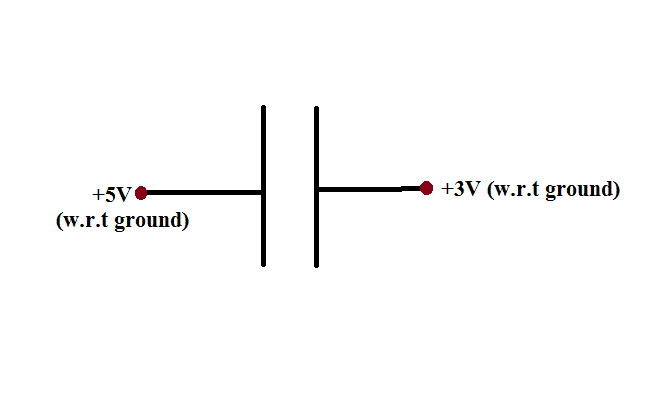
upload_2014-12-31_15-19-57.png
 
Physics news on Phys.org
And what potential is this particular ground at with respect to another ground? Does the ground potential matter?
 
Bystander said:
And what potential is this particular ground at with respect to another ground? Does the ground potential matter?
Actually, by 'ground', I mean something which is electrically neutral. Both of the plates are connected to some conductor which has lack of electrons (and so they are electrically positive). But the voltages of the plates are not the same.
 
Well, if one plate is charged to +5v and the other to +3v, is there a potential difference between them?
 
Drakkith said:
Well, if one plate is charged to +5v and the other to +3v, is there a potential difference between them?
Why not? It's (+5V) - (+3V) = 2V
 
Okay. So if the potential between the plates is 2 volts, do you think the capacitor is "charged"? Why or why not?
 
Drakkith said:
Okay. So if the potential between the plates is 2 volts, do you think the capacitor is "charged"? Why or why not?
In a capacitor, one of the plates is charged positive and the other negative and they are equal in quantity. But in this case, both the plates lack electron. So how can it provide negative charge or, electron?
If I assume, the plate connected to 3V is charged negative, then the plate will have a negative electric potential, and so there should be a current flow because it is connected with a voltage generator which will always keep potential to +3V.
 
Last edited:
Both plates lack a very, very small number of electrons. Over 99.999% of the electrons are still on the plates. The plate charged to +5v simply has a few more electrons missing. A few missing electrons adds up to a large amount of charge.
 
Drakkith said:
Both plates lack a very, very small number of electrons. Over 99.999% of the electrons are still on the plates. The plate charged to +5v simply has a few more electrons missing. A few missing electrons adds up to a large amount of charge.

But the point is, if the plate connected to +3V is negatively charged, then it will have a negative electric potential. As, it is connected to a voltage generator which always keeps the voltage to +3V, there should be a current flow. So, the plate will keep losing electrons, won't it?
 
  • #10
Not at all. The plate will lose electrons until it reaches +3 volts. It will then stop losing them and remain at +3v.
 
  • #11
Drakkith said:
Not at all. The plate will lose electrons until it reaches +3 volts. It will then stop losing them and remain at +3v.
How can the plate have negative charge, but positive electric potential?
 
  • #12
arpon said:
How can the plate have negative charge, but positive electric potential?

It doesn't have a "negative charge", it has -2 volts of potential relative to ground compared to the +5v plate. Remember that electric potential is measured between two points. Measuring the voltage between the ground and each plate gives you +3v and +5v, but measuring from one plate to the other gives you either +2v or -2v. In other words, if you measure the voltage between the plates with a volt meter, you'll get either +2v or -2v depending on how you place the leads. Switching them around will cause current to flow the other way through the voltmeter and it will read the voltage a being the opposite sign.
 
  • #13
Drakkith said:
It doesn't have a "negative charge", it has -2 volts of potential relative to ground compared to the +5v plate. Remember that electric potential is measured between two points. Measuring the voltage between the ground and each plate gives you +3v and +5v, but measuring from one plate to the other gives you either +2v or -2v. In other words, if you measure the voltage between the plates with a volt meter, you'll get either +2v or -2v depending on how you place the leads. Switching them around will cause current to flow the other way through the voltmeter and it will read the voltage a being the opposite sign.
So, you are saying, both the plates will have positive charges?
 
  • #14
arpon said:
So, you are saying, both the plates will have positive charges?

Relative to ground, yes.
 
  • #15
arpon,

Absolute potentials don't matter, only relative potentials. You could label both plates as +5 +3 or +1005 +1003 or -1005 -1003, and the result is the same.

Zero volts, is an arbitrary choice. We normally choose "ground" as zero volts becasuse it is natural and convenient. But other choices for zero work just as well.

An "uncharged object" has the same number of electrons as protons. But even an uncharged object can have a plus or minus potential difference between it and some other object.

Think relative, not absolute voltage. Balls roll down a ramp the same if the ramp is at the top of a mountain or at the bottom of a valley, as long as one end of the ramp is at a height higher relative to the other end.
 
  • #16
Stop press. Scientists discover the Earth isn't at 0V. The "ground" we have all being relying on is actually at -1000V wrt the sun today. Would it make any difference to your circuit?

Hot today.png
 
  • #17
In the typical situation (which is most commonly described in textbooks), one of the plate is charged +Q and the other -Q; If the potential difference is V, then the capacitance is defined as C = \frac{Q}{V}.
Then, what it would be in this case as I mentioned in post #1. My question is in the point that Drakkith said both the charges are positive.
anorlunda said:
arpon,

Absolute potentials don't matter, only relative potentials. You could label both plates as +5 +3 or +1005 +1003 or -1005 -1003, and the result is the same.

Zero volts, is an arbitrary choice. We normally choose "ground" as zero volts becasuse it is natural and convenient. But other choices for zero work just as well.

An "uncharged object" has the same number of electrons as protons. But even an uncharged object can have a plus or minus potential difference between it and some other object.

Think relative, not absolute voltage. Balls roll down a ramp the same if the ramp is at the top of a mountain or at the bottom of a valley, as long as one end of the ramp is at a height higher relative to the other end.
Drakkith said:
Relative to ground, yes.
 
  • #18
Relative to ground yes, but also relative to any common point (of which ground is a convenient but not mandatory point).

Look at all the responses so far. They are all telling you the same thing.
 
  • #19
arpon said:
In the typical situation (which is most commonly described in textbooks), one of the plate is charged +Q and the other -Q; If the potential difference is V, then the capacitance is defined as C = \frac{Q}{V}.
Then, what it would be in this case as I mentioned in post #1. My question is in the point that Drakkith said both the charges are positive.

Use 2 volts as the voltage in the equation and you'll come out with the right answer.
 

Similar threads

  • · Replies 1 ·
Replies
1
Views
1K
  • · Replies 9 ·
Replies
9
Views
2K
  • · Replies 2 ·
Replies
2
Views
511
  • · Replies 16 ·
Replies
16
Views
3K
  • · Replies 7 ·
Replies
7
Views
2K
Replies
7
Views
2K
  • · Replies 5 ·
Replies
5
Views
2K
  • · Replies 21 ·
Replies
21
Views
2K
  • · Replies 14 ·
Replies
14
Views
2K
  • · Replies 19 ·
Replies
19
Views
5K