Solve Bound Charge Question: Griffith's Book Example

  • Thread starter Thread starter Tony Hau
  • Start date Start date
  • Tags Tags
    Bound Charge
Click For Summary
SUMMARY

The discussion focuses on solving a bound charge problem from Griffith's book on electromagnetism. The bound surface charge density is defined as $$\sigma_b = \mathbf{P} \cdot \hat{\mathbf{n}}$$, leading to the potential solutions for both interior and exterior regions of a polarized sphere. The potential is derived as $$V(r,\theta) = \frac{P}{3\epsilon_o} r \cos\theta$$ for \( r \leq R \) and $$V(r,\theta) = \frac{P}{3\epsilon_o} \frac{R^3}{r^2} \cos\theta$$ for \( r \geq R \). The boundary conditions at \( r = R \) are crucial for ensuring continuity of the potential and its derivative, which are discussed in detail.

PREREQUISITES
  • Understanding of bound charge concepts in electromagnetism
  • Familiarity with Griffith's "Introduction to Electrodynamics"
  • Knowledge of spherical coordinates and Laplace's equation
  • Basic principles of electric displacement field, \( \mathbf{D} \)
NEXT STEPS
  • Study the derivation of potential solutions in spherical coordinates
  • Explore boundary conditions in electrostatics, particularly for polarized materials
  • Learn about the electric displacement field \( \mathbf{D} \) and its relation to \( \mathbf{E} \)
  • Investigate the implications of bound charge on electric fields in dielectric materials
USEFUL FOR

Students and professionals in physics, particularly those specializing in electromagnetism, as well as educators seeking to clarify concepts related to bound charges and potential solutions in electrostatics.

Tony Hau
Messages
107
Reaction score
30
Homework Statement
Find the electric field produced by a uniformly polarized sphere of radius R.
Relevant Equations
Potential of a polarized object: ##V(\mathbf r) = \frac{1}{4 \pi \epsilon_o} \oint_{S} \frac{\sigma_b}{r}{da} + \frac{1}{4\pi \epsilon_o} \int_V \frac{\rho_b}{r} d{\tau} ##

Charged density of bound charge: ##\rho_b \equiv - \nabla \cdot \mathbf P##

Surface charge density of bound charge: ##\sigma_b \equiv \mathbf P \cdot \hat {\mathbf n} ##
This is an example of Griffith's book on bound charge, and the following is the solution to this example.

We choose the z-axis to conincide with the direction of polarization.

By $$\sigma_b \equiv \mathbf P \cdot \hat {\mathbf n} $$ and $$\rho_b \equiv - \nabla \cdot \mathbf P$$ we can see that ##\rho_b## is 0 and ##\sigma_b = Pcos\theta##.

The book then gives the solution to the potential without steps, which is: $$V(r,\theta) =
\begin{cases}
\frac{P}{3 \epsilon_o} rcos\theta & \text{for} \text{ }r \leq R \\
\frac{P}{3\epsilon_o}\frac{R^3}{r^2}cos\theta & \text{for } \text{ }r \geq R
\end{cases} $$

This is a figure from the book:
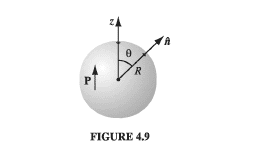
1599034816989.png

My attempt to the solution is like this:
$$V(\mathbf r) = \frac{1}{4 \pi \epsilon_o} \oint_{S} \frac{\sigma_b}{r}{da} $$, because ##\rho_b = 0##.

Then, ##\oint_{S} \frac{\sigma_b}{r}da= \int_0^ {\pi}\int_0^{2\pi} \frac{Pcos\theta}{R} R^{2}sin\theta d\theta d\phi##

I think the variable r is a constant because it is integrating over a surface; the r is fixed. However, it is not the case for the solution. Can anyone help?
 
Last edited:
Physics news on Phys.org
I don't think the integral formulation will necessarily help you; I believe it should be <br /> V(\mathbf{r}) = \int_S \frac{\sigma_b}{\|\mathbf{r} - \mathbf{r}&#039;\|}\,dS&#039; where the integration is with respect to the primed variable.

I would instead note that since \rho = 0 the potential satisfies \nabla^2 V = 0 in r &lt; R and r &gt; R.

I don't know enough EM to say what boundary condition it must satisfy at r = R due to the charged sphere (presumably Griffiths will tell you), but I suspect that it will end up being a condition of the form \frac{\partial V}{\partial r} = A\cos\theta for some constant A. That would suggest looking for solutions of the form V(r) = f(r) \cos \theta.
 
  • Like
Likes   Reactions: Tony Hau
pasmith said:
I don't think the integral formulation will necessarily help you; I believe it should be <br /> V(\mathbf{r}) = \int_S \frac{\sigma_b}{\|\mathbf{r} - \mathbf{r}&#039;\|}\,dS&#039; where the integration is with respect to the primed variable.

I would instead note that since \rho = 0 the potential satisfies \nabla^2 V = 0 in r &lt; R and r &gt; R.

I don't know enough EM to say what boundary condition it must satisfy at r = R due to the charged sphere (presumably Griffiths will tell you), but I suspect that it will end up being a condition of the form \frac{\partial V}{\partial r} = A\cos\theta for some constant A. That would suggest looking for solutions of the form V(r) = f(r) \cos \theta.
The Laplace's equation ##\nabla ^{2} V =0##, has the following solution in spherical coordinates: $$V = \sum_{l=0}^{\infty} (A_l r^l + \frac{B_l}{r^{l+1})P_{l}(cos\theta) $$.

The potential boundary condition can be calculated by letting ##V_{in} = V_{out}##. But I don't know as well how you can satisfy the boundary condition for this case. The book hasn't mentioned it.
 
Last edited:
pasmith said:
I don't think the integral formulation will necessarily help you; I believe it should be <br /> V(\mathbf{r}) = \int_S \frac{\sigma_b}{\|\mathbf{r} - \mathbf{r}&#039;\|}\,dS&#039; where the integration is with respect to the primed variable.

I would instead note that since \rho = 0 the potential satisfies \nabla^2 V = 0 in r &lt; R and r &gt; R.

I don't know enough EM to say what boundary condition it must satisfy at r = R due to the charged sphere (presumably Griffiths will tell you), but I suspect that it will end up being a condition of the form \frac{\partial V}{\partial r} = A\cos\theta for some constant A. That would suggest looking for solutions of the form V(r) = f(r) \cos \theta.
You are totally correct and smart! Thanks.
Here is the solution I have worked out:

The potetial for the interior of the sphere in spherical coordinates is: $$V_{in} = \sum_{l=0}^\infty A_l r^l P_l(cos\theta)$$

By the boundary condition that: $$V_{in} = V_{out}$$ and $$\frac{\partial V_{out}}{\partial r} - \frac{\partial V_{in}}{\partial r} = -\frac{\sigma}{\epsilon_o}$$ at ## r=R##, we obtain $$\sum_{l=0}^{\infty}(2l+1)A_l R^{l-1} P_l (cos\theta) = \frac {\sigma}{\epsilon_o}$$ $$= \frac{Pcos\theta}{\epsilon_o}$$

Obviously only the term for ##l=1## survives, and ##A_1 = \frac{P}{3\epsilon_o}##.

Subsituting ##A_1 = \frac{P}{3\epsilon_o}## into ##V_{in} = \sum_{l=0}^\infty A_l r^l P_l(cos\theta)##, we get $$V_{in}=\frac{P}{3\epsilon_o}r cos\theta$$
 
Last edited:
Having now checked my copy of Grant & Phillips, it appears that if \mathbf{D}_1 is the field inside the sphere and \mathbf{D}_2 the field outside then at r = R the condition is <br /> (\mathbf{D}_2 - \mathbf{D}_1) \cdot \mathbf{e}_r = \sigma with V continuous. In the absence of volume charge density we have \mathbf{D} = \epsilon_0\mathbf{E} = -\epsilon_0\nabla V.
 
  • Like
Likes   Reactions: Tony Hau

Similar threads

  • · Replies 1 ·
Replies
1
Views
3K
Replies
4
Views
4K
  • · Replies 6 ·
Replies
6
Views
2K
  • · Replies 1 ·
Replies
1
Views
2K
Replies
6
Views
3K
Replies
16
Views
2K
  • · Replies 6 ·
Replies
6
Views
892
  • · Replies 19 ·
Replies
19
Views
2K
  • · Replies 1 ·
Replies
1
Views
2K
  • · Replies 10 ·
Replies
10
Views
5K