Boundary conditions for 2 ropes fixed to a massless ring with a damper

Click For Summary
SUMMARY

The discussion focuses on determining the boundary conditions for two ropes, denoted as ##T_1 \mu_1## and ##T_2 \mu_2##, fixed to a massless ring with a massless damper characterized by the force equation ##F_d = -bv_y##. The participants establish that the sum of forces in the vertical direction must equal zero, leading to the equation ##-T_1 \frac{\partial \psi_1}{\partial x} + T_2 \frac{\partial \psi_2}{\partial x} - b \frac{dy}{dt} = 0##. They conclude that the height conditions at ##x=0## require ##y_d = \psi_1(0,t) = \psi_2(0,t)##, and further derive that for ##b = Z_1 - Z_2##, the resultant ##R## equals zero. The discussion emphasizes the importance of correctly identifying the impedance terms ##Z_i## and their impact on the boundary conditions.

PREREQUISITES
  • Understanding of boundary conditions in mechanical systems
  • Familiarity with impedance in wave equations
  • Knowledge of differential equations related to forces and motion
  • Basic concepts of dampers and their mathematical modeling
NEXT STEPS
  • Study the derivation of boundary conditions in mechanical systems
  • Learn about wave equations and their applications in physics
  • Investigate the role of impedance in wave propagation
  • Explore the mathematical modeling of dampers in mechanical systems
USEFUL FOR

Mechanical engineers, physicists, and students studying dynamics and wave mechanics will benefit from this discussion, particularly those interested in boundary conditions and damping effects in mechanical systems.

Redwaves
Messages
134
Reaction score
7
Homework Statement
The boundary conditions for 2 ropes fixed to a massless ring with a massless damper
A wave comes from the left (rope 1) to the right (rope 2).
Relevant Equations
##\psi_1 = Ae^{i(\omega t -k_1x)} + Re^{i(\omega t + k_1x)}##
##\psi_2 = Te^{i(\omega t -k_2x)}##
Hi,
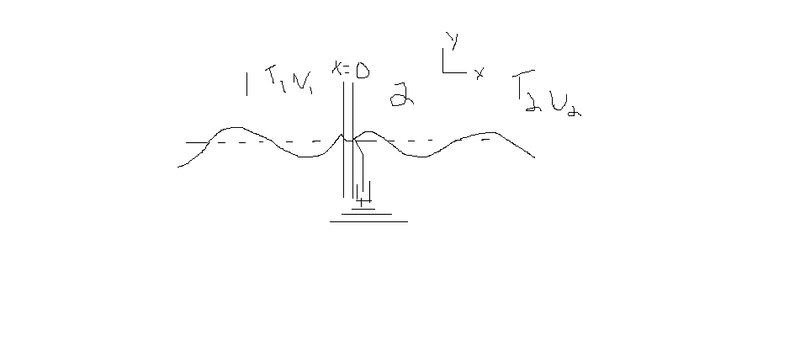
I'm not quite sure if I'm correct. I need to find the boundary conditions for 2 ropes ##T_1 \mu_1, T_2 \mu_2## fixed at ##x=0## to a massless ring with a massless damper of force ##F_d - -bv_y##

Here what I think, since the ring and the damper is massless ##\sum F_y = 0##. Thus, ##-T_1 \frac{\partial \psi_1}{\partial x} + T_2 \frac{\partial \psi_2}{\partial x} -b \frac{dy}{dt} = 0##

Then, the height must be the same for the first rope, the ring and the second rope at ##x=0##, thus ##y_d = \psi_1(0,t) = \psi_2(0,t)##
Which mean, A + R = T, since ##Ae^{i(\omega t -k_1x)} + Re^{i(\omega t + k_1x)} = Te^{i(\omega t -k_2x)}## at x=0
oDiWczg.png
 
Last edited:
Physics news on Phys.org
Is there a diagram that goes with this problem? I'm having trouble getting all of the terms correct...
 
I did a diagram. Is it clear enough?
 
Redwaves said:
I did a diagram. Is it clear enough?
Bwaaa. So the two ropes are co-linear, and there is a ring in the middle connecting them with some sort of damper? Is there really no diagram with the problem that you've been given?
 
It's exactly like that. I just drew it myself, but it's basically the same. Correct me if I'm wrong, but to find the boundary conditions, I don't think I need this diagram. Since, there are only 3 forces in the y direction and I know that the damper and the ring is massless.

The goal is the find that ##b = Z_1 - Z_2## to have ##R = 0##. However, I found ##R = -Z_1 + Z_2##. I'm pretty sure my boundary conditions is not correct. ##Z_i## are the impedance.
 
Last edited:
##-T_1 \frac{\partial \psi_1}{\partial x} + T_2 \frac{\partial \psi_2}{\partial x} -b \frac{dy}{dt} = 0##
##T = A + R##

With those conditions I get ##R = \frac{Z_1A - Z_2B - bA}{Z_1 + Z_2 +b}##
if ##b = Z_1 - Z_2##, ##R = 0##
This is the correct answer. But are my boundary conditions correct?
 
Redwaves said:
##-T_1 \frac{\partial \psi_1}{\partial x} + T_2 \frac{\partial \psi_2}{\partial x} -b \frac{dy}{dt} = 0##
##T = A + R##

With those conditions I get ##R = \frac{Z_1A - Z_2B - bA}{Z_1 + Z_2 +b}##
if ##b = Z_1 - Z_2##, ##R = 0##
This is the correct answer. But are my boundary conditions correct?
This looks good to me, except I think the B in the numerator of R should be A.
 
If B in the numerator of R is A, I didn't get 0 if ##b = Z_1 - Z_2##
 
Redwaves said:
If B in the numerator of R is A, I didn't get 0 if ##b = Z_1 - Z_2##

Can you show the individual steps of how you get ##R = \frac{Z_1A - Z_2B - bA}{Z_1 + Z_2 +b}## to reduce to ##R = 0## when ##b = Z_1 - Z_2##?
 

Similar threads

  • · Replies 1 ·
Replies
1
Views
2K
  • · Replies 2 ·
Replies
2
Views
2K
  • · Replies 40 ·
2
Replies
40
Views
5K
Replies
4
Views
2K
  • · Replies 17 ·
Replies
17
Views
3K
  • · Replies 4 ·
Replies
4
Views
4K
Replies
9
Views
2K
  • · Replies 1 ·
Replies
1
Views
2K
  • · Replies 8 ·
Replies
8
Views
4K
  • · Replies 8 ·
Replies
8
Views
5K