Math Amateur
Gold Member
MHB
- 3,920
- 48
- TL;DR
- The thread concerns the link between Garling's definition of a bounded set and the condition of a set being norm bounded or bounded in norm ...
I am reading D. J. H. Garling's book: "A Course in Mathematical Analysis: Volume II: Metric and Topological Spaces, Functions of a Vector Variable" ... ...
I am focused on Chapter 11: Metric Spaces and Normed Spaces ... ...
I need some help with some remarks by Garling concerning a subset being norm bounded of bounded in norm ...
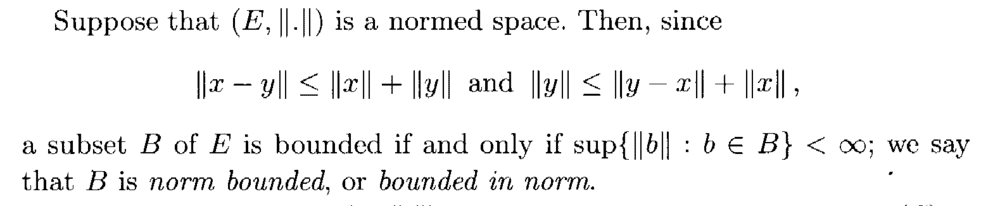
The particular remarks by Garling read as follows:
Note that the definition of a bounded set by Garling is included in the following text:
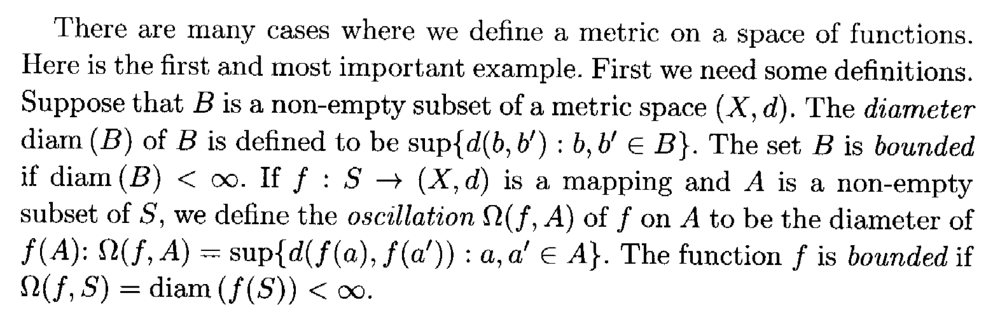
In the remarks by Garling above we read the following:
" ... ... Then since
##\mid \mid x - y \mid \mid \le \mid \mid x \mid \mid + \mid \mid y \mid \mid## and ##\mid \mid y \mid \mid \le \mid \mid y - x \mid \mid + \mid \mid x \mid \mid##
a subset ##B## is bounded if and only if ##\text{sup} \{ \mid \mid b \mid \mid \ : \ b \in B \} \lt \infty## ... ... ... "Can someone please explain/demonstrate how (given Garling;s definition of a bounded subset) that the statements:
##\mid \mid x - y \mid \mid \le \mid \mid x \mid \mid + \mid \mid y \mid \mid## and ##\mid \mid y \mid \mid \le \mid \mid y - x \mid \mid + \mid \mid x \mid \mid##
lead to the statement that:
a subset ##B## is bounded if and only if ##\text{sup} \{ \mid \mid b \mid \mid \ : \ b \in B \} \lt \infty## ... ... ... ?Hope someone can help ...
Peter
======================================================================================
It may help some readers of the above post to have access to the start of Garling's section on normed spaces in order to familiarize them with Garling's approach and notation ... so I am providing the same ... as follows:
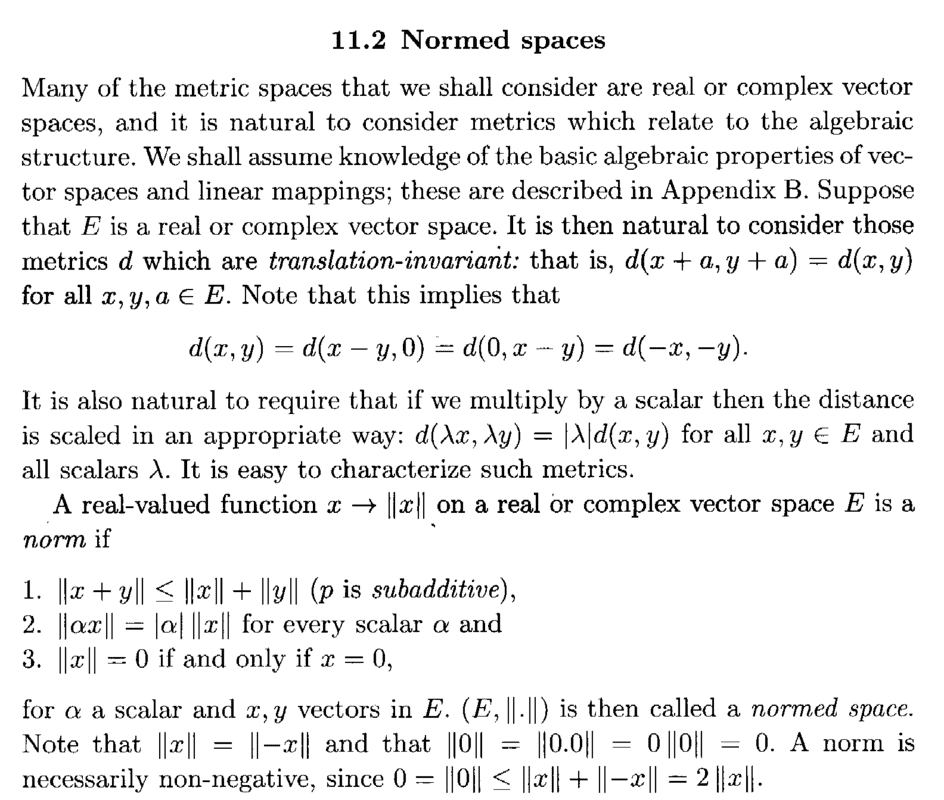 Hope that helps ...
Peter
I am focused on Chapter 11: Metric Spaces and Normed Spaces ... ...
I need some help with some remarks by Garling concerning a subset being norm bounded of bounded in norm ...
The particular remarks by Garling read as follows:
Note that the definition of a bounded set by Garling is included in the following text:
In the remarks by Garling above we read the following:
" ... ... Then since
##\mid \mid x - y \mid \mid \le \mid \mid x \mid \mid + \mid \mid y \mid \mid## and ##\mid \mid y \mid \mid \le \mid \mid y - x \mid \mid + \mid \mid x \mid \mid##
a subset ##B## is bounded if and only if ##\text{sup} \{ \mid \mid b \mid \mid \ : \ b \in B \} \lt \infty## ... ... ... "Can someone please explain/demonstrate how (given Garling;s definition of a bounded subset) that the statements:
##\mid \mid x - y \mid \mid \le \mid \mid x \mid \mid + \mid \mid y \mid \mid## and ##\mid \mid y \mid \mid \le \mid \mid y - x \mid \mid + \mid \mid x \mid \mid##
lead to the statement that:
a subset ##B## is bounded if and only if ##\text{sup} \{ \mid \mid b \mid \mid \ : \ b \in B \} \lt \infty## ... ... ... ?Hope someone can help ...
Peter
======================================================================================
It may help some readers of the above post to have access to the start of Garling's section on normed spaces in order to familiarize them with Garling's approach and notation ... so I am providing the same ... as follows:
Peter
Last edited: