Bungee Jumping and Conservation of Energy

Click For Summary
SUMMARY

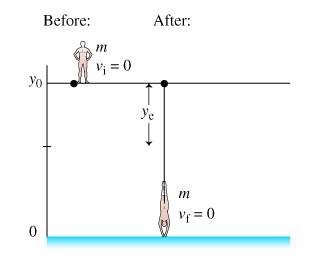
The discussion centers on calculating the mass of a bungee jumper using the conservation of energy principle. The equation derived is m = (0.5KX²)/gy, where K represents the spring constant, X is the stretch of the bungee cord, g is the acceleration due to gravity, and y is the height from which the jumper falls. Clarifications regarding the variables y_e (the length of the relaxed cord) and y_0 (the distance from the bridge to the water) are essential for accurate calculations. The participants emphasize the importance of using the correct definitions for these variables to solve the problem effectively.

PREREQUISITES
  • Understanding of conservation of energy principles
  • Familiarity with spring constants and Hooke's Law
  • Basic knowledge of gravitational force calculations
  • Ability to interpret physics diagrams and variables
NEXT STEPS
  • Research the application of Hooke's Law in real-world scenarios
  • Learn about energy conservation in elastic systems
  • Explore the physics of bungee jumping and related forces
  • Study the effects of variable spring constants on bungee cord performance
USEFUL FOR

Students studying physics, particularly those interested in mechanics and energy conservation, as well as educators looking for practical examples of these concepts in action.

cse63146
Messages
435
Reaction score
0
[SOLVED] Bungee Jumping and Conservation of Energy

Homework Statement


A bored college student decides to try bungee jumping. He attaches an elastic bungee cord to his ankles and happily jumps off a tall bridge across a river. He ends up barely touching the water before the cord jerks him back up.

Find the mass of the student m.
Express the student's mass in terms of variables given in the problem introduction and any appropriate constants.
98693A.jpg

98693B.jpg


Homework Equations


mgy = 0.5KX^{2}

The Attempt at a Solution


so I get m = (0.5KX^{2})/gy

but this doesn't seem right. Any ideas?
 
Last edited:
Physics news on Phys.org
What doesn't seem right about it? Looks OK to me. (Not a good model for a real bungee cord, but that's OK.)
 
would I use y_{e} instead of y and X?
 
cse63146 said:
would I use y_{e} instead of y?
What is y_{e}? If that's how much the cord stretches, then you should use that instead of X.
 
It's there on the picture, but it looks like it only goes half way (y_e) of the bungee cord

I tried inputing this:o.5k(y_e)^2/gy_0 and it says it's wrong. Any suggestions?
 
Last edited:
cse63146 said:
It's there on the picture, but it looks like it only goes half way (y_e) of the bungee cord
Without a clear definition, we can only guess. It's not clear from the diagram, but I presume y_e is either the unstretched length of the bungee cord, or the amount that it stretches. There's no additional information? (What text is this?)
 
It's masteringphysics (online assignment). It's says that y_e is the length the of relaxed cord y_o is the distance between the bridge and the water and y_o>y_e, so once the cord stretches, would it have a length of y_o?
 
Yes. Now that you know what y_e and y_0 mean, you can find the amount of stretch in the cord at the lowest point. (Of course, the cord is attached to his ankles, so it doesn't stretch the full distance to y_0. Lacking any data, I would ignore that issue.)
 
Got it, thanks again.
 

Similar threads

Replies
44
Views
6K
  • · Replies 3 ·
Replies
3
Views
3K
  • · Replies 14 ·
Replies
14
Views
6K
  • · Replies 3 ·
Replies
3
Views
2K
Replies
9
Views
4K
  • · Replies 17 ·
Replies
17
Views
4K
  • · Replies 5 ·
Replies
5
Views
3K
  • · Replies 8 ·
Replies
8
Views
3K
  • · Replies 1 ·
Replies
1
Views
6K
  • · Replies 8 ·
Replies
8
Views
3K