Burst/Rupture Disk Capacity - Experimental vs. Theoretical

Click For Summary

Discussion Overview

The discussion revolves around the discrepancies between theoretical calculations and experimental results regarding the bursting pressures of burst disks used in a cold gas cannon. Participants explore the implications of material properties, disk thickness, and the validity of theoretical models in predicting performance under pressure.

Discussion Character

  • Exploratory
  • Technical explanation
  • Debate/contested
  • Experimental/applied

Main Points Raised

  • One participant describes the construction of a cold gas cannon using burst disks made of Brass 260 H02, noting that the thickness of the disks determines the bursting pressure.
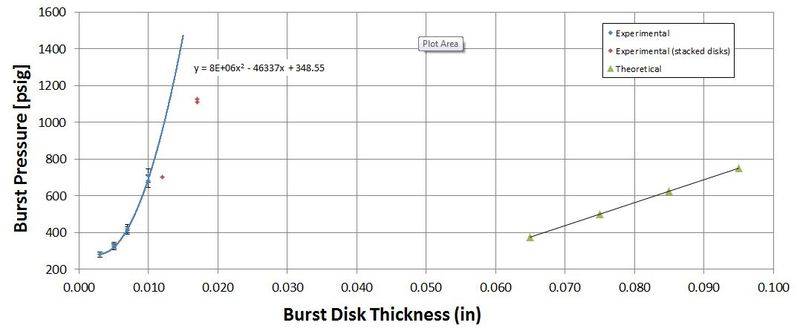
  • Theoretical calculations based on a "circular plate, uniform load, edged clamped" model suggest high required thicknesses for the disks, which contradicts experimental findings that thinner disks were needed to achieve desired bursting pressures.
  • Another participant suggests that the deflections at rupture pressure may exceed the disk thickness, questioning the validity of the theoretical equations used.
  • A later reply mentions that the equations may only be valid up to the yield point of the material, as observed during a leakdown test where a thick disk showed visible deformation without failure.
  • One participant shares observations of bulging in other contexts, indicating that deformation may place the disk in a different stress regime once yielding occurs.

Areas of Agreement / Disagreement

Participants express differing views on the validity of theoretical models in light of experimental results, with no consensus reached on the reasons for discrepancies between theoretical predictions and observed behavior of the burst disks.

Contextual Notes

Participants note that the theoretical equations may not hold once the disk yields, and there is uncertainty regarding the extent of deflection relative to disk thickness at rupture pressures.

jstluise
Messages
58
Reaction score
0
We have built a cold gas cannon that utilizes burst disks as the means to quickly release the built up pressure with maximum flow. The bore for the burst disk is 2" and the material is Brass 260 H02 (1/2 Hard). The disks are solid and flat (i.e. no scoring or features to promote a certain type of failure). The only thing that varies is the thickness of the disks, and that determines the bursting pressure.

In calculating the theoretical bursting pressures, I found this problem to be exactly like the "circular plate, uniform load, edged clamped" as seen on this website: (http://www.roymech.co.uk/Useful_Tables/Mechanics/Plates.html). As expected, the max stress occurs at the edges of the plate.

I calculated the theoretical disk thicknesses based on the bursting pressures we want to use. I found the theoretical thicknesses to be very high just based on intuition and a couple papers I've seen about burst disks. I also did some quick FEA in Solidworks, and the results mostly agreed with my calculations. We considered all of this and used much thinner disks when we started actual testing/calibration.

After the initial testing, we found we needed much thinner burst disks (compared to theoretical) to achieve the bursting pressures we wanted. Here is a plot comparing experimental to theoretical:
qSJH7Zs.jpg


I saw on the website it says, "The equations are only valid if the deflection is small compared to the plate thickness." I thought this might be my problem but my calculated defection is only 10-20% of my plate thickness. Maybe that is still too big.

Does anyone have some thoughts on why the two do not agree?
 
Engineering news on Phys.org
I would guess your deflections are many times your disc thickness at rupture pressure. Have you (safely) observed the amount of disc bulge prior to bursting?
 
insightful said:
I would guess your deflections are many times your disc thickness at rupture pressure. Have you (safely) observed the amount of disc bulge prior to bursting?

Thanks for the response. We have not observed the burst disk prior to bursting; we keep a very safe distance with proper barricading.

After thinking about it a bit more, I'm convinced that the equations I referenced are only valid up to yield. At one point we performed a leakdown test by using a very thick piece of brass (0.040") and bringing the pressure chamber up to 400 psi. After the test, even the thick disk was visibly deformed (very slight bulge). According to the equations, the max stress with t=0.040" and p=400 psi is around 187 ksi, which is much higher than the yield strength of the material (52 ksi). So, the disk did yield as the equations said it would, but there was not failure even though the ultimate strength of the brass is around 62 ksi.

After the disk yields some, I'm sure the deflection is more than the thickness of the disk, so the equations are invalid after that point. I can accept that. And, I'm not complaining about finding out these values experimentally either :) Here are the remnants of a 0.005" disk.

rJ59djE.jpg
 
Neat photo. I have observed bulging lids and bottoms on 55 gal drums and specified many rupture discs. There's a lot of art and trial and error in rupture disc design. I assume that once your disc deforms some, you have a brass "balloon" and are in a different stress regime.
 

Similar threads

  • · Replies 1 ·
Replies
1
Views
2K
  • · Replies 2 ·
Replies
2
Views
2K
Replies
1
Views
2K
  • · Replies 2 ·
Replies
2
Views
9K
  • · Replies 2 ·
Replies
2
Views
2K
  • · Replies 8 ·
Replies
8
Views
22K
  • · Replies 9 ·
Replies
9
Views
2K
  • · Replies 0 ·
Replies
0
Views
4K
  • · Replies 1 ·
Replies
1
Views
5K
  • · Replies 5 ·
Replies
5
Views
4K