Calc 1, f'(x) > 0 if x < 0 ? What does this mean?

  • Thread starter Thread starter LearninDaMath
  • Start date Start date
  • Tags Tags
    Calc 1 Mean
Click For Summary

Homework Help Overview

The discussion revolves around the interpretation of the derivative of a function, specifically focusing on the condition f'(x) > 0 when x < 0. Participants are trying to understand the implications of this condition in the context of a graph that features two parabolas.

Discussion Character

  • Conceptual clarification, Mathematical reasoning, Problem interpretation

Approaches and Questions Raised

  • Participants are exploring the meaning of the derivative f'(x) in relation to the slope of tangent lines on a graph. Questions arise about the specific values and behavior of the function and its derivative in different intervals.

Discussion Status

Some participants are providing insights into the behavior of the function based on its derivative, while others are clarifying the notation used in the notes. There is an ongoing exploration of how the derivative relates to the graph's characteristics, with no explicit consensus reached.

Contextual Notes

There is mention of a graph with two parabolas and confusion regarding the notation of derivatives in the notes. Participants are also addressing the impact of missing part of the lecture on their understanding of the material.

LearninDaMath
Messages
295
Reaction score
0
My math calc 1 class starts just 10 minutes after my physics class ends and it's on the opposite side of campus and yesterday I had my first exam in physics and ended up missing the first 3 minutes of my math class lecture. I copied the notes from the board, but didn't hear what he was saying about the graph. He's an excellent professor, but without hearing what he was saying, I can't figure out what the notes are talking about.

Can anyone look at this graph and the formula and decipher what concept/lesson the professor was describing?
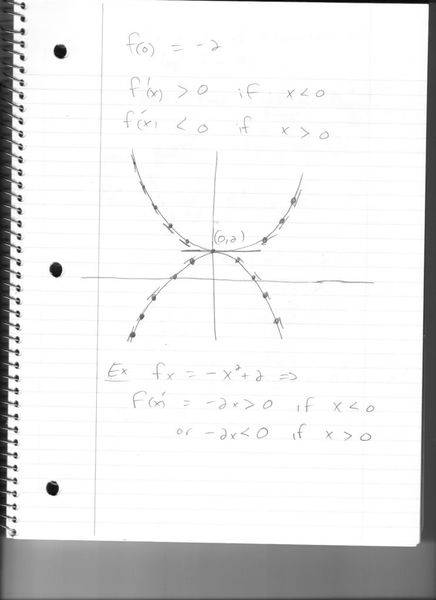

calc.jpg


perhaps f(0) = -2 doesn't correspond to anything on this graph..it could be from somthing else he had already erased before I got to class, i just don't know.

So I'm trying to figure out what it all means.
 
Physics news on Phys.org
LearninDaMath said:
My math calc 1 class starts just 10 minutes after my physics class ends and it's on the opposite side of campus and yesterday I had my first exam in physics and ended up missing the first 3 minutes of my math class lecture. I copied the notes from the board, but didn't hear what he was saying about the graph. He's an excellent professor, but without hearing what he was saying, I can't figure out what the notes are talking about.

Can anyone look at this graph and the formula and decipher what concept/lesson the professor was describing?
The title of this thread, f'(x) > 0 if x < 0 ? What does this mean? means that when x is negative, the slope f(x) (well, actually the slope of the line tangent to f(x)) is positive, as in the lower of the two graphs.
 
HallsofIvy said:
The graph shows what looks like two parabolas, both with vertex at (0, 2), one opening upward, the other opening downward. The rest of the information is related to the lower parabola. It says, for example, that if x< 0, then f'(x)> 0. The derivative, f'(x), can be interpreted as "the slope of the tangent line". f'(x)> 0 means all tangent lines have positive slope- are going up to the right. Also "if x> 0, then f'(x)< 90" so for x positive, the derivative is negative which means tangent lines are going down to the right. The short lines on each dot on the graph represent those tangent lines.


HallsofIvy, thanks

I quoted you to this thread because I asked for deletion of the other thread since I accidently posted it in the wrong forum section and didn't want to lose your response upon deletion. I'm reading your response now.
 
Hi LearninDaMath! :smile:

(I assume you're ok with the main part …

demonstrating how the sign of f' works, with two examples, one with f'' > 0 and one with f'' < 0 ?)

I'll guess that that should read f''(0) = -2 :wink:
 
I think I understand.

So if I have any function, say, f(x) = 2x^2 + 5x

and I take the derivative: f'(x) = 4x + 5

then for any value of x I choose for the independent variable: say, x = -7,

then f'(x) = 4(-7) + 5 = -23

and so f'(x) < 0 so the slope of the tangent is negative at x = -7

Is this a correct description of the concept here?

Hi Tiny-Tim,

So the first three functions at the top of the notes should be double primes instead of regular functions?
 
Last edited:
Hi LearninDaMath! :smile:
LearninDaMath said:
… and so f'(x) < 0 so the slope of the tangent is negative at x = -7

Is this a correct description of the concept here?

Yes, wherever f'(x) < 0, the slope is negative
Hi Tiny-Tim,

So the first three functions at the top of the notes should be double primes instead of regular functions?

No, only the first one.

The other two say that, on that particular graph (the top one), f'(x) is negative on the left, and positive on the right (as you can see from the graph).
 
ah, moment of clarity, the notes make sense now :) thanks
 

Similar threads

Replies
4
Views
4K
Replies
4
Views
1K
  • · Replies 9 ·
Replies
9
Views
3K
Replies
7
Views
2K
  • · Replies 5 ·
Replies
5
Views
3K
Replies
5
Views
2K
  • · Replies 11 ·
Replies
11
Views
2K
Replies
2
Views
2K
  • · Replies 15 ·
Replies
15
Views
3K
  • · Replies 2 ·
Replies
2
Views
2K