Calc III Double Integral Question

4 replies · 2K views · last reply
dropoutofschool
Messages
3
Reaction score
0
View attachment 96628
Three double integrals summed: integral from 1/√2 to 1 of integral from 0 to x of xy dy dx, plus integral from 1 to √2 of integral from 0 to x of xy dy dx, plus integral from √2 to 2 of integral from 0 to √(4−x²) of xy dy dx.


This is the problem I'm trying to solve. The directions require me to rewrite as a single integral and evaluate. But I'm having trouble setting the bounds for a complete compounded integral. The graph of the region would look something like this...
View attachment 96629
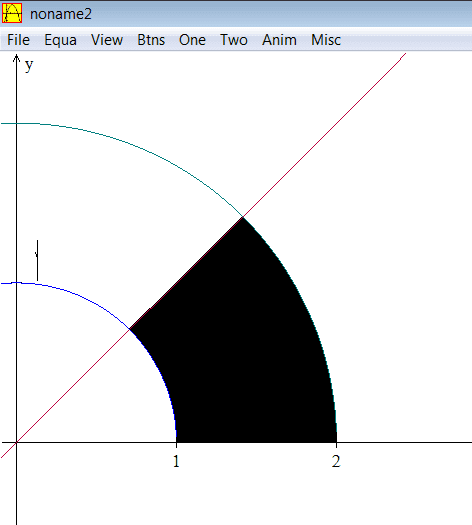
Graph in the first quadrant of a shaded region between two circular arcs of radius 1 and radius 2 centred at the origin, bounded below by the x-axis and on the upper left by the line y = x.

Where the shaded area is the region. I would think its a Type 2 region (dxdy). The y bounds would be 0 to√2 and the x bounds would be from x=sqrt(1-x^2) to x=sqrt(4-x^2)... so so I thought. I then realized that these bounds would extra space outside of the intended shaded region, so the y=x linemust be involved in the bounds somehow.

I just need help setting the integral up, the actual integrating should be easy. Thanks ! Any help is appreciated!
 
Last edited by a moderator:
Ugh Pictures didn't post... please refer to this...
Sum of three double integrals: integral from 1/sqrt(2) to 1 of integral from sqrt(1-x^2) to x of xy dy dx, plus integral from 1 to sqrt(2) of integral from 0 to x of xy dy dx, plus integral from sqrt(2) to 2 of integral from 0 to sqrt(4-x^2) of xy dy dx.


Screenshot of a plotting program titled noname2 showing a black shaded region in the first quadrant bounded by two circular arcs of radius 1 and 2 centred at the origin and two rays from the origin at a 45-degree angle, with x-axis ticks labelled 1 and 2 and a y-axis.
 
dropoutofschool said:
View attachment 96628
This is the problem I'm trying to solve. The directions require me to rewrite as a single integral and evaluate. But I'm having trouble setting the bounds for a complete compounded integral. The graph of the region would look something like this...
View attachment 96629
Where the shaded area is the region. I would think its a Type 2 region (dxdy). The y bounds would be 0 to√2 and the x bounds would be from x=sqrt(1-x^2) to x=sqrt(4-x^2)... so so I thought. I then realized that these bounds would extra space outside of the intended shaded region, so the y=x linemust be involved in the bounds somehow.

I just need help setting the integral up, the actual integrating should be easy. Thanks ! Any help is appreciated!

I'm pretty sure the idea is to write the integral in polar form, not in Cartesian form... There's no way you can write this integral in Cartesian form with only one integral.
 
Last edited:
In the future, please post questions like this in the Homework & Coursework sections (under Calculus), not here in the technical math sections.
 
WOW! Completely forgot about polar, just completed the problem----for future reference, the answer is 15/16. Thank you sir and will change where I post next time!
