Calc. Thermal Deflection for Alum. Sleeve & Steel Beam

  • Thread starter Thread starter Dell
  • Start date Start date
  • Tags Tags
    Thermal
Click For Summary
SUMMARY

The discussion centers on calculating the thermal deflection of an aluminum sleeve surrounding a steel beam, specifically determining the temperature change (ΔT) required to connect the sleeve to a rigid plate at the end of the beam. The equations presented involve the original length of the sleeve (Lo) and the thermal expansion coefficients of aluminum (αAl) and steel (αSt). Participants debate the necessity of knowing Lo, concluding that while it is not a fixed numeric value, it is essential for solving ΔT in relation to the sleeve's length.

PREREQUISITES
  • Understanding of thermal expansion principles
  • Familiarity with material properties, specifically aluminum and steel
  • Knowledge of algebraic manipulation of equations
  • Basic concepts of thermal deflection in engineering
NEXT STEPS
  • Research thermal expansion coefficients for various materials
  • Study the principles of thermal deflection in composite materials
  • Learn how to derive equations involving multiple variables in engineering contexts
  • Explore practical applications of thermal expansion in mechanical design
USEFUL FOR

Mechanical engineers, materials scientists, and students studying thermal dynamics in engineering applications will benefit from this discussion.

Dell
Messages
555
Reaction score
0
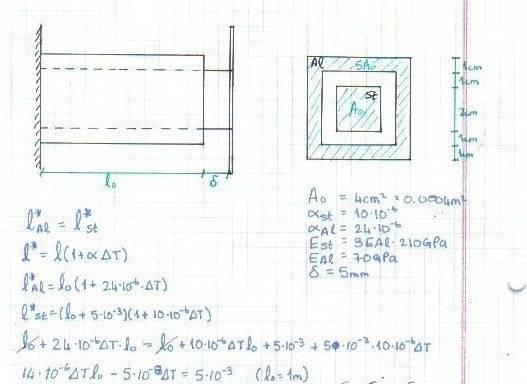
given an aluminium sleeve with a steel beam inside as seeen in the diagram below
q1.jpg


knowing that the length of the steel beam is 5mm longer than the sleeve and that a rigid plate is connected to the end of the steel beam,

find the change in temperature needed to be able to connect the sleeve to the plate?

i base my answer on the assumption that when T=Tf

LAl=LSt

LAl=Lo(ΔT*αAl+1)
LSt=(Lo + 0.005)(ΔT*αSt+1)after comparing i find that my expression for ΔT is dependent on Lo, but Lo, the original length of the sleeve, was not given in the question

is there any way to solve this without knowing Lo?? is there a way i can find Lo?
 
Last edited:
Physics news on Phys.org
What happens if you divide the first equation with the second?
 
that is more or less what i did

but I am still going to have Lo in my equation
 
I would say it is not possible and I cannot see anything you've done wrong.

I'd say it's logical that it would depend on the initial length due to 5mm being a fixed value.

Imagine L0 being 1e-10m. An large deltaT would be required. With L0 being extremely large, the opposite would apply.

Agree?
 
Lo is a given parameter. You would, of course, solve for deltaT in terms of Lo.
 
no, Lo isn't a given parameter, i added it in the hope that it would cancel out
 
And what makes you think a given parameter must be a specific numeric value, instead of a variable? Why not solve for deltaT?
 
JUST because all the other values were numerical
 

Similar threads

  • · Replies 11 ·
Replies
11
Views
3K
Replies
5
Views
3K
  • · Replies 8 ·
Replies
8
Views
3K
Replies
9
Views
11K
  • · Replies 1 ·
Replies
1
Views
4K
  • · Replies 2 ·
Replies
2
Views
2K
  • · Replies 1 ·
Replies
1
Views
5K
Replies
5
Views
2K
Replies
4
Views
6K
Replies
20
Views
14K