Calculate Acceleration of Automobile at t = 4s

  • Thread starter Thread starter davev
  • Start date Start date
Click For Summary

Homework Help Overview

The discussion revolves around calculating the acceleration of an automobile at a specific time, t = 4 seconds, based on its velocity graph. Participants are exploring the relationship between velocity and acceleration in the context of motion along a straight highway.

Discussion Character

  • Conceptual clarification, Mathematical reasoning, Assumption checking

Approaches and Questions Raised

  • Participants discuss the definition of acceleration and its calculation, questioning the original poster's assumption that acceleration is zero when the automobile is momentarily stopped. They explore the concept of acceleration as the rate of change of velocity rather than a simple division of velocity by time.

Discussion Status

The discussion is ongoing, with participants providing clarifications about the nature of acceleration and its calculation. Some guidance has been offered regarding the correct interpretation of acceleration as the slope of the velocity graph, rather than using a formula that may lead to confusion.

Contextual Notes

There is a focus on understanding the relationship between velocity and acceleration, with participants noting the importance of considering the change in velocity over time rather than just the velocity at a single point. The original poster's approach is challenged, highlighting the need for a deeper understanding of the concepts involved.

davev
Messages
31
Reaction score
0
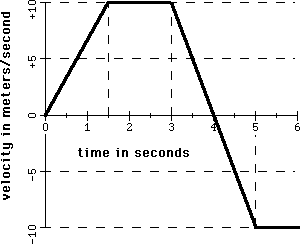
An automobile moves forward and backward on a straight highway.The graph shows the velocity of this automobile as a function of time.
BIOZAcE.gif


What is the acceleration of the automobile at t = 4 s? (Round to two significant digits.)


a = change in velocity / time


I said the acceleration was zero, because the automobile would be stopped at t = 4 s. This is wrong, however.
 
Physics news on Phys.org
davev said:
An automobile moves forward and backward on a straight highway.The graph shows the velocity of this automobile as a function of time.

BIOZAcE.gif


What is the acceleration of the automobile at t = 4 s? (Round to two significant digits.)

a = change in velocity / time
I said the acceleration was zero, because the automobile would be stopped at t = 4 s. This is wrong, however.

Of course it is wrong. The automobile may be stopped, but acceleration is the rate of change of velocity. It's just in between moving forwards and moving backwards. Try that again.
 
Dick said:
Of course it is wrong. The automobile may be stopped, but acceleration is the rate of change of velocity. It's just in between moving forwards and moving backwards. Try that again.

The question is asking for the acceleration at exactly 4 s, so if I used the formula a = v/t I would get a = 0/4, which is 0.

The answer is -10, but I don't understand why when that acceleration is reached a second later.
 
davev said:
The question is asking for the acceleration at exactly 4 s, so if I used the formula a = v/t I would get a = 0/4, which is 0.

The answer is -10, but I don't understand why when that acceleration is reached a second later.

It's because acceleration is the slope of your velocity curve. It's not v/t. It's dv/dt, the derivative or approximately Δv/Δt if you pick two points around your point. It's the rate of change of velocity, not v/t. As you almost said to begin with it's (change of velocity)/(change of time).
 
Last edited:

Similar threads

  • · Replies 6 ·
Replies
6
Views
1K
  • · Replies 17 ·
Replies
17
Views
3K
  • · Replies 5 ·
Replies
5
Views
3K
Replies
1
Views
5K
  • · Replies 19 ·
Replies
19
Views
2K
Replies
5
Views
2K
Replies
1
Views
3K
  • · Replies 2 ·
Replies
2
Views
17K
  • · Replies 8 ·
Replies
8
Views
2K
  • · Replies 2 ·
Replies
2
Views
3K