Calculate resultant force of a linear mechanism

Click For Summary
SUMMARY

The discussion focuses on calculating the resultant force required to slide a roller down a wedge cam mechanism, specifically addressing the forces involved in the design. The key parameters include a maximum compressed force (F2) of 1kg and an angle of 20 degrees. The calculation for the required force (F1) is established as F1 = F2 * Tan(20°). Additionally, the impact of friction on the force calculations is highlighted, particularly in relation to the type of bearing used for the roller.

PREREQUISITES
  • Understanding of basic mechanics and force diagrams
  • Familiarity with trigonometric functions, specifically tangent
  • Knowledge of friction forces and their impact on mechanical systems
  • Experience with linear motion mechanisms and their design
NEXT STEPS
  • Research the principles of force diagrams in mechanical design
  • Learn about the effects of friction in linear motion systems
  • Explore different types of bearings and their friction characteristics
  • Study the application of trigonometric functions in engineering calculations
USEFUL FOR

Mechanical engineers, machine designers, and students studying mechanics who are involved in the design and analysis of linear motion mechanisms.

Travis T
Messages
18
Reaction score
2
TL;DR
Would like to calculate force required for a wedge cam design
Hi all,

I'm currently designing a linear to linear transform mechanism (wedge cam design).

Would like to check how much force required to push/ slide the roller down.
To ease calculation, i have include some assumption:

F2 = 1kg @ maximum compressed
angle = 20degree
F1 required = ?

and how to draw the resultant force diagram for this example?
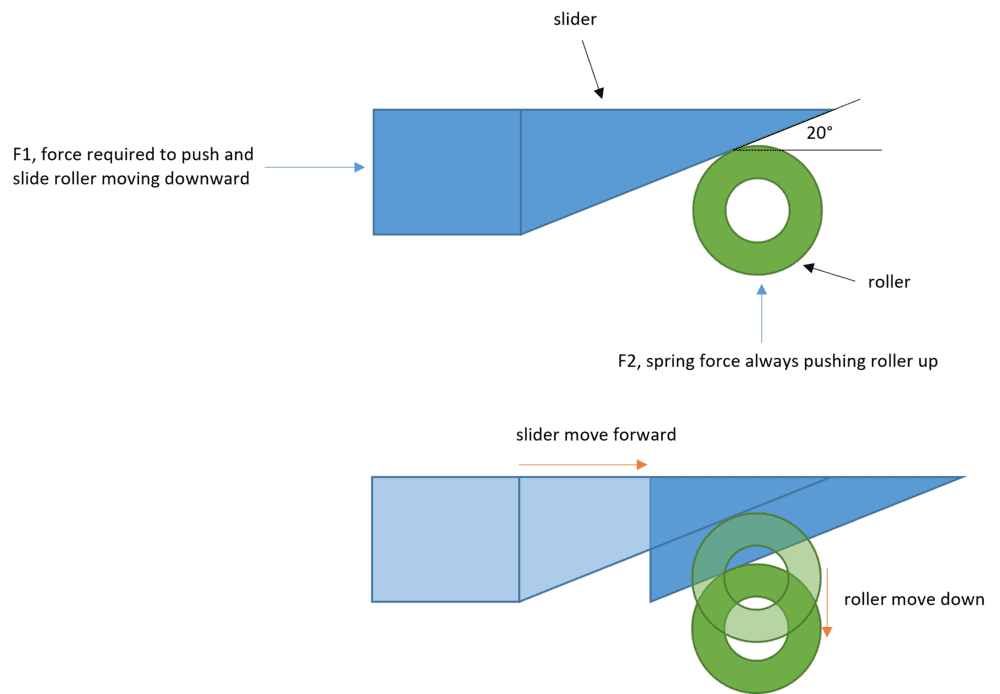
Picture1.png


Thanks.
 
Engineering news on Phys.org
Is this homework?

The resultant force diagram is centered on the point where the roller contacts the wedge. The force vector is perpendicular to the surface at the point of contact. You have the vertical component of that force vector. Get that part of the diagram right before doing the calculations.
 
Thanks for reply,

It is not a homework.
It is for machine designing.
The figure is just drafted to show basic mechanism motion.
 
jrmichler said:
The force vector is perpendicular to the surface at the point of contact.
The normal force is certainly normal to the surface, but there will also be some amount of friction tangent to the surface.
 
  • Like
Likes   Reactions: Travis T
Since the two forces are orthogonal; F1 = F2 * Tan( 20° )
 
  • Like
Likes   Reactions: Lnewqban and Travis T
Dr.D said:
The normal force is certainly normal to the surface, but there will also be some amount of friction tangent to the surface.

If the roller is mounted with bearing, will friction force insignificant and can be ignored?
 
Travis T said:
If the roller is mounted with bearing, will friction force insignificant and can be ignored?
If the bearing is a simple cylindrical pin then friction will depend on lubrication and it may be a problem. If the bearing is a low friction rolling bearing then friction will probably not be a big problem.
 
Travis T said:
If the roller is mounted with bearing, will friction force insignificant and can be ignored?
The friction force between slider and sliding surface may be a bigger problem regarding additional F1 needed to overcome friction.
 

Similar threads

  • · Replies 9 ·
Replies
9
Views
5K
  • · Replies 11 ·
Replies
11
Views
4K
Replies
19
Views
3K
Replies
3
Views
2K
Replies
2
Views
2K
Replies
4
Views
2K
  • · Replies 6 ·
Replies
6
Views
2K
Replies
9
Views
2K
  • · Replies 6 ·
Replies
6
Views
2K
  • · Replies 26 ·
Replies
26
Views
3K