What is the formula for calculating force in a crank and slider mechanism?

Click For Summary

Discussion Overview

The discussion revolves around calculating the force required to push a plate in a crank and slider mechanism, focusing on the relationship between the angle of the plates and the force needed for movement. Participants explore the mathematical and conceptual aspects of this mechanical system, with an emphasis on non-linear behavior and the influence of angles on force requirements.

Discussion Character

  • Exploratory
  • Technical explanation
  • Conceptual clarification
  • Debate/contested

Main Points Raised

  • One participant seeks a simplified formula to calculate the force needed to push plate B at various angles, expressing discomfort with complex mathematics.
  • Another participant inquires about the lengths of the plates, indicating that this is a critical factor in the calculations.
  • The weight of the plates is specified as 1kg each, with a mention of no friction in the system.
  • There is a suggestion that the force required is non-linear and varies with the angle between the plates, with specific reference to the force being easier to apply at 0 degrees and more challenging at 180 degrees.
  • A participant reflects on their experience with designing machines, noting that they rely on intuition rather than formal calculations, but acknowledge the need for more structured understanding in this case.
  • Discussion includes the idea that the mass distribution changes with the angle, suggesting that at 180 degrees, the effective mass to lift is 1kg, and at 60 degrees, it may be half of that.
  • A link to another thread is provided for additional hints, suggesting the need for a coordinate rotation in the calculations.

Areas of Agreement / Disagreement

Participants do not reach a consensus on a specific formula or method for calculating the force, and multiple viewpoints regarding the influence of angles and mass distribution remain present throughout the discussion.

Contextual Notes

Participants express uncertainty about the mathematical relationships involved, particularly regarding trigonometric functions and their application to the problem. There are unresolved assumptions about the system's dynamics and the specific conditions under which the calculations would apply.

ShaiNaveh
Messages
5
Reaction score
0
Hi all,

I have a question regarding a simple crank and slider mechanism, but I'm not a mathematician. This means that long formulas scare me... (: I've been searching around and haven't found anything I can really understand.

I'm trying to get a "ball park" formula to calculate the amount of force I'll need to push plate B at a given angle between the two plates in order for them to fold. I suppose that when the angle is 180 deg., no force would do the trick, but at 0 deg it would be the easiest. I'm also sure it's not linear, but that's as far as my knowledge takes me for this kind of linkage...
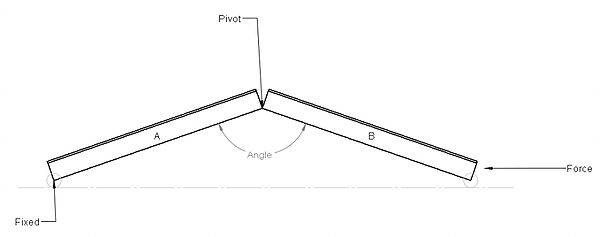
81a8ba_86c3d41559d04f0daaefe600a4e9722d~mv2.jpg


For this example let's say the the plates weigh 1kg each, and there is no friction involved. It's probably something you guys blurt out in your sleep, for me it's voodoo...Any help would be appreciated.

Many thanks, and happy September 1st holiday for us parents... (:
 
Engineering news on Phys.org
Lengths of the plates?
 
Bystander said:
Lengths of the plates?
Ohhh dear, you're right, that IS important... It's 0.5m each.

Thank you.
 
Are you familiar with trig functions?
 
Bystander said:
Are you familiar with trig functions?
The basic stuff I suppose
 
Give you any ideas?
 
Bystander said:
Give you any ideas?
Not sure I understand what you mean...
Do trig functions give me any ideas, or are you asking me if I want you to give me any ideas...
 
ShaiNaveh said:
Do trig functions give me you any ideas
 
Yes, they give me an idea, but only an idea regarding the non-linear fashion of the force I need. As I said, I have a real problem with understanding formulas, all the way back to my school years. I've been designing and building machines for years using my experience and gut feeling when it comes to selecting motion components. So far nothing has crashed... but sometimes my gut feeling is not enough and I need to go back to school.

The way I see it, the mass is centered in the pivot. It should be half of each plate's mass when the angle is 180 deg., so there's 1kg to lift there. I also know that the pivot point gets easier to lift in a non-linear manner. It should be half the mass at 60 deg. if I'm not mistaken.
 

Similar threads

  • · Replies 5 ·
Replies
5
Views
2K
Replies
7
Views
3K
Replies
7
Views
5K
  • · Replies 3 ·
Replies
3
Views
14K
  • · Replies 2 ·
Replies
2
Views
4K
Replies
10
Views
4K
Replies
3
Views
2K
Replies
6
Views
6K
  • · Replies 7 ·
Replies
7
Views
3K
  • · Replies 8 ·
Replies
8
Views
4K