Calculate the discriminant of a basis [Number Theory]

Click For Summary

Homework Help Overview

The discussion revolves around calculating the discriminant of a basis in the context of number theory, specifically involving norms and properties of algebraic integers. Participants explore various mathematical expressions and their implications in the context of the problem.

Discussion Character

  • Exploratory, Mathematical reasoning, Assumption checking

Approaches and Questions Raised

  • Participants discuss rewriting equations and taking norms, questioning how to represent certain expressions as matrices. There is an exploration of the properties of norms and differentiation techniques related to polynomial expressions.

Discussion Status

The discussion is active, with participants providing guidance on differentiation and the properties of norms. There is a recognition of the need for rigorous proof regarding the number of conjugates and the calculation of norms, but no explicit consensus has been reached on all points.

Contextual Notes

Some participants express uncertainty about specific calculations and the implications of their assumptions, particularly regarding the values of norms and the structure of matrices involved in the problem.

Firepanda
Messages
425
Reaction score
0
Question:

df91ts.png


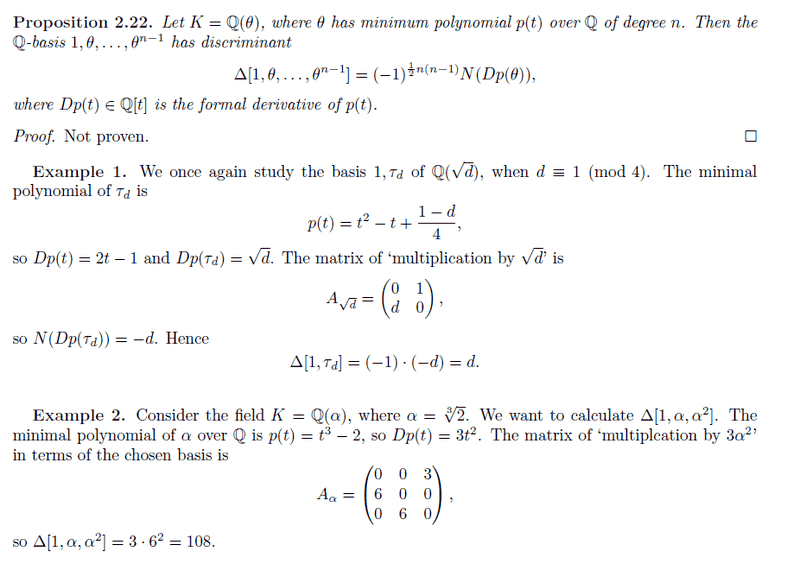
The needed proposition and two examples:
1zb9px4.png


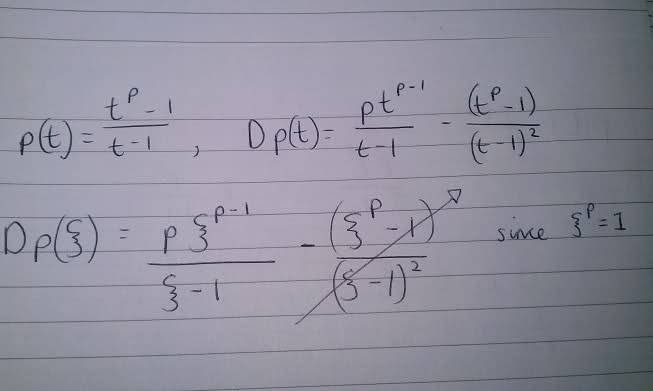
This is as far as I have got:

zn0m8h.jpg


I need to reduce this (I think) so I can represent is as a matrix! Any idea on how to do this?

Thanks
 
Physics news on Phys.org
How about rewriting your last equation as
[tex](\zeta - 1)Dp(\zeta) = p\zeta^{p-1}[/tex] and then taking norms of both sides?
 
I'm unsure on how to calculate [itex]N(p\zeta^{p-1})[/itex]

[itex]N(\zeta - 1) = 5[/itex] though.
 
[itex]N(\zeta - 1)[/itex] isn't 5 - not unless p=5.

As for [itex]N(p \zeta^{p-1})[/itex], this is just [itex]N(p)N(\zeta)^{p-1}[/itex], and [itex]N(p)[/itex] and [itex]N(\zeta)[/itex] are really easy to compute.
 
Providing [itex]N(\zeta - 1)=p[/itex] (is this easy to prove?) then I also get [itex]N(p)=p^{2}[/itex] and [itex]N(\zeta)=1[/itex]

So my overall answer should be p?
 
[itex]N(p)[/itex] should be [itex]p^{p-1}[/itex].

And as for computing [itex]N(\zeta-1)[/itex], you can either do it the determinant way (and do a bunch of row operations), or you could use the differentiation trick you used above except with [itex]t=1[/itex] isntead of [itex]t=\zeta[/itex].
 
Hmm when t=1 I get the denominator as 0, am I not using it right?
 
Notice that
[tex]t^p - 1 = (t-1)(t-\zeta)\cdots(t-\zeta^{p-1})[/tex] so the t-1 in the denominator gets canceled off.

Edit:
Actually, we don't want to be looking at (t^p-1)/(t-1), rather just at t^p-1. Differentiate both sides of the equation above and plug in t=1.
 
Just to be clear you want me to differentiate both sides of [itex]t^p - 1 = (t-1)(t-\zeta)\cdots(t-\zeta^{p-1})[/itex]?

Unsure on how to do the RHS without getting messy!
 
  • #10
Yes, that's what I want you to differentiate. It won't be too messy (especially if you plug in t=1 after you differentiate). :)
 
  • #11
Hmm I'll admit I'm not sure how to go about doing the RHS!

Do I need to? Why can't I use just the differential of the LHS?
 
  • #12
If you differentiate the RHS and plug in t=1, everything will immediately vanish except for the first term, which becomes
[tex](1-\zeta)(1-\zeta^2)\cdots(1-\zeta^{p-1}).[/tex]
This really just follows from the product rule of differentiation.
 
  • #13
morphism said:
If you differentiate the RHS and plug in t=1, everything will immediately vanish except for the first term, which becomes
[tex](1-\zeta)(1-\zeta^2)\cdots(1-\zeta^{p-1}).[/tex]
This really just follows from the product rule of differentiation.

Ah I see, sorry I've never used the product rule for more than 2 terms before, I get it now!

so [itex]p = (1-\zeta)(1-\zeta^2)\cdots(1-\zeta^{p-1})[/itex]

i suppose we want to rearrange this?
 
  • #14
No real rearrangement is necessary. Just notice that the RHS is also [itex](\zeta - 1)(\zeta^2 - 1) \cdots (\zeta^{p-1}-1)[/itex] (because p is odd), which is just the product of all the conjugates of [itex]\zeta-1[/itex], a.k.a. _____
 
  • #15
Norm!

So the norm is p? Havn't we got a few too many conjugates though?
 
  • #16
Yes, the norm is p, and no we have the right amount of conjugates! This is because the conjugates of [itex]\zeta[/itex] are [itex]\zeta[/itex] itself and [itex]\zeta^2, \ldots, \zeta^{p-1}[/itex]. Try to actually write down a rigorous proof, using minimal polynomials. It should be easy.
 
  • #17
Ok thanks :)

Is N(p) = p^p-1 since we can write the matrix as a matrix with only p along the diagonal?
 
  • #18
Firepanda said:
Ok thanks :)

Is N(p) = p^p-1 since we can write the matrix as a matrix with only p along the diagonal?
Yup!
 

Similar threads

Replies
9
Views
2K
Replies
4
Views
2K
  • · Replies 14 ·
Replies
14
Views
3K
Replies
34
Views
4K
  • · Replies 6 ·
Replies
6
Views
4K
  • · Replies 3 ·
Replies
3
Views
2K
  • · Replies 3 ·
Replies
3
Views
2K
  • · Replies 0 ·
Replies
0
Views
778
  • · Replies 2 ·
Replies
2
Views
1K
  • · Replies 9 ·
Replies
9
Views
4K