Calculate the velocity when 2 progressive waves are added together

Click For Summary
SUMMARY

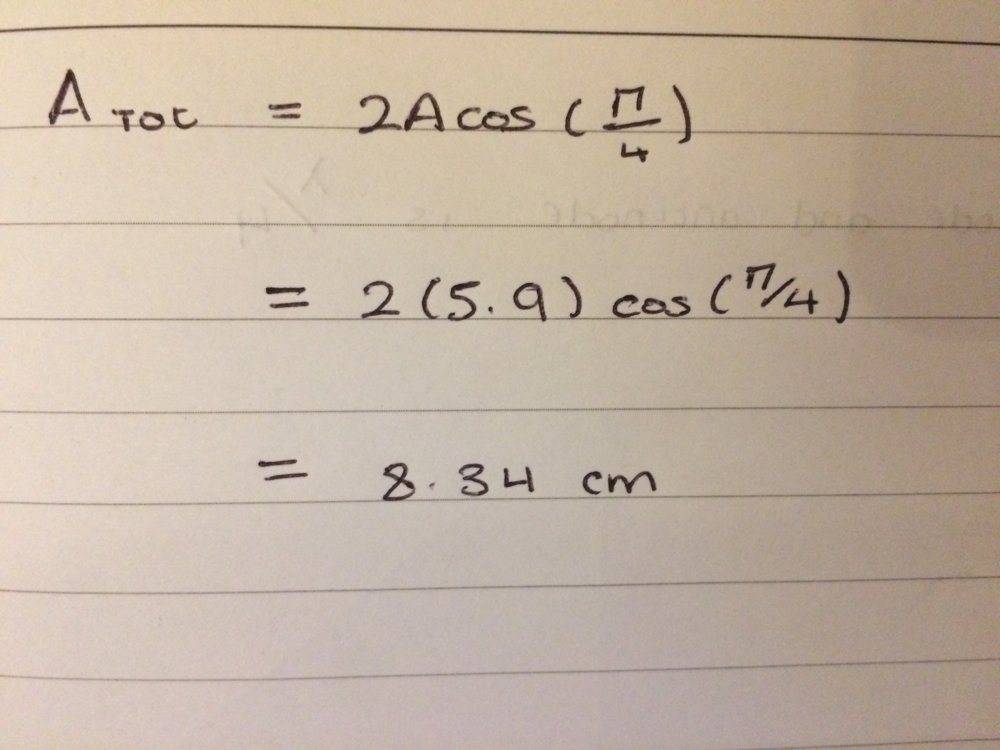
The discussion focuses on calculating the velocity of a resultant wave formed by the superposition of two progressive waves. The final amplitude calculated was 8.34 cm, and the maximum velocity of the resultant wave was determined to be 1.23 m/s. Participants clarified that the maximum velocity refers to the speed at which a point on the wave rises, not the propagation velocity of the wave itself. The importance of identifying relevant information in problem-solving was emphasized throughout the conversation.

PREREQUISITES
  • Understanding of wave superposition principles
  • Knowledge of wave amplitude and velocity concepts
  • Familiarity with maximum velocity calculations in wave mechanics
  • Basic skills in interpreting physics problems and relevant data
NEXT STEPS
  • Study wave superposition and resultant wave properties
  • Learn about maximum velocity calculations in wave motion
  • Research the differences between wave velocity and particle velocity
  • Explore practical examples of wave interactions in physics
USEFUL FOR

Students studying wave mechanics, physics educators, and anyone interested in understanding the dynamics of wave interactions and calculations.

Bolter
Messages
262
Reaction score
31
Homework Statement
Finding the resultant velocity of when 2 waves are added together
Relevant Equations
See below
So here is my problem

Screenshot 2020-03-06 at 12.06.40.png


I have had a go at this and get an answer of 8.34cm to be my final amplitude
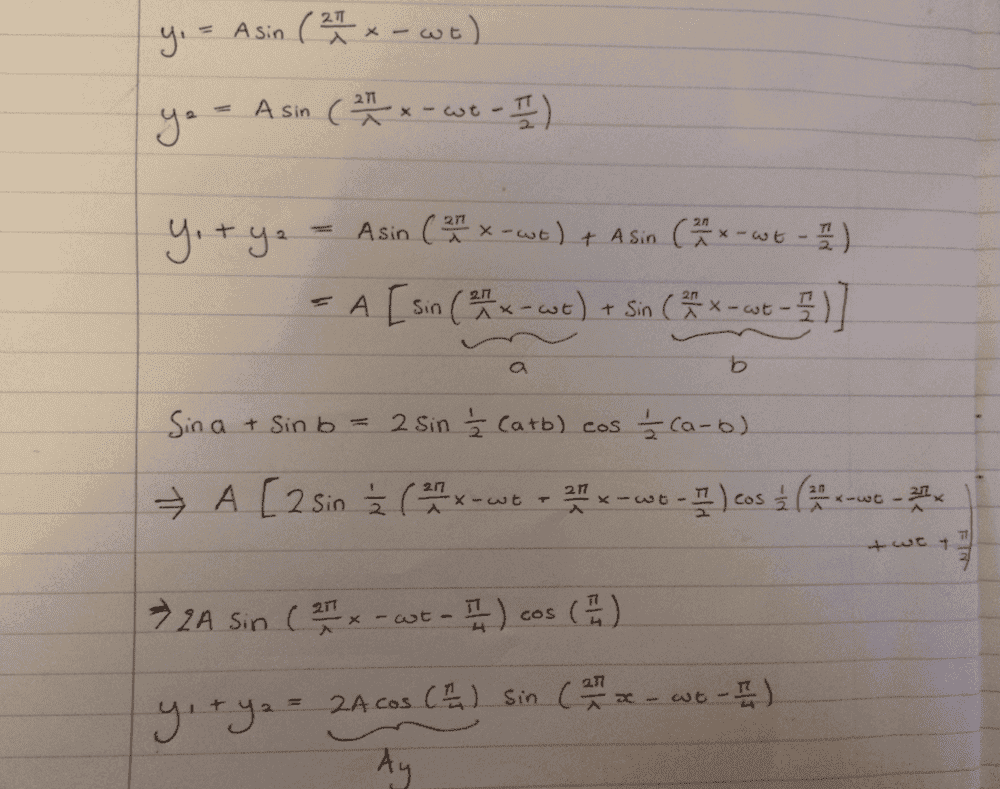
Screenshot 2020-03-06 at 12.07.46.png

IMG_4039.JPG


The next part that I have been given is to calculate the velocity of when 2 waves are added together. I'm not so sure how to go about this, this is what I have tried anyway

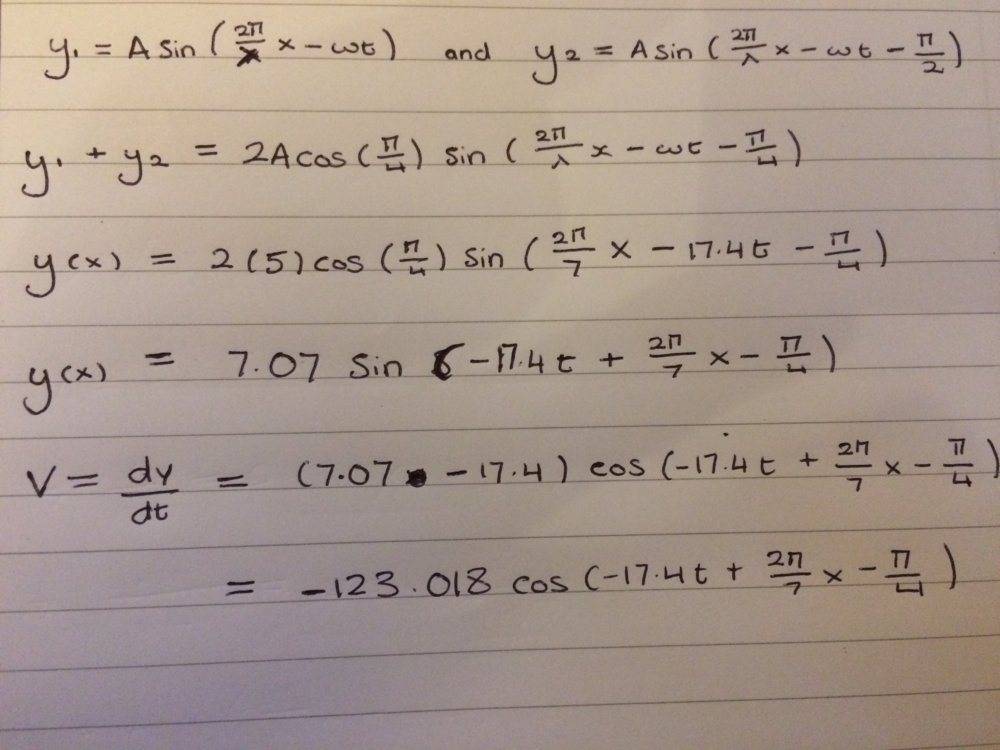
Screenshot 2020-03-06 at 12.06.48.png


IMG_4040.JPG


Can someone please help on how to do work out the velocity of the resultant wave?

Thanks!
 
Physics news on Phys.org
Could I just work out the velocity of the wave produced from doing this?

IMG_0782.JPG


I'm really confused here
 
So I have thought about this question again, and I'm thinking that they are asking for the maximum velocity here of the wave that gets produced, since I cannot work out the velocity at any given time of the wave as I am not given a time value or the horizontal displacement x

So would this be an appropriate thing to do?

IMG_4043.JPG
 
If a speed of 1.23 m/s is correct? Would it be best to include the negative sign as it asks for the velocity so I shouldn't be taking the absolute value of that then
 
Your post #2 looks right.
In post #3 you have calculated the max velocity at which a point on the wave rises. That is not the velocity of the wave.
 
haruspex said:
Your post #2 looks right.
In post #3 you have calculated the max velocity at which a point on the wave rises. That is not the velocity of the wave.

Ok thank you, I was a bit overwhelmed by this question as they had given extra info that wasn't used in the calculation so I ought to think I was doing something wrong. I see my error here now. Thanks again!
 
Bolter said:
they had given extra info that wasn't used in the calculation
That ought to be a more common practice. It is what happens in the real world. Deciding what information is relevant is the first challenge.
 
  • Like
Likes   Reactions: Bolter

Similar threads

  • · Replies 3 ·
Replies
3
Views
2K
  • · Replies 9 ·
Replies
9
Views
2K
  • · Replies 2 ·
Replies
2
Views
1K
  • · Replies 6 ·
Replies
6
Views
1K
  • · Replies 5 ·
Replies
5
Views
2K
  • · Replies 29 ·
Replies
29
Views
2K
  • · Replies 4 ·
Replies
4
Views
2K
  • · Replies 19 ·
Replies
19
Views
1K
  • · Replies 4 ·
Replies
4
Views
1K
  • · Replies 5 ·
Replies
5
Views
4K