Calculating Area of Polar Function: Spiral r = 5(e^.1θ)

Click For Summary
SUMMARY

The discussion focuses on calculating the area of the polar function defined by the spiral equation r = 5(e^.1θ). The specific task is to find the area in Quadrant I that lies outside the second revolution (2π < θ < 4π) and inside the third revolution (4π < θ < 6π). The correct bounds for the second revolution are confirmed as 2π < θ < 4π, while the bounds for the third revolution are established as 4π < θ < 6π. Understanding these bounds is crucial for accurately calculating the area of the specified region.

PREREQUISITES
  • Understanding of polar coordinates and polar equations
  • Knowledge of calculating areas in polar coordinates
  • Familiarity with the concept of revolutions in polar graphs
  • Basic proficiency in trigonometric functions and their properties
NEXT STEPS
  • Study the method for calculating area in polar coordinates using the formula A = 1/2 ∫ r(θ)² dθ
  • Learn about the properties of exponential functions in polar equations
  • Explore the concept of multiple revolutions in polar graphs and their implications
  • Practice solving similar problems involving polar functions and area calculations
USEFUL FOR

Students studying calculus, particularly those focusing on polar coordinates, as well as educators seeking to enhance their teaching methods for area calculations in polar functions.

klarge
Messages
5
Reaction score
0
1. Problem: Use the spiral r = 5(e^.1θ). Find the area of the region in Quadrant I that is outside the second revolution of the spiral and inside the third revolution.


2. Homework Equations :
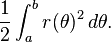
39d48006ae0953cf0cc5bdec86aa9332.png


3. Attempt at solution:

My problem with finding the area of a polar graph is determining the bounds, so to get the right bounds for this graph do I set the equation equal to zero? I am really at a loss as to how to set up the bounds. Any hints would be helpful.
 
Physics news on Phys.org
So... the second revolution is between which values of \theta and the third is between which values of \theta? \theta = 0 is the start of the first.
 
2nd between -2pi and 2pi and the third between -4pi and 4pi?
 
One full revolution is 2\pi radians. If revolution 1 is for 0 &lt; \theta &lt; 2\pi and the second revolution starts at \theta = 2\pi radians and spans 2\pi subsequent radians, the second revolution has what range of \theta?.
 
2\pi &lt; \theta &lt; 4\pi
and the third would be 4\pi &lt; \theta &lt; 6\pi.
 
Correct.
 
So the bounds would be between 2\pi &lt; \theta &lt; 4\pi?
 

Similar threads

  • · Replies 3 ·
Replies
3
Views
2K
  • · Replies 1 ·
Replies
1
Views
2K
  • · Replies 2 ·
Replies
2
Views
2K
  • · Replies 1 ·
Replies
1
Views
2K
Replies
3
Views
2K
  • · Replies 6 ·
Replies
6
Views
2K
  • · Replies 2 ·
Replies
2
Views
1K
  • · Replies 15 ·
Replies
15
Views
2K
Replies
7
Views
3K
  • · Replies 5 ·
Replies
5
Views
2K