Calculating components of a force applied at an angle

Click For Summary

Homework Help Overview

The discussion revolves around calculating the X and Y components of two forces, F1 and F2, applied at an angle to an inclined plane. The original poster expresses confusion regarding the setup and calculations, particularly in relation to a diagram that is referenced but not provided.

Discussion Character

  • Exploratory, Assumption checking, Problem interpretation

Approaches and Questions Raised

  • Participants discuss the clarity of the problem statement and the diagram, with some questioning the representation of the incline and the forces involved. There are attempts to clarify how to correctly assign components to the forces and the use of trigonometric functions for calculations.

Discussion Status

Participants are actively engaging with the problem, offering suggestions for diagram adjustments and questioning the assumptions about the forces' orientations. There is a mix of interpretations regarding the application of trigonometry and the relationship between the forces and the inclined surface.

Contextual Notes

There is mention of a previous problem that the original poster has solved, which may influence their understanding of the current problem. The lack of a clear diagram and problem statement is noted as a potential barrier to effective discussion.

Kyle Spengler
Messages
4
Reaction score
0
1. The problem statement, all variables, and given/known data
Attached is a diagram of what I am trying to solve. I need to calculate the X and Y components for both F1 and F2. The results will then be used in a later problem that I've already solved but I am coming up with an error and I was unsure about this part of the problem.
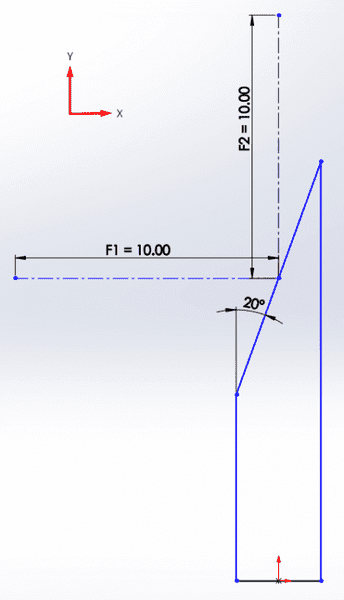
upload_2017-3-10_19-27-34.png


The Attempt at a Solution


I tried converting the F1 value into the F1x component and then using trig to solve from that but my number in the later calculation aren't matching up and I think it's coming from this part. This problem yet very similar to the sliding block problem on an incline slope is very different in how things are oriented and set up and it's causing me lots of confusion.
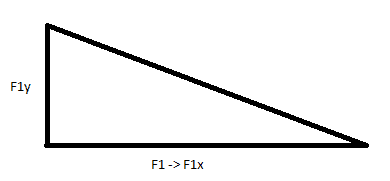
upload_2017-3-10_19-43-57.png
 
Last edited by a moderator:
Physics news on Phys.org
That diagram is unclear to me without the problem statement itself. Is the blue line supposed to represent an incline that the forces are being applied to that you want to find the next force in the x and y direction for? If so, keep in mind that both F1 and F2 will have both an x and y component acting on the incline that you need to sum.
 
I really only need to calculate one at a time. They are independent of each other but both forces need to be evaluated. The blue outlined area is a representation of the body the forces are being applied too. All that really needs to be noted is the angle of the inclined plane and the resulting X and Y components aligning with the coordinate system I drew.
 
Regardless it should be a simple case of trig. Tangent should do it looks like.
 
TJGilb said:
Regardless it should be a simple case of trig. Tangent should do it looks like.
Am I doing it correctly in assigning the X component of F1 to F1 itself and then using trig to solve for Y as I have drawn out in the triangle?
 
It looks off to me. When drawing the diagram, draw the 10 N as a horizontal force into the triangle, draw another coinciding line that is perpendicular to the triangle, and then connect them with a vertical line. If that doesn't make sense, I may be able to draw a picture and upload.

Edit: I've went ahead and uploaded a picture of what I was talking about.
Picture1.png
 
Last edited:
Kyle Spengler said:
Am I doing it correctly in assigning the X component of F1 to F1 itself and then using trig to solve for Y as I have drawn out in the triangle?
If I understand your diagram, F1 is applied in the X direction, so its X component is F1 and its Y component is zero.
Maybe what you intend to ask is the components normal to and parallel to the surface?
 
TJGilb said:
It looks off to me. When drawing the diagram, draw the 10 N as a horizontal force into the triangle, draw another coinciding line that is perpendicular to the triangle, and then connect them with a vertical line. If that doesn't make sense, I may be able to draw a picture and upload.

Edit: I've went ahead and uploaded a picture of what I was talking about.View attachment 114367
That is what I was thinking. Now I just use trig and solve for F1Y?

haruspex said:
If I understand your diagram, F1 is applied in the X direction, so its X component is F1 and its Y component is zero.
Maybe what you intend to ask is the components normal to and parallel to the surface?
That is what I am confused about. If I was pushing against an angled surface with a horizontal force, wouldn't there be resulting X and Y components of forces that can be calculated, like in this sitiation? How I visualised is is how TJGilb drew it. Is that what you're describing as well?
 
Kyle Spengler said:
That is what I was thinking. Now I just use trig and solve for F1Y?

Yes.
 
  • #10
Kyle Spengler said:
If I was pushing against an angled surface with a horizontal force, wouldn't there be resulting X and Y components of forces
Imagining yourself applying a force can be deceptive. If you push against an angled surface the normal force will push you sideways. If you resist that then that changes the force you apply. Try thinking of it as attaching a very long rod to a joint on the surface and pushing on the far end of the rod.
 
  • #11
Without knowing details of the problem, this is what have so far.
 

Attachments

  • wedge.gif
    wedge.gif
    3.4 KB · Views: 537

Similar threads

Replies
2
Views
2K
  • · Replies 11 ·
Replies
11
Views
2K
Replies
3
Views
1K
  • · Replies 1 ·
Replies
1
Views
1K
  • · Replies 2 ·
Replies
2
Views
2K
  • · Replies 6 ·
Replies
6
Views
2K
  • · Replies 4 ·
Replies
4
Views
2K
  • · Replies 4 ·
Replies
4
Views
2K
  • · Replies 2 ·
Replies
2
Views
3K
Replies
22
Views
3K