Calculating distance between charged Balls

  • Thread starter Thread starter psy
  • Start date Start date
  • Tags Tags
    Balls Charged
Click For Summary
SUMMARY

The discussion centers on calculating the new distance between two charged conductive balls after one is decharged. Initially, the balls are 5 cm apart, and the electrostatic force is described by Coulomb's law, F = k ⋅ q1 ⋅ q2 / r^2. When one ball is decharged, it becomes neutral, leading to an induced charge distribution that results in attraction between the balls. The new equilibrium distance can be derived from the modified Coulomb's law, resulting in r^2 = k * q / F * 4, where the force and distance in the new equilibrium remain unknown.

PREREQUISITES
  • Understanding of Coulomb's law and electrostatic forces
  • Basic knowledge of charge distribution in conductive materials
  • Familiarity with gravitational forces and their relation to electrostatic forces
  • Ability to manipulate algebraic equations for physical calculations
NEXT STEPS
  • Study the principles of electrostatics and charge interactions in conductive materials
  • Learn about induced charge distribution and its effects on nearby objects
  • Explore the mathematical derivation of Coulomb's law and its applications
  • Investigate the concept of equilibrium in electrostatic systems and how to calculate it
USEFUL FOR

Physics students, electrical engineers, and anyone interested in electrostatics and charge interactions in conductive materials will benefit from this discussion.

psy
Messages
13
Reaction score
1
Hello! I have the following problem and attempt for solution.

Two equal, small conductive balls hang on two long non-conductive threads attached to a hook. The balls are charged with the same charges and are located 5 cm apart. One of the balls will now be decharged. What is the new distance between the balls?
So the Force between the balls : F= k ⋅ q1 ⋅ q2 / r^2 .
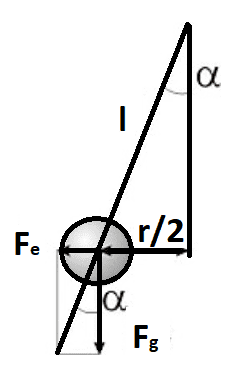
upload_2018-5-5_20-35-30.png


Also there is the gravitational force F= m⋅g.

sinα = (r/2)/l ; tanα= Fe/Fg.

l- length of the thread

sinα = tanα ; (r/2)/l = Fe/Fg → Fe= r⋅m⋅g / 2⋅l . Putting this in the above equation :

Fe= k ⋅ q1 ⋅ q2 / r^2 → r^2 = k ⋅ q1 ⋅ q2 / Fe → r^2 = (k ⋅ q1 ⋅ q2) / (r⋅m⋅g / 2⋅l ).

Now if i don't have any given length of the thread and mass of the balls, how is it possible to calculate the distance?
Is there another way to calculate it?

Kind regards
 

Attachments

  • upload_2018-5-5_20-35-30.png
    upload_2018-5-5_20-35-30.png
    5.9 KB · Views: 613
Physics news on Phys.org
If there is zero charge on one ball, what is the electrostatic force between the two balls?
 
0?
 
psy said:
0?
Right. So how far would the balls be forced apart?
 
This is a bit tricky. The balls are conductors. If one is charged and the other not charged then the force between them is not zero. And it will change subsequently, so I assume they are asking for the new equilibrium.
I note that the question says the ball is "decharged"; it does not say "earthed", which would create another complication.
 
Well in case there is no Electrostatic force there is no electrostatic "push", so the only force left should be the gravitational.

Is this correct?
 
psy said:
Well in case there is no Electrostatic force
But there is.
 
So one ball gets decharged, so its neutral after that. Yet the positive Charge of the other ball "reorganizes" the charges in the neutral one, it attracts the unlike charges to the nearer side of the ball and "pushes" away the like charges. As the unlike charges are closer, distance is smaller, the attracting force is stronger, so the balls are going to be attracted?
 
psy said:
So one ball gets decharged, so its neutral after that. Yet the positive Charge of the other ball "reorganizes" the charges in the neutral one, it attracts the unlike charges to the nearer side of the ball and "pushes" away the like charges. As the unlike charges are closer, distance is smaller, the attracting force is stronger, so the balls are going to be attracted?
Yes. The induced charge distribution results in attraction.
So what will happen subsequently?

Btw, sometimes it is asked whether there is a force between a charged object and an uncharged insulator. Surprisingly, there is. Even though charges cannot redistribute freely over the insulator, there are induced dipoles at the atomic level.
 
  • #10
So the half of the electrons from the neutral one are transferring to the charged ball. A new Equilibrium takes place, where the charges are +q/2 on both balls. So again they are pushing each other away, yet with smaller distance as the charges are smaller.

As the Coulombs law F = k * q1 * q2 / r^2 says the square of the distance and the electrostatic force are indirect proportional , the new distance will be :

F = (k * q/2 * q/2)/ r^2 => r^2 = k * q / F * 4 .

In first case it was r^2 = k * q^2 / F

Yet the force and the distance in the new Equilibrium are unknown. How can i get to calculate it?
 
  • #11
psy said:
half of the electrons from the neutral one are transferring to the charged ball.
That isn't really meaningful. You could say a charge of -q/2 is transferred. But you got the right result.
psy said:
F = (k * q/2 * q/2)/ r^2 => r^2 = k * q / F * 4 .
Go back to the last equation you had in post #1. You had r on both sides. You need to rearrange into the form r=[an expression not involving r] and apply it to this later condition too.
 

Similar threads

Replies
23
Views
1K
  • · Replies 9 ·
Replies
9
Views
857
  • · Replies 2 ·
Replies
2
Views
4K
Replies
2
Views
2K
Replies
9
Views
2K
  • · Replies 3 ·
Replies
3
Views
2K
  • · Replies 5 ·
Replies
5
Views
2K
Replies
9
Views
5K
  • · Replies 4 ·
Replies
4
Views
2K
  • · Replies 3 ·
Replies
3
Views
4K