Calculating Electrostatic Force with Coulomb's Law

Join the discussion
Ask a follow-up here, or get your own question answered by working scientists, mathematicians and engineers — people, not an autocomplete.
Real named experts · corrections over time · the nuance an AI answer skips
3 replies · 14K views
antiderivativ
Messages
17
Reaction score
0
Four point-charges are fixed at the corners of a 3.0m X 4.0m rectangle. The coordinates of the corners and the values of the charges are listed below.
q1 = 100 microC (0, 4m), q2 = 36 microC (4m, 3m), q3 = 125 microC (0, 3m) and q4 = 32 microC (0,0). Compute the net electrostatic force acting on the 100 microC charge.
ke = 8.99 x 10⁹

I'm using Coulomb's Law.
F = [tex]\frac{ke*q1*q2}{r^2}[/tex]

Here is my attempt at a solution. Is it correct?
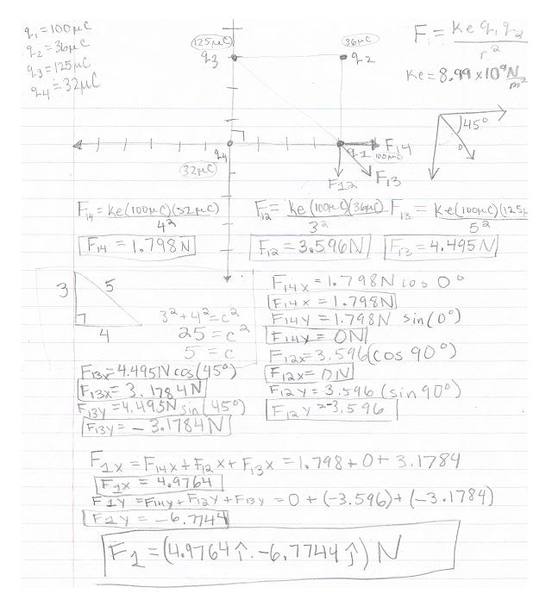
6-1.jpg
 
Last edited:
Physics news on Phys.org


Hi antiderivativ,

antiderivativ said:
Four point-charges are fixed at the corners of a 3.0m X 4.0m rectangle. The coordinates of the corners and the values of the charges are listed below.
q1 = 100 microC (0, 4m), q2 = 36 microC (4m, 3m), q3 = 125 microC (0, 3m) and q4 = 32 microC (0,0). Compute the net electrostatic force acting on the 100 microC charge.
ke = 8.99 x 10⁹

I'm using Coulomb's Law.
F = [tex]\frac{ke*q1*q2}{r^2}[/tex]

Here is my attempt at a solution. Is it correct?

6-1.jpg

No, I don't believe that is correct. When you find the components of F13, you are using an angle of 45 degrees. It would have been a 45 degree angle if the charges were at the corners of a square, but since this is a rectangle it will be different.

You can use your 3-4-5 triangle you have on the page to find the correct angle. What do you get?


Thanks for the reply! My new angle is 53.13. Is this better? :)
6-2.jpg


antiderivativ said:
Thanks for the reply! My new angle is 53.13. Is this better? :)
6-2.jpg

Really close! But you changed your triangle when you calculated the angle, and that gave you the wrong angle.

If you look at the 3-4-5 triangle about halfway down the page on the left side, the 3 side is vertical and the 4-side is horizontal, and that matches your problem and calculation.

At the bottom of the page, you switched the 3 and 4 sides. You did the correct procedure; it's just that if you use your original triangle, you'll do:

[tex] \tan^{-1}\left(\frac{3}{4}\right)[/tex]

instead of the arctangent of 4/3.