Calculating Limit of sin(e^x) Using L'Hopital's Rule - Step by Step Guide

  • Thread starter Thread starter ironman
  • Start date Start date
  • Tags Tags
    l'hopital Limits
Click For Summary
SUMMARY

The forum discussion focuses on calculating the limit of sin(e^x) as x approaches infinity using L'Hopital's Rule. Participants clarify that the limit results in an indeterminate form of ∞/∞, allowing the application of L'Hopital's Rule. However, the discussion reveals that the dominant terms in the numerator and denominator must be identified for accurate evaluation. Ultimately, the consensus is that the limit approaches 1, supported by the Squeeze Theorem and the bounded nature of the sine function.

PREREQUISITES
  • Understanding of limits in calculus
  • Familiarity with L'Hopital's Rule
  • Knowledge of the Squeeze Theorem
  • Basic properties of exponential and logarithmic functions
NEXT STEPS
  • Study the application of L'Hopital's Rule in various limit problems
  • Explore the Squeeze Theorem in depth with examples
  • Learn about the growth rates of functions, particularly exponential vs. logarithmic
  • Utilize graphing tools like Desmos to visualize limits and function behavior
USEFUL FOR

Students and educators in calculus, mathematicians analyzing limits, and anyone seeking to deepen their understanding of L'Hopital's Rule and limit evaluation techniques.

ironman
Messages
17
Reaction score
0
Hello (:

Can someone help me calcultating this limit (as x → ∞)


This is the function:
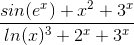
CodeCogsEqn.gif

If I just kept deriving sin(e^x) nothing really happened.

So I tried using L'Hopital but partly, i guess:

CodeCogsEqn-4.gif


so:
(1 or -1) × 1 + 0 + 0 / 0 + ∞ + ∞The answer must be 1 (according to wolfram alpha) but i don't see how that can be...
 
Physics news on Phys.org
You probably should re-examine how to apply L'Hopital's Rule. What you are doing makes no sense.
 
Ah yes I know: so because you get '∞/∞' in the original function you can use l'Hopital so you get

CodeCogsEqn-5.gif


But then what am I to do with the e^x cos (e^x) because nothing useful will come if I keep deriving that part. (as far as I can see...)
 
Instead of using "L'Hopital's rule" at all, you should think about which terms dominate the numerator and demonimator. The numerator and denominator each consist of three terms but one of those terms increases much faster than the other two.
 
  • Like
Likes ironman
Ahh now it makes sense I think.
So in the nominator 3^x is the fastest growing term, and in de denominator that would be ln(x)^3 (?)
So if you divide by those terms, both the fastest growing terms will become 1 and the others will become 0.
 
ironman said:
Ahh now it makes sense I think.
So in the nominator 3^x is the fastest growing term,
Yes
ironman said:
and in de denominator that would be ln(x)^3 (?)
No, it's not.
ironman said:
So if you divide by those terms, both the fastest growing terms will become 1 and the others will become 0.
 
ironman said:
Hello :)

Can someone help me calcultating this limit (as x → ∞)


This is the function:

View attachment 74803
If I just kept deriving sin(e^x) nothing really happened.

So I tried using L'Hopital but partly, i guess:

View attachment 74806

so:
(1 or -1) × 1 + 0 + 0 / 0 + ∞ + ∞The answer must be 1 (according to wolfram alpha) but i don't see how that can be...

Your notation is not sufficiently precise: by ##ln(x)^3## do you mean ##\ln(x^3)## or ##(\ln x)^3##? If I read it using strict mathematical parsing rules it would come out at the latter.
 
Mark44 said:
Yes
No, it's not.

Than it must be 3^x...
but (ln(x))^3 with x to infinity equals: e to the power something equals infinity therefore (e^∞)^3 which grows faster than 3^∞ , right?
 
Ray Vickson said:
Your notation is not sufficiently precise: by ##ln(x)^3## do you mean ##\ln(x^3)## or ##(\ln x)^3##? If I read it using strict mathematical parsing rules it would come out at the latter.

I'm sorry. I mean:
CodeCogsEqn-6.gif
 
  • #10
ironman said:
Than it must be 3^x...
but (ln(x))^3 with x to infinity equals: e to the power something equals infinity therefore (e^∞)^3 which grows faster than 3^∞ , right?
No, (ln(x))3 doesn't grow faster than 3x. You have several errors in what you wrote above, one of which is the incorrect way you replaced (ln(x))3.
 
  • #11
Ok thanks Mark44 :) And thanks for the help guys!
 
  • #12
Because sine is bounded between -1 and 1, you could deal with the sine term by saying
$$\frac{-1 + x^2 + 3^x}{(\ln x)^3+2^x+3^x} \le \frac{\sin(e^x) + x^2 + 3^x}{(\ln x)^3+2^x+3^x} \le \frac{1 + x^2 + 3^x}{(\ln x)^3+2^x+3^x}$$ and then using the squeeze theorem, but this would be the roundabout way of solving the problem.

Think about the log function, perhaps look at its graph. Is ##\ln x## bigger than or smaller than ##x## when ##x>1##?
 
  • #13
A trick for limits is to use a graphing calculator. Desmos is free and nice. Other than sin(e^x) everything is is going to infinity as the limit goes to infinity. Now you have to figure out what is growing the fastest so you can divide everything else by it. You can either graph everything individually to help you see it or take the derivative of every individual term to figure out the fastest grower.
 
Last edited:

Similar threads

Replies
1
Views
1K
  • · Replies 14 ·
Replies
14
Views
2K
Replies
5
Views
2K
  • · Replies 23 ·
Replies
23
Views
2K
  • · Replies 3 ·
Replies
3
Views
2K
  • · Replies 8 ·
Replies
8
Views
2K
  • · Replies 9 ·
Replies
9
Views
3K
Replies
4
Views
2K
  • · Replies 5 ·
Replies
5
Views
2K
  • · Replies 3 ·
Replies
3
Views
7K