Calculating Mass in Relativistic Systems

  • Thread starter Thread starter ttttrigg3r
  • Start date Start date
  • Tags Tags
    Conservation
Click For Summary

Homework Help Overview

The discussion revolves around calculating the mass of a ball in a relativistic context, specifically addressing the implications of relativistic mass and momentum conservation. Participants are exploring the nuances of mass definitions in different frames of reference.

Discussion Character

  • Conceptual clarification, Assumption checking, Problem interpretation

Approaches and Questions Raised

  • Participants are attempting to clarify the definitions of mass in the context of relativistic physics, questioning whether the mass referred to is rest mass or includes kinetic contributions. There are discussions about the calculations involving momentum and the implications of varying mass in different scenarios.

Discussion Status

The conversation is ongoing, with participants providing insights and corrections to each other's reasoning. Some have offered guidance on how to structure calculations more formally, while others are questioning assumptions about mass changes and the implications of high velocities on mass. There is no explicit consensus yet, but productive lines of inquiry are being explored.

Contextual Notes

Participants note ambiguities in the problem statement regarding the mass of the ball and the astronaut, leading to different interpretations. There is also mention of homework constraints that may affect how participants present their calculations.

ttttrigg3r
Messages
48
Reaction score
0
Hello. I've uploaded the question onto pictures and linked them. I hope this method of asking a question works.
I'm trying to find the mass of the ball, but I get the square root of a negative number. Can someone take a look to see if I'm doing this problem correctly?
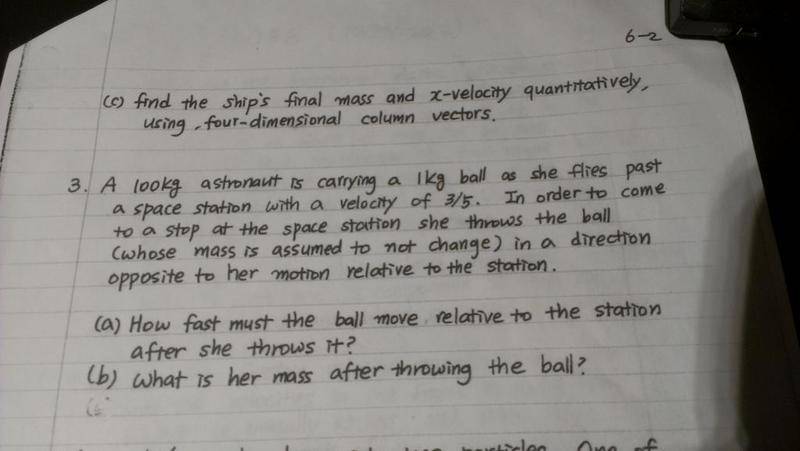
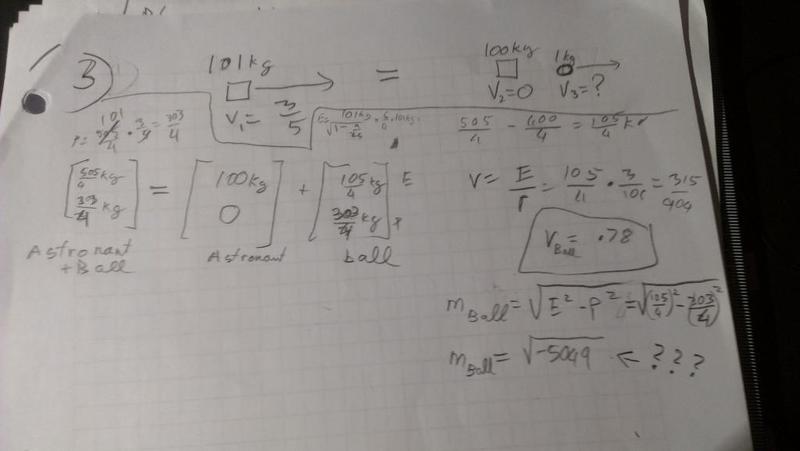
IMAG0012.jpg

IMAG0013.jpg

 
Physics news on Phys.org
What immediately occurs to me:
In ##p^0=E/c## is that E the rest-mass energy, total energy, or kinetic energy?
(Closer look - you seem to have calculated gamma ... apologies: it is difficult for me to see your reasoning.)

It can help see where you went wrong (or right!) if you leave the actual numbers out until the end.

eg. In space-station coordinates: ##P_i = (M+m)\gamma_i(1,0,0,u)^t;\; P_f=M(1,0,0,0)^t+m\gamma_f(1,0,0,v)^t## (...or something) you have to find ##v## from the conservation laws and knowing ##M##, ##m##, ##\gamma_i##, and ##u##.

The laws give you two equations.
If you do this as a list, formally, you are less likely to get the numbers mixed up at the end.
 
Last edited:
OH I see. The mass of the astronaut in the final momentum is not 100kg like I thought. Have to give it the Variable M. Ok This will be a piece of cake then. Thanks.
 
No - I just used variables to keep track of what's what.
Remember that the questions says to assume the astronaught's mass does not change.
All the masses I used are rest-masses.

What I am trying to get you to do is go back over the calculation more formally.
 
No actually the question says it is the mass of the ball that does not change.
Here is my answer. I'm about 90% sure of it. Can you please check it out and see if what I did is good?
IMAG0016.jpg
 
ttttrigg3r said:
No actually the question says it is the mass of the ball that does not change.
Oh so it does - I'm corrected. I find it ambiguous anyway ... why would it change?
Here is my answer. I'm about 90% sure of it. Can you please check it out and see if what I did is good?
Why do you make people work so hard to read your working? It'll cost you marks.
 
Is my handwriting/work too sloppy? I will try to make it much neater.
 
It's the layout - your working is all over the place so I cannot easily follow your reasoning. Someone marking your work could easily think you've left something out of misunderstood something. At least there's boxes around your final answers but those are worth, at most, one mark each.

You can reality check your results though ... should the speed of the ball be very high to cancel the momentum? Why would the astronaught's mass change (and is that a reasonable mass for an astronaught?)
 
Ok here is what I've concluded about the velocity of the ball and the astronaut's mass. The velocity of the ball must be extremely high (close to c=1) to balance out the fact the the astronaut has velocity 0 in the final momentum in the x direction. Also the astronaut's mass in the beginning is 100kg whereas her final mass is 50.5 kg. This is because in the beginning the astronaut was moving with v=3/5 which is a big enough velocity to make her much more massive than when she is standing still. 50.5kg is about 110lbs which makes sense for a human being.

ps. Is the following statement correct?
As velocity increases approaching c=1, the more massive you get.
 
  • #10
So the masses quoted are not rest-masses, but kinetic energy contributions seen in the space-station frame? (Nobody literally gains mass by virtue of going fast.)

This also suggests a very small astronaut doesn't it?

I always thought the m in the 4-momentum was rest-mass though.
If the initial mass is not rest mass them don't we put ##\gamma_i (M+m)=101kg##?
 

Similar threads

Replies
10
Views
3K
  • · Replies 2 ·
Replies
2
Views
1K
  • · Replies 6 ·
Replies
6
Views
2K
  • · Replies 12 ·
Replies
12
Views
2K
  • · Replies 4 ·
Replies
4
Views
2K
  • · Replies 17 ·
Replies
17
Views
2K
Replies
2
Views
2K
  • · Replies 5 ·
Replies
5
Views
3K
  • · Replies 14 ·
Replies
14
Views
2K
  • · Replies 30 ·
2
Replies
30
Views
4K