SUMMARY
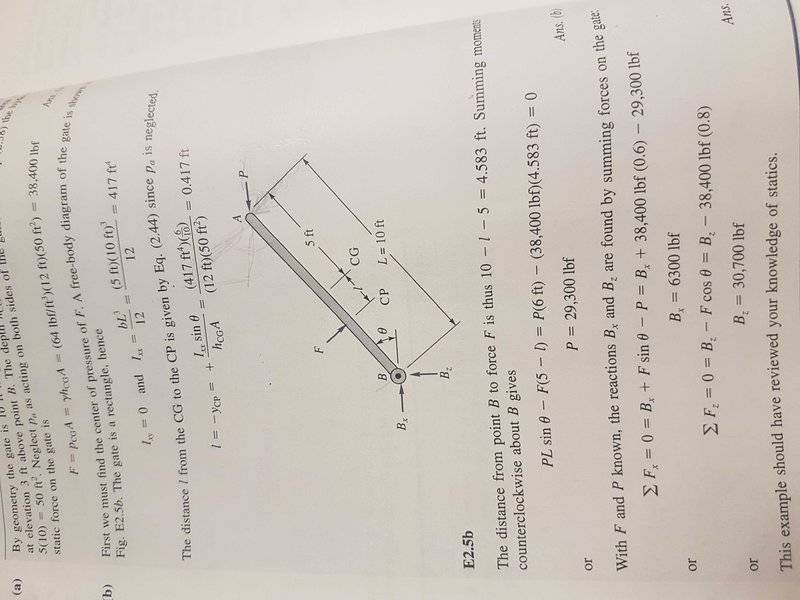
The moment generated by force P on a gate is calculated using the formula Moment = P * L * sin(θ), where L is the length of the lever arm and θ is the angle between the force and the lever arm. The perpendicular distance from the pivot point to the line of action of the force is represented by L * sin(θ). This calculation is crucial for understanding the mechanics of forces acting on structures, particularly in two-dimensional scenarios. The moment vector acts in the direction opposite to the applied force F.
PREREQUISITES
- Understanding of basic trigonometry, specifically sine functions.
- Familiarity with the concept of moments in physics.
- Knowledge of force vectors and their components.
- Basic principles of mechanics, particularly in two-dimensional systems.
NEXT STEPS
- Study the application of the cross product in calculating moments in 3D mechanics.
- Learn about the role of lever arms in static equilibrium problems.
- Explore advanced trigonometric identities and their applications in physics.
- Investigate the principles of torque and its relationship with moments in engineering contexts.
USEFUL FOR
Students studying physics or engineering, particularly those focusing on mechanics and static equilibrium, as well as educators seeking to clarify concepts related to moments and forces.