Calculating Q such that E(0,0,0)=0

  • Topic: Engineering 
  • Thread starter falyusuf
  • Start date
2 replies · 1K views · last reply
falyusuf
Messages
35
Reaction score
3
Homework Statement
Attached below.
Relevant Equations
Attached below.
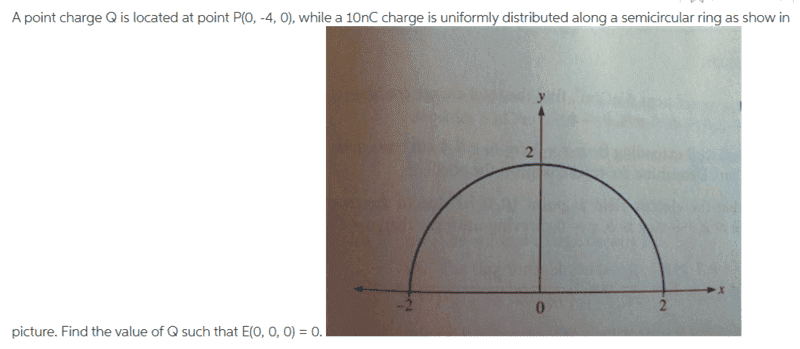
Question

Diagram of a semicircular ring of radius 2 in the xy-plane, centred at the origin on the x-axis, with the y-axis marked 2 and the x-axis marked -2 and 2 at the ends.

Relevant equation;
Equation E = Q √(α_R) / (4πε₀R²), with the square root sign covering the symbol α and R, typeset in LaTeX-style math.

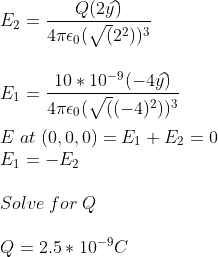
My attempt:
Handwritten-style LaTeX derivation: E2 = Q(2y)/(4pi e0 (sqrt(2^2))^3), E1 = 10*10^-9(-4y)/(4pi e0 (sqrt((-4)^2))^3), E at (0,0,0) = E1 + E2 = 0, E1 = -E2, solve for Q, giving Q = 2.5*10^-9 C.


Could someone please confirm my answer?
 
Electric field at the Origin contributed from half ring is of direction - y and its magnitude is expressed by integral
[tex]\frac{1}{4 \pi \epsilon_0} \int_0^\pi \frac{\rho r \sin\theta d\theta }{r^2}[/tex]
where r is radius of half ring, ##\rho## is line density of its charge.
 
The component radial is cancel out, because of all direction of component radial around circle center
 
Attachments
  • Diagram of a surface element dS = dr*r*dα above a horizontal plane, with radial vector r̂, vertical vector ž of length d, and vector ā = r̂ + ž to a point on the x-axis, with a = sqrt(r^2+d^2).
    Electrostatics with charged circle.jpg
    31.3 KB · Views: 163