Calculating Tension in a System of Trolleys

  • Thread starter Thread starter Say17
  • Start date Start date
  • Tags Tags
    Force Tension
Click For Summary
SUMMARY

The discussion focuses on calculating the tension in a system of two trolleys with masses of 3 kg and 1 kg, subjected to forces of 50 N and 10 N, respectively. The net force acting on the system is determined to be 40 N, leading to an acceleration of 10 m/s². The tension in the thread connecting the trolleys is calculated using the formula T = m1/(m1 + m2) * F, resulting in a final tension of 20 N. The conversation emphasizes the importance of correctly applying Newton's laws to find the net forces and accelerations in such systems.

PREREQUISITES
  • Understanding of Newton's laws of motion
  • Basic knowledge of force and mass calculations
  • Familiarity with tension in connected systems
  • Ability to perform algebraic manipulations
NEXT STEPS
  • Study the application of Newton's second law (F = ma) in multi-body systems
  • Learn about tension calculations in different configurations of connected masses
  • Explore the effects of varying forces on the acceleration of connected objects
  • Investigate frictionless systems and their implications in tension calculations
USEFUL FOR

Students studying physics, particularly those focusing on mechanics, as well as educators and anyone interested in understanding the dynamics of connected objects under external forces.

Say17
Messages
11
Reaction score
1
Homework Statement
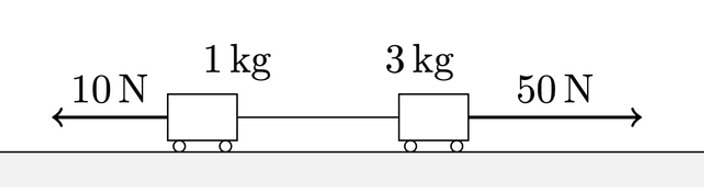
Two trolleys with masses of 3kg and 1kg are connected by a wire. A force of 50N is exerted on the 3kg trolley and a force of 10N on the 1kg trolley. Any friction is negligible.

How much tension exists in the thread between the trolleys?
Relevant Equations
F = (m1+m2)a
Hi all,
Image 23.06.23 at 16.15.jpeg


To find out the tension. First I have to find out the a.

1. step
F = ma
F = (m1+m2) *a
F = (1+3)*a
F = 4*a
F/4 = a

F = 10N + 50 N
F = 60 N

60/4 = 15 m/s^2

2.step
T =( m1/ (m1 + m2)) * F
T = (1/ 1+3) * 60
T = 15 N

But the final result is 20N.

Thanks for your help!
 
Physics news on Phys.org
Say17 said:
Homework Statement: Two trolleys with masses of 3kg and 1kg are connected by a wire. A force of 50N is exerted on the 3kg trolley and a force of 10N on the 1kg trolley. Any friction is negligible.

How much tension exists in the thread between the trolleys?
Relevant Equations: F = (m1+m2)a

F = 10N + 50 N
The two forces act in opposite directions, therefore the net force on the system of two trolleys must be less than the sum of their magnitudes.
 
So it means one of them is minus?
 
If you pull to the right with 50 N of force, and your friend pulls to the left with 10 N of force, what is the net force?

Also, where are you getting the equation ##T=\frac{m_1}{m_1+m_2}F##?
 
I saw this formula somewhere and thought this may work......
So it is 50N - 10N = 40N?
 
Say17 said:
I saw this formula somewhere and thought this may work......
So it is 50N - 10N = 40N?
Forget the formula you saw and reason it out.
If a force of 50 N pulled to the left and another 50 N force pulled to the right, what would be the net force on the two trolleys?
What would happen if you reduced the force to the left from 50 N to 10 N?
What would happen if you reduced the force to the left from 10 N to zero?
 
If a force of 50 N pulled to the left and another 50 N force pulled to the right, what would be the net force on the two trolleys? 0
What would happen if you reduced the force to the left from 50 N to 10 N? 40N
What would happen if you reduced the force to the left from 10 N to zero? 10 N
 
Say17 said:
If a force of 50 N pulled to the left and another 50 N force pulled to the right, what would be the net force on the two trolleys? 0
What would happen if you reduced the force to the left from 50 N to 10 N? 40N
What would happen if you reduced the force to the left from 10 N to zero? 10 N
Great! You answered your own question in post #5. Now you can finish the problem.
 
Then I have to divide 40 N by 2?
 
  • #10
Say17 said:
Then I have to divide 40 N by 2?
Why 2? What does 2 represent?

Just modify the two steps that you showed originally in post #1 knowing what you know now.
 
  • #11
kuruman said:
Why 2? What does 2 represent?
There are two trolleys. They get ##20N## each is the idea, I guess.
 
  • #12
Yes exactly, because there are two trolleys.
 
  • #13
Say17 said:
Yes exactly, because there are two trolleys.
Why would the force be split evenly between the two trolleys?
 
  • #14
PeroK said:
Why would the force be split evenly between the two trolleys?
Oh you are right. They have different mass.
 
  • #15
Even if they had same mass, dividing the net force on the system by two has no meaning. The external force on one trolley is 50N and the external force on the other is 10N. The internal force on each is the tension in the string. You either write N's law for the system, using the net external force (40 N in magnitude) or you write it for each body with the actual forces acting on that body.
 
Last edited:
  • Like
Likes MatinSAR and SammyS
  • #16
Say17 said:
First I have to find out the a.
Using ##F_{net}=ma## you can find acceleration of this system. Suppose that the length of the thread is constant, so both objects have the same acceleration.
You can find the net external force that acts on system with both objects:
1687633795984.png

You simply find net external force and mass of the system using above picture. then you can find acceleration of system which is equal to the acceleration of each object. After finding acceleration use ##F_{net}=ma## for one of the objects then you can find tension force. You need to add two more forces to the picture above then you can find that what is the net force(##F_{net}##) that acts on each object.
 
  • #17
Say17 said:
I saw this formula somewhere and thought this may work......
No, it's a formula for the tension in a cord connecting two objects in a particular situation. Not this situation, though. When you look at the two situations you can see that they are entirely different.

Say17 said:
So it is 50N - 10N = 40N?
Yes, that's the net force on the two-object system. Use it to find the acceleration of that system. Then use that acceleration to find the net force on either one of the objects.
 
  • #18
MatinSAR said:
You simply find net external force and mass of the system using above picture. then you can find acceleration of system which is equal to the acceleration of each object. After finding acceleration use ##F_{net}=ma## for one of the objects then you can find tension force. You need to add two more forces to the picture above then you can find that what is the net force(##F_{net}##) that acts on each object.
Actually, when one has the common acceleration of the masses, one does not need to add two or more forces to find the net force on each object. Just multiply the mass of the object by the common acceleration.
 
  • #19
kuruman said:
Actually, when one has the common acceleration of the masses, one does not need to add two or more forces to find the net force on each object. Just multiply the mass of the object by the common acceleration.
I meant that by adding other forces, we determine the net force on the object which has mass of 1 kg as ##T-10N## then then we substitute in N's law.
##F_{net}=ma##
##F_{net}=T-10N##
##T-10=ma=10## so ##T=20N.##
1687790655629.png
 

Similar threads

Replies
14
Views
3K
  • · Replies 1 ·
Replies
1
Views
2K
Replies
3
Views
3K
Replies
21
Views
891
Replies
16
Views
2K
  • · Replies 11 ·
Replies
11
Views
2K
  • · Replies 3 ·
Replies
3
Views
2K
  • · Replies 5 ·
Replies
5
Views
2K
  • · Replies 1 ·
Replies
1
Views
2K
Replies
2
Views
2K