Calculating the bending stress of a simply supported beam

Click For Summary
SUMMARY

This discussion focuses on calculating the bending stress of a simply supported beam subjected to a central load of 12 kN over a 6 m span. The consensus is that the maximum bending moment should be used for stress calculations, which occurs at the midpoint of the beam. The bending stress is determined by the distance from the neutral axis, with stresses above the neutral axis being compressive and those below being tensile. For beginners in Finite Element Analysis (FEA), SolidWorks Simulation is recommended due to its user-friendly interface, while Abaqus is noted for its advanced capabilities.

PREREQUISITES
  • Understanding of bending moment and shear force diagrams
  • Knowledge of bending stress calculations and the neutral axis concept
  • Familiarity with Finite Element Analysis (FEA) principles
  • Basic proficiency in SolidWorks or Abaqus software
NEXT STEPS
  • Research the calculation of bending stress using the formula: σ = My/I
  • Learn about the properties of the neutral axis in beam theory
  • Explore SolidWorks Simulation for basic FEA applications
  • Investigate advanced features of Abaqus for structural mechanics analysis
USEFUL FOR

Engineers, structural analysts, and students interested in beam mechanics and Finite Element Analysis, particularly those starting with SolidWorks or seeking to deepen their understanding of bending stress calculations.

tomtomtom1
Messages
160
Reaction score
8
TL;DR
Calculating Bending Stress Of A Member
Hello all

I am trying to calculate the bending stress of a simply supported beam with a load of 12kn at the middle of a 6m span, member depth of 0.016m

I have drawn both the bending moment and shear force diagram.

I want to know the following:-

1) When calculating the bending stress would you always use the Max bending moment Or would you use the bending moment at a particular point along the member? below is a sketch:-
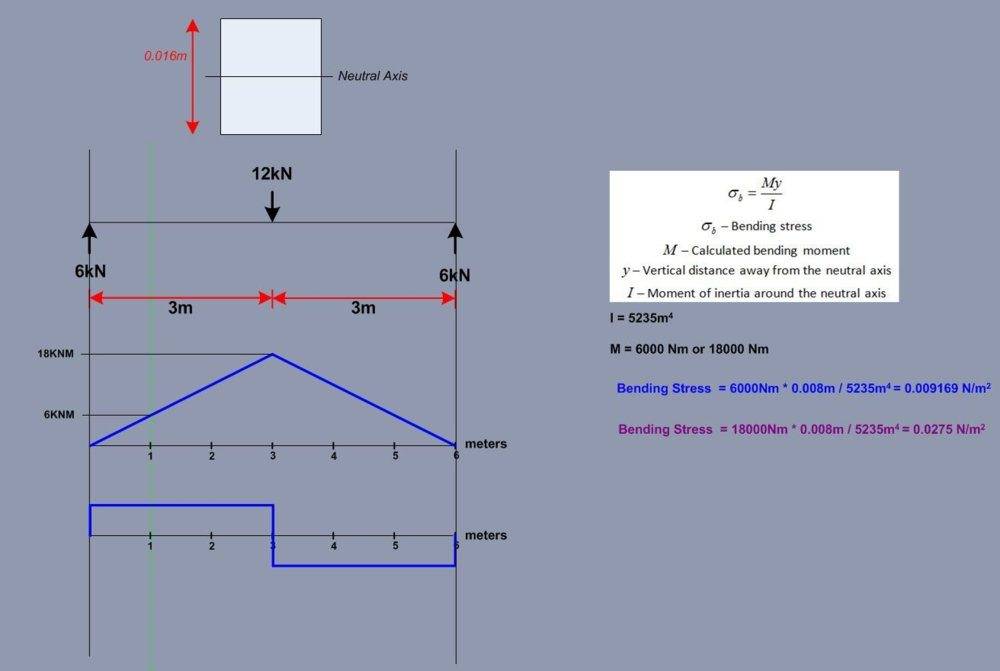
m1.JPG


As you can see i have calculated the bending stress at 1m along the beam - is it convention to always use the max bending moment at all points along the beam or the actual bending moment at the point along the beam to which your calculating the bending stress for?

As you can see i have 2 answers and i am not sure which is correct?

2) How would you know that the value i get for bending stress is compressive or tensile, i think that i get a positive value which is compressive because i went 0.008m UP my neutral axis which is in compression - would this be correct?

Thank you.
 
Engineering news on Phys.org
We pretty much always calculate bending stress at a point along the beam where bending moment (and thus also stress) is highest. So in the case of simply supported beam with force in the middle this point will be in the middle of the beam. The formula for bending stress includes vertical distance from neutral axis. Bending stress is maximum in extreme (outer) fibers so we take the distance from neutral axis to points of the cross section farthest away from this axis.
Now when it comes to the sign, in this case stresses above neutral axis will be compressive while those below the neutral axis will be tensile.
 
  • Like
Likes   Reactions: tomtomtom1 and berkeman
FEAnalyst said:
We pretty much always calculate bending stress at a point along the beam where bending moment (and thus also stress) is highest. So in the case of simply supported beam with force in the middle this point will be in the middle of the beam. The formula for bending stress includes vertical distance from neutral axis. Bending stress is maximum in extreme (outer) fibers so we take the distance from neutral axis to points of the cross section farthest away from this axis.
Now when it comes to the sign, in this case stresses above neutral axis will be compressive while those below the neutral axis will be tensile.

FEAAnalyst.

Thanks

Just out of interest what FEA software do you use?

I wanted to start using one but wasnt sure which one would be the easiest to learn just as a starter.

A few people are using Solidworks.

Thoughts?

Thanks
 
I use several FEA programs but mainly Abaqus (on a daily basis). It's not as intuitive for beginners as other software but has really huge capabilities. In my opinion Abaqus is the best choice for structural mechanics. I work in SolidWorks Simulation too. This one is good for people starting their adventure with FEA. It has some significant limitations but is really powerful for a CAD-embedded FEA module.
 
  • Like
  • Informative
Likes   Reactions: tomtomtom1, jrmichler and berkeman
I have also used both Abaqus and SolidWorks Simulation. SolidWorks is all that I ever needed for machine design linear static analyses. After, that is, I identified the limitations and developed work arounds. SolidWorks is particularly weak on problems with contact, but almost all machine design and structural problems can be solved without using contact.

A problem like the Howe truss in this thread would be trivial in SolidWorks: https://www.physicsforums.com/threa...s-2d-pinned-at-both-ends.981939/#post-6278877.

In order to use FEA effectively, it is absolutely necessary to have a solid understanding of basic stress, strain, FBD, moment, shear, etc concepts.
 
  • Like
Likes   Reactions: tomtomtom1
Thank you all.

I think i am going to start with solid works to being with and at the same time continue to learn the basics.

I have now started by adventure into the FEA :)

Thank you.
 
  • Like
Likes   Reactions: jrmichler

Similar threads

  • · Replies 30 ·
2
Replies
30
Views
8K
  • · Replies 1 ·
Replies
1
Views
2K
  • · Replies 3 ·
Replies
3
Views
2K
Replies
1
Views
2K
Replies
36
Views
5K
  • · Replies 1 ·
Replies
1
Views
4K
  • · Replies 1 ·
Replies
1
Views
2K
  • · Replies 3 ·
Replies
3
Views
4K
Replies
2
Views
2K
  • · Replies 1 ·
Replies
1
Views
2K