Calculating the filter capacitor for a power supply

Click For Summary
SUMMARY

This discussion focuses on calculating the filter capacitor for a 9V power supply using a 7809 voltage regulator and a full wave rectifier. The load current is specified at 1A, leading to the formula C = I*t/(ΔV) for capacitor sizing. Key points include the relationship between time (t) and ripple voltage (ΔV), emphasizing that as t decreases, ripple increases, and that ΔV is determined by permissible ripple rather than being arbitrarily chosen. The conversation highlights the importance of understanding the mains frequency and its impact on capacitor calculations.

PREREQUISITES
  • Understanding of basic electronics principles, including voltage regulation.
  • Familiarity with the 7809 voltage regulator specifications.
  • Knowledge of full wave rectifier operation and its effects on power supply design.
  • Basic grasp of capacitor behavior in filtering applications.
NEXT STEPS
  • Research the impact of ripple voltage on voltage regulator performance.
  • Learn about capacitor sizing calculations for different load currents.
  • Explore the effects of varying mains frequency on power supply design.
  • Study the relationship between filter capacitors and transient response in power supplies.
USEFUL FOR

Electronics engineers, hobbyists designing power supplies, and students studying voltage regulation and filtering techniques will benefit from this discussion.

TheRedDevil18
Messages
406
Reaction score
2
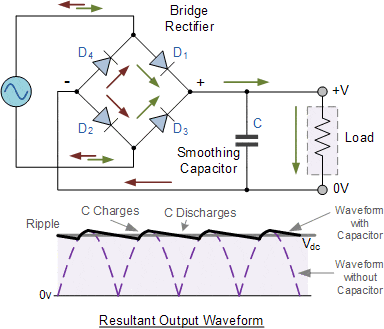
Trying to build a simple 9V power supply using a 7809 voltage regulator and full wave rectifier. The load current from the regulator is 1A. So I = C*dv/dt, therefore,

C = I*t/(delta V)
uitiQ.gif


To my understanding t is the time between the two peaks or the time the capacitor supplies the load. So if t is reduced, shouldn't the ripple increase ?, so isn't ripple (delta V) dependent on t ?, if so then why is delta V just arbitrarily chosen without considering t ?
 
Engineering news on Phys.org
1, t is fixed if you are using mains power - at roughly 0.01sec.
2, ripple would increase with t, if you were using a variable frequency supply.
This should be clear from the graph. If the peaks are further apart, the output drops more between peaks.
3, I don't think delta V is arbitrarily chosen. It comes from the permissible ripple. You know delta t, from mains frequency, and I from your spec. Then you calculate C.
Permissible ripple may come from the difference between, the lowest operating voltage of your regulator and the peak value your capacitor charges to.
 
  • Like
Likes   Reactions: davenn
TheRedDevil18 said:
So if t is reduced, shouldn't the ripple increase ?,
look at your graph
TheRedDevil18 said:
So I = C*dv/dt, therefore,
solve for dv
dv = I/C X dt , therefore
increasing Δt increases Δv

you knew that, just you were in a hurry. Think in small patient steps.
 
  • Like
Likes   Reactions: davenn

Similar threads

  • · Replies 8 ·
Replies
8
Views
2K
  • · Replies 8 ·
Replies
8
Views
2K
  • · Replies 63 ·
3
Replies
63
Views
8K
  • · Replies 9 ·
Replies
9
Views
4K
  • · Replies 52 ·
2
Replies
52
Views
3K
  • · Replies 2 ·
Replies
2
Views
2K
  • · Replies 15 ·
Replies
15
Views
2K
  • · Replies 16 ·
Replies
16
Views
4K
  • · Replies 41 ·
2
Replies
41
Views
7K
  • · Replies 7 ·
Replies
7
Views
2K