Calculating the flux density between two magnets

Click For Summary
SUMMARY

The discussion centers on calculating the flux density between two rectangular magnets, each rated at 1 Tesla, positioned 3cm apart. The force on a 28 SWG wire passing 1.5cm from each magnet is calculated using the formula F = BIL, where B is the flux density. Due to the falloff of the magnetic field, the effective flux density at the wire's location is approximately 0.1 Tesla, resulting in a force of 0.0025 N, insufficient to move the wire. Suggestions include using Finite Element Modelling software for more accurate calculations and increasing current to enhance the wire's deflection.

PREREQUISITES
  • Understanding of magnetic field concepts and flux density
  • Familiarity with the formula F = BIL for calculating force on a current-carrying wire
  • Knowledge of Finite Element Modelling software for magnetic field analysis
  • Basic electronics skills for manipulating current through a wire
NEXT STEPS
  • Research Finite Element Modelling software options for magnetic field simulations
  • Explore advanced techniques for measuring magnetic flux density
  • Learn about the effects of different wire gauges on magnetic force
  • Investigate methods for increasing current safely in experimental setups
USEFUL FOR

Physics students, electrical engineers, and hobbyists conducting experiments with magnetic fields and current-carrying conductors will benefit from this discussion.

SteveDavies
Messages
3
Reaction score
0
TL;DR
Two rectangular magnets, each of 1 Tesla, are spaced 3cm apart, with their large areas facing each other - North facing South. How do I find the flux density at the point between them?
This is for an experiment to deflect a 28 SWG wire between two magnets, 3cm apart, by passing a current through it (example attached). The force on the wire is obviously F = BIL, but the wire will be passing at 1.5cm from each magnet so there will be some significant fall off of B and I can't assume B (in BIL) to be 2 Teslas. The magnets are 5cm × 1.9cm × 0.6cm and 1 Tesla each.
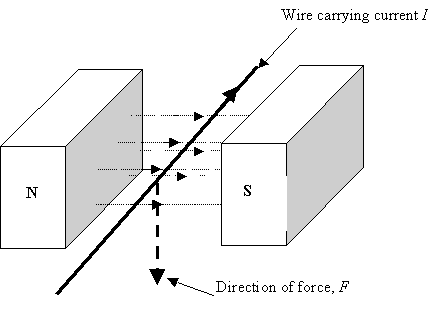
magnets.gif


Many thanks,

Steve.
 
Engineering news on Phys.org
You're right that there will be falloff, and the flux density throughout the region between the magnet faces will not be uniform. You can predict the magnetic field for a rectangular magnet along its central axis fairly easily. See: this page. It's a commercial site with which I have no association or affiliation.

Elsewhere in the region between the magnets you'll probably have to resort to Finite Element Modelling software. There's one such mentioned on that website and they appear to be offering for free download.
 
Last edited:
  • Like
Likes   Reactions: SteveDavies
gneill said:
You're right that there will be falloff, and the flux density throughout the region between the magnet faces will not be uniform. You can predict the magnetic for a rectangular magnet along its central axis fairly easily. See: this page. It's a commercial site with which I have no association or affiliation.

Elsewhere in the region between the magnets you'll probably have to resort to Finite Element Modelling software. There's one such mentioned on that website and they appear to be offering for free download.

Thanks Gneill. Very useful!

Steve.
 
SteveDavies said:
Summary:: Two rectangular magnets, each of 1 Tesla, are spaced 3cm apart, with their large areas facing each other - North facing South. How do I find the flux density at the point between them?

This is for an experiment to deflect a 28 SWG wire between two magnets, 3cm apart, by passing a current through it (example attached). The force on the wire is obviously F = BIL, but the wire will be passing at 1.5cm from each magnet so there will be some significant fall off of B and I can't assume B (in BIL) to be 2 Teslas. The magnets are 5cm × 1.9cm × 0.6cm and 1 Tesla each.

View attachment 256250

Many thanks,

Steve.

Two approaches, one would be to pass a known current through the wire and measure the force, then B=F/IL.

The second is the calculation method, and this is not as simple as it may seem. Permanent magnets are generally not offered as having x tesla. Fundamentally permanent magnets are a source of H or magneto motive force, the resultant B or flux density is determined by the reluctance of the magnetic circuit the magnet is in.

Now a permanent magnet will exhibit some flux density even in free space, since it has built in reluctance dependent on the shape of the magnet. It is this flux density that the linked page is calculating.

As soon as more magnets come into play, or you have a reluctance path other than air, these equations will not work. In this case you will have to at minimum estimate your magnetic circuit similar to this:
1580394456938.png


If you want to have the most force out of your wire in the case you have drawn, you'll want to add in magnetic path (ie iron) linking the backs of the magnets to each other so the only high reluctance path is through the air gap.
 
  • Like
Likes   Reactions: SteveDavies
Thanks essenmein.

The problem was that I couldn't get any movement from the wire. I think it's because at 28 SWG it was too rigid and heavy. I didn't have a horseshoe magnet available, so I was using separate magnets.

The Magnadur magnets are rated at 1 Tesla but according to supermagnete.de (I emailed them) the Tesla rating is measured at the centre of the magnet and at the surface it is always a lot less. Using their calculator, with the wire is at a distance of about 15mm from each magnet, it will have received a total field of about 0.1 Telsa.

So, over a length of 50mm (the length of the magnet) and at a current of 0.5A you get:

F = B I L

F = (0.1) (0.5) (0.05) = 0.0025 N

Which is equivalent to a mass of 0.25mg and is not enough to move the wire.

There are a couple of videos on YouTube though where they have managed to get this to work, but I think the wire they are using is a lot thinner - more like piano wire.

Thanks again for you suggestions,

Steve.
 
My preference, when all else fails, is more current. :smile:

If you build a little pulse switch thing with a fet and current limiting resistor to a power supply or something then you can put more amps through the wire, albeit for a shorter duration. I'd play with duration and some decent amps and see if you can get the wire to wiggle. Only reference I have is 110Adc will make the positive and negative wires move noticeably closer to each other when hanging in free air.
 
  • Like
Likes   Reactions: SteveDavies

Similar threads

  • · Replies 20 ·
Replies
20
Views
5K
  • · Replies 14 ·
Replies
14
Views
6K
  • · Replies 24 ·
Replies
24
Views
2K
Replies
2
Views
3K
  • · Replies 2 ·
Replies
2
Views
2K
  • · Replies 35 ·
2
Replies
35
Views
5K
Replies
4
Views
2K
  • · Replies 6 ·
Replies
6
Views
12K
  • · Replies 3 ·
Replies
3
Views
2K
  • · Replies 1 ·
Replies
1
Views
1K