Calculating the initial frequency of a decelerating flywheel

Click For Summary

Homework Help Overview

The discussion revolves around calculating the initial frequency of a decelerating flywheel, focusing on the relationship between angular velocity and frequency during a period of constant deceleration. Participants explore the implications of average values and the effects of time on these quantities.

Discussion Character

  • Exploratory, Conceptual clarification, Mathematical reasoning, Problem interpretation, Assumption checking

Approaches and Questions Raised

  • Participants discuss the conversion of time and angles into angular velocity, questioning how to derive initial frequency from average values. There is exploration of the average angular velocity during constant deceleration and its implications for the problem.

Discussion Status

Several participants have offered insights into the average calculations and the relationship between initial and final velocities. There is an ongoing exploration of different approaches to find the initial frequency, with some participants attempting to apply trial and error methods to gain clarity.

Contextual Notes

Participants note that the problem involves a period of 5 minutes and 800 revolutions, with the additional constraint that the rotational frequency drops to two-thirds of its starting frequency. There is uncertainty regarding the exact values of initial and final frequencies, leading to various interpretations and calculations.

Stuka_Hunter
Messages
11
Reaction score
1
Homework Statement
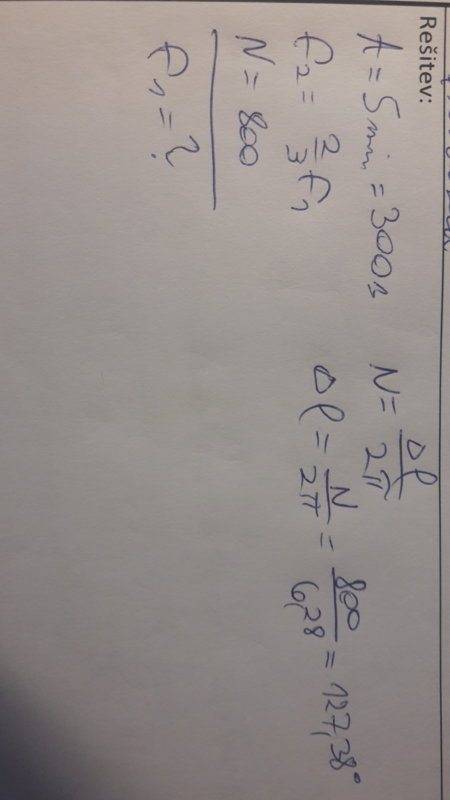
When we stop rotating the flywheel, the rotational frequency drops in 5 minutes to two thirds of its starting frequency, in which time the flywheel does 800 rotations. What is the starting frequency?
Relevant Equations
None given
I converted 5 minutes to 300 seconds, and movement angle per second as shown on the picture. From here on I am lost, as the angular velocity can't be calculated, as the time given isn't the one in which the flywheel does one rotation.

I apologise if I used any expressions wrong, english is not my mother toungue... :sorry:
15732990878541128181.jpg
 
Physics news on Phys.org
I guess we are assuming a constant deceleration here?

What can you say about the time-average of angular velocity during a period of constant acceleration (or deceleration)?

PS Not just angular velocity, but any quantity that is changing at a constant rate.
 
Yes, this is constant deceleration.

Well, with constant deceleration the angular velocity drops at a constant rate with each passing second. That is what I am aware of. How to get that into an equation with 4 parts and 2 of them missing, not so much. :/
 
Stuka_Hunter said:
Yes, this is constant deceleration.

Well, with constant deceleration the angular velocity drops at a constant rate with each passing second. That is what I am aware of. How to get that into an equation with 4 parts and 2 of them missing, not so much. :/

I asked you about the average of the quantity over a period of constant change. Any ideas?

Suppose a car accelerates from ##0## to ##30m/s## at a constant rate. What is its average speed during that time?
 
That is simple, the average is 0+30 divided by two, so 15 m/s
 
Stuka_Hunter said:
That is simple, the average is 0+30 divided by two, so 15 m/s

Yes, and that generalises to the average being half way between the initial and final values. And applies to deceleration as well.

If a car decelerates from ##30m/s## to ##20m/s## at a constant rate, I'm sure you can see what the average speed over that period must be.

There's another important aspect of the average. If you know the time over which the change takes place, then the time multiplied by the average value gives what?

Perhaps think linear velocity first, then extend the idea to angualr velocity.
 
PeroK said:
There's another important aspect of the average. If you know the time over which the change takes place, then the time multiplied by the average value gives what?

So, if I divide the angle i calculated with 300 seconds of time, then I should get average angular velocity? That is what an equation in my notebook says at least.

But consequently this also gives an average frequency, going by the equation w=2×Pi×f (w being angular velocity and f being frequency). Not the initial frequency or the later frequency, as required.
 
Stuka_Hunter said:
So, if I divide the angle i calculated with 300 seconds of time, then I should get average angular velocity? That is what an equation in my notebook says at least.

But consequently this also gives an average frequency, going by the equation w=2×Pi×f (w being angular velocity and f being frequency). Not the initial frequency or the later frequency, as required.

Hang on! One step at a time. We have a period of ##5## minutes. There's nothing wrong with converting to seconds, but let's stick with minutes for the time being. And we have 800 revolutions in that time.

That's an average of 160 rpm

(rpm = revolutions per minute)

If that's all we knew, then there is no unique answer. It could have started at 320 rpm and reduced to zero; or it could have started at 200 rpm and reduced to 120. Or, it could have started at 161rpm and reduced to 159.

But, we are told something else:

Stuka_Hunter said:
the rotational frequency drops in 5 minutes to two thirds of its starting frequency

Does that help?
 
I am so lost in this right now, even if solution may be simple...

So, two thirds of 160 rpm is 106 rpm. If I multiply that by 5 minutes, that gives me 530 rpm. Is that then rpm of final frequency?
 
  • #10
Stuka_Hunter said:
I am so lost in this right now, even if solution may be simple...

So, two thirds of 160 rpm is 106 rpm. If I multiply that by 5 minutes, that gives me 530 rpm. Is that then rpm of final frequency?

No. You know the average is 160 rpm. And you know that it started at ##x## rpm and it ended at ##2x/3## rpm.

That's the same mathematics as a car that started at ##x \ m/s## ended at ##2x/3 \ m/s## and had an average speed of ##160 m/s## during this time.

Or, it could be any other physical quantity described as a rate per unit of time.

You need to find ##x## where ##160## is half way between ##x## and ##2x/3##.
 
  • #11
Stuka_Hunter said:
I am so lost in this right now, even if solution may be simple...

So, two thirds of 160 rpm is 106 rpm. If I multiply that by 5 minutes, that gives me 530 rpm. Is that then rpm of final frequency?

There is another way to get an insight into problems like this - and perhaps even solve them. In English it's called "trial and error". What you can do is guess an answer and see whether it works out.

I'm going to guess that the wheel started at ##300## rpm and reduced to ##200## rpm (over the 5 minutes).

That gives an average speed of ##250## rpm over 5 minutes, which is ##1250## revolutions. Which is too high. We are told it was only ##800## revolutions.

In fact, I can now see a way to get the answer from that. But let's continue with our trial and error:

Next I'll guess ##210## rpm, reducing to ##140## rpm, average of ##175## rpm, total ##875## revolutions. (getting closer).

What about ##180## rpm, reducing to ##120## rpm, average of ##150## rmp, total ##750## revolutions. (Closer again, but too low.)

Now, you could put this calculation into a spreadsheet and keep trying until you get ##800## revolutions. But, I'd hope that during this process you would see what is going on mathematically and be able to solve the problem directly.
 
  • #12
This is my last attempt. I went by the form or average velocity calculator, so:

Average velocity = (final velocity + initial velocity)/2

I replaced average velocity with 160 rpm, final velocity with 2x/3 and initial velocity with x. I got 192, which i assume is initial velocity. The final velocity is then 2 thirds of that, or 128 rpm.
 
  • #13
Stuka_Hunter said:
This is my last attempt. I went by the form or average velocity calculator, so:

Average velocity = (final velocity + initial velocity)/2

I replaced average velocity with 160 rpm, final velocity with 2x/3 and initial velocity with x. I got 192, which i assume is initial velocity. The final velocity is then 2 thirds of that, or 128 rpm.

Can you check that all works out? See above.
 
  • #14
I am going to make a guess and say it does. I am solving this example for an entire day, so I am going to thank you for your help and move on. :bow:
 
  • Like
Likes   Reactions: PeroK
  • #15
Stuka_Hunter said:
I am going to make a guess and say it does. I am solving this example for an entire day, so I am going to thank you for your help and move on. :bow:

Try to learn something from it! It wasn't difficult, if you looked at it the right way.
 

Similar threads

Replies
11
Views
1K
  • · Replies 5 ·
Replies
5
Views
1K
Replies
44
Views
5K
Replies
4
Views
2K
  • · Replies 9 ·
Replies
9
Views
2K
  • · Replies 23 ·
Replies
23
Views
6K
  • · Replies 7 ·
Replies
7
Views
3K
  • · Replies 4 ·
Replies
4
Views
3K
  • · Replies 11 ·
Replies
11
Views
2K
  • · Replies 7 ·
Replies
7
Views
8K