Calculating the Specific Heat of a Solution with NaCl and H2O

Click For Summary
SUMMARY

This discussion focuses on calculating the specific heat and latent heats of fusion for a solution of sodium chloride (NaCl) in water (H2O). Participants confirm that the heat of fusion is dependent on the concentration of the brine, particularly at 10% NaCl concentration, where no NaCl formation occurs at -21ºC or -5ºC. The conversation also delves into the application of Raoult's law and the derivation of the freezing point depression formula, emphasizing the dissociation of NaCl into sodium and chloride ions. A participant attempts to calculate the specific heat for a 10 wt% NaCl solution, arriving at an unexpectedly high value, indicating a potential error in their calculations.

PREREQUISITES
  • Understanding of Raoult's law and its application in solutions
  • Familiarity with the concept of latent heat and specific heat
  • Basic knowledge of thermodynamics, particularly phase changes
  • Ability to perform calculations involving molar fractions and weight percentages
NEXT STEPS
  • Study the derivation and application of the freezing point depression formula in physical chemistry
  • Learn about the dissociation of ionic compounds in solution, specifically NaCl
  • Explore the principles of thermodynamics related to phase transitions and latent heat
  • Practice calculations involving specific heat and latent heat for various concentrations of NaCl solutions
USEFUL FOR

Chemistry students, physical chemists, and researchers involved in thermodynamic studies of solutions, particularly those working with saltwater systems and phase change phenomena.

joaquinjbs
Messages
15
Reaction score
0
It's possible to calculate the latent heats of fusion and the specific heat of a solution of H2O and NaCl?
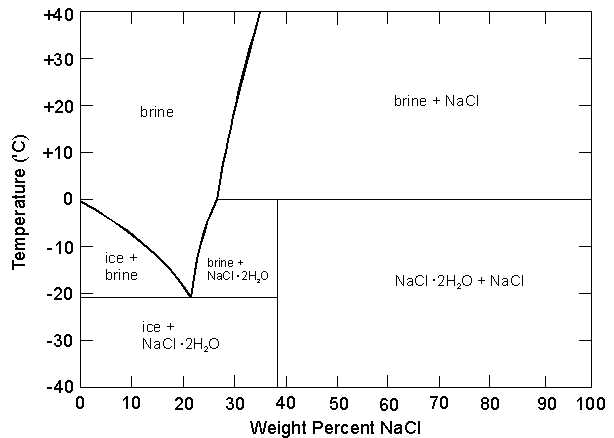
fig6_1_1.gif


In some cases, it would have two latent heats of fusion? For example, at 10% NaCl, one at -21ºC and another at -5ºC?

Thanks!
 
Chemistry news on Phys.org
Yes, the heat of fusion will be a function of the concentration of the brine.
 
Thank you DrDu. I guess that heat of fusion will be at -21ºC, but If I have 10% of NaCl, would I have another different heat of fusion at -5ºC, or it would be the same?
 
joaquinjbs said:
In some cases, it would have two latent heats of fusion? For example, at 10% NaCl, one at -21ºC and another at -5ºC?
Thanks!
With a 10% solution there is no NaCl formation at either of these two temperatures. The heat of fusion comes into the calculation only on the line between brine and brine + NaCl .
 
  • Like
Likes Serena
BvU said:
With a 10% solution there is no NaCl formation at either of these two temperatures. The heat of fusion comes into the calculation only on the line between brine and brine + NaCl .

Well, thank you BvU. But for me it's interested what happened on the left of eutectic point. I could calculate the latent heat of fusion of ice+brine?
 
You form ice and the composition moves towards the eutectic point when cooling further.
 
You can do so, at least for 0% concentration. For very small concentrations, the chemical potential of water in the liquid phase follows Raoult's law ##\mu_l(T,x)=\mu_{l0}(T)+RT \ln(x)## where x is the molar fraction of water in brine. Pressure is constant, so I don't mention it any further. The chemical potential of the solid phase, which consists of pure ice, is ##\mu_s(T)## and depends only on temperature. Now on the melting curve, ##\Delta G=\mu_l(T,x)-\mu_s(T)=0##. We can now use a Taylor expansion for ##\mu(T,x)## around ##\mu(T_0,1)##, where ##T_0## is the melting point of pure ice. We know that ##\partial \Delta G/\partial T|_{P,x}=\Delta S=\Delta H/T_0## and ## \partial \Delta G/\partial x|_{T_0,P}=-RT_0 (1-x)##. So ##0=\Delta G=(\Delta H/T_0)\cdot \Delta T -RT(1-x)## or
##\Delta H=RT_0^2(1-x)/\Delta T##. In the calculation of x, you have to take into account that NaCl will dissociate into sodium and chloride ions.
 
  • Like
Likes joaquinjbs
DrDu said:
You can do so, at least for 0% concentration. For very small concentrations, the chemical potential of water in the liquid phase follows Raoult's law ##\mu_l(T,x)=\mu_{l0}(T)+RT \ln(x)## where x is the molar fraction of water in brine. Pressure is constant, so I don't mention it any further. The chemical potential of the solid phase, which consists of pure ice, is ##\mu_s(T)## and depends only on temperature. Now on the melting curve, ##\Delta G=\mu_l(T,x)-\mu_s(T)=0##. We can now use a Taylor expansion for ##\mu(T,x)## around ##\mu(T_0,1)##, where ##T_0## is the melting point of pure ice. We know that ##\partial \Delta G/\partial T|_{P,x}=\Delta S=\Delta H/T_0## and ## \partial \Delta G/\partial x|_{T_0,P}=-RT_0 (1-x)##. So ##0=\Delta G=(\Delta H/T_0)\cdot \Delta T -RT(1-x)## or
##\Delta H=RT_0^2(1-x)/\Delta T##. In the calculation of x, you have to take into account that NaCl will dissociate into sodium and chloride ions.
Ok, thank you very much!
 
DrDu said:
You can do so, at least for 0% concentration. For very small concentrations, the chemical potential of water in the liquid phase follows Raoult's law ##\mu_l(T,x)=\mu_{l0}(T)+RT \ln(x)## where x is the molar fraction of water in brine. Pressure is constant, so I don't mention it any further. The chemical potential of the solid phase, which consists of pure ice, is ##\mu_s(T)## and depends only on temperature. Now on the melting curve, ##\Delta G=\mu_l(T,x)-\mu_s(T)=0##. We can now use a Taylor expansion for ##\mu(T,x)## around ##\mu(T_0,1)##, where ##T_0## is the melting point of pure ice. We know that ##\partial \Delta G/\partial T|_{P,x}=\Delta S=\Delta H/T_0## and ## \partial \Delta G/\partial x|_{T_0,P}=-RT_0 (1-x)##. So ##0=\Delta G=(\Delta H/T_0)\cdot \Delta T -RT(1-x)## or
##\Delta H=RT_0^2(1-x)/\Delta T##. In the calculation of x, you have to take into account that NaCl will dissociate into sodium and chloride ions.
I have been thinking about this all day, but I'm not able to resolve the problem. If you don't mind, could you show me an example?

Than you.
 
Last edited:
  • #10
Basically, the final result I derived is the formula for freezing point depression. Every book on physical chemistry should contain a discussion.
 
  • #11
DrDu said:
Basically, the final result I derived is the formula for freezing point depression. Every book on physical chemistry should contain a discussion.
Thank you, but I'm going to do with an practical experiment. Even so I'll try to resolve the formula.
 
  • #12
A first step would be to convert weight percent to molar fraction.
 
  • #13
DrDu said:
You can do so, at least for 0% concentration. For very small concentrations, the chemical potential of water in the liquid phase follows Raoult's law ##\mu_l(T,x)=\mu_{l0}(T)+RT \ln(x)## where x is the molar fraction of water in brine. Pressure is constant, so I don't mention it any further. The chemical potential of the solid phase, which consists of pure ice, is ##\mu_s(T)## and depends only on temperature. Now on the melting curve, ##\Delta G=\mu_l(T,x)-\mu_s(T)=0##. We can now use a Taylor expansion for ##\mu(T,x)## around ##\mu(T_0,1)##, where ##T_0## is the melting point of pure ice. We know that ##\partial \Delta G/\partial T|_{P,x}=\Delta S=\Delta H/T_0## and ## \partial \Delta G/\partial x|_{T_0,P}=-RT_0 (1-x)##. So ##0=\Delta G=(\Delta H/T_0)\cdot \Delta T -RT(1-x)## or
##\Delta H=RT_0^2(1-x)/\Delta T##. In the calculation of x, you have to take into account that NaCl will dissociate into sodium and chloride ions.

Well I'm back! I would like to resolve this exercise so...

For example, applying this formula to a solution with 10 wt% NaCl (0.17 mol NaCl), which has a T0 = 268 K, ΔT = 1 K and R = 8.31 J/(molK); I have ΔH = 495392 J

Now with n = 1 mol, and ΔT = 1 K:
Cp = ΔH/(nΔT) = 495392 J/(molK) → 8470*103 J/(KgK)

So this would be the specific heat of a solution with 10 wt% NaCl in water at -5 ºC. But this huge number has no sense... something I'm doing wrong, could you help me?
 

Similar threads

Replies
1
Views
3K
  • · Replies 2 ·
Replies
2
Views
3K
  • · Replies 1 ·
Replies
1
Views
2K
  • · Replies 3 ·
Replies
3
Views
2K
  • · Replies 5 ·
Replies
5
Views
3K
  • · Replies 3 ·
Replies
3
Views
2K
  • · Replies 4 ·
Replies
4
Views
3K
  • · Replies 2 ·
Replies
2
Views
742
  • · Replies 131 ·
5
Replies
131
Views
9K
  • · Replies 0 ·
Replies
0
Views
1K