Calculating the Specific Heat of a Solution with NaCl and H2O

Click For Summary

Discussion Overview

The discussion revolves around calculating the specific heat and latent heats of fusion for a solution of NaCl in water (H2O), particularly focusing on the effects of concentration on these properties. Participants explore theoretical aspects, mathematical formulations, and practical implications of these calculations.

Discussion Character

  • Exploratory
  • Technical explanation
  • Mathematical reasoning
  • Homework-related

Main Points Raised

  • Some participants inquire whether it is possible to calculate the latent heats of fusion and specific heat for a NaCl and H2O solution, particularly at different concentrations.
  • One participant suggests that the heat of fusion will vary with the concentration of the brine.
  • Another participant questions if there would be different heats of fusion at specific temperatures for a 10% NaCl solution.
  • It is noted that at a 10% solution, no NaCl formation occurs at certain temperatures, and the heat of fusion is relevant only along the line between brine and brine + NaCl.
  • Participants discuss the behavior of the solution as it cools towards the eutectic point and the implications for calculating latent heat of fusion.
  • One participant provides a detailed mathematical approach using Raoult's law and chemical potential to derive a formula related to freezing point depression.
  • Another participant expresses difficulty in resolving a specific problem and requests an example to clarify the calculations.
  • There is mention of converting weight percent to molar fraction as a necessary step in calculations.
  • A participant shares a derived formula for freezing point depression and expresses intent to conduct a practical experiment.
  • One participant presents a calculation for specific heat based on their derived values but questions the validity of the resulting large number.

Areas of Agreement / Disagreement

Participants do not reach a consensus on the calculations or the implications of their findings. Multiple competing views and approaches remain, particularly regarding the effects of concentration on latent heat and specific heat.

Contextual Notes

Some calculations depend on specific assumptions about concentration and temperature, and participants highlight the need for careful consideration of these factors in their discussions.

joaquinjbs
Messages
15
Reaction score
0
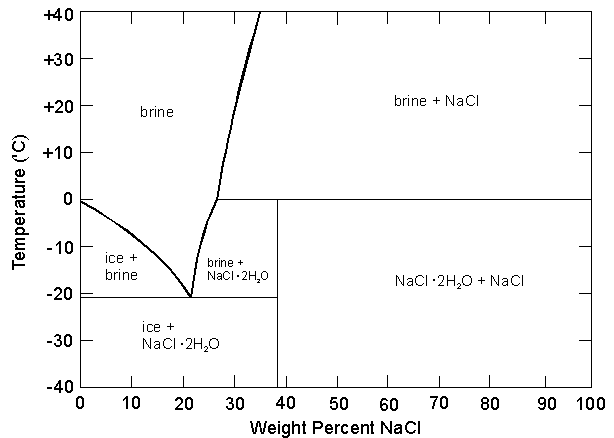
It's possible to calculate the latent heats of fusion and the specific heat of a solution of H2O and NaCl?

fig6_1_1.gif


In some cases, it would have two latent heats of fusion? For example, at 10% NaCl, one at -21ºC and another at -5ºC?

Thanks!
 
Chemistry news on Phys.org
Yes, the heat of fusion will be a function of the concentration of the brine.
 
Thank you DrDu. I guess that heat of fusion will be at -21ºC, but If I have 10% of NaCl, would I have another different heat of fusion at -5ºC, or it would be the same?
 
joaquinjbs said:
In some cases, it would have two latent heats of fusion? For example, at 10% NaCl, one at -21ºC and another at -5ºC?
Thanks!
With a 10% solution there is no NaCl formation at either of these two temperatures. The heat of fusion comes into the calculation only on the line between brine and brine + NaCl .
 
  • Like
Likes   Reactions: Serena
BvU said:
With a 10% solution there is no NaCl formation at either of these two temperatures. The heat of fusion comes into the calculation only on the line between brine and brine + NaCl .

Well, thank you BvU. But for me it's interested what happened on the left of eutectic point. I could calculate the latent heat of fusion of ice+brine?
 
You form ice and the composition moves towards the eutectic point when cooling further.
 
You can do so, at least for 0% concentration. For very small concentrations, the chemical potential of water in the liquid phase follows Raoult's law ##\mu_l(T,x)=\mu_{l0}(T)+RT \ln(x)## where x is the molar fraction of water in brine. Pressure is constant, so I don't mention it any further. The chemical potential of the solid phase, which consists of pure ice, is ##\mu_s(T)## and depends only on temperature. Now on the melting curve, ##\Delta G=\mu_l(T,x)-\mu_s(T)=0##. We can now use a Taylor expansion for ##\mu(T,x)## around ##\mu(T_0,1)##, where ##T_0## is the melting point of pure ice. We know that ##\partial \Delta G/\partial T|_{P,x}=\Delta S=\Delta H/T_0## and ## \partial \Delta G/\partial x|_{T_0,P}=-RT_0 (1-x)##. So ##0=\Delta G=(\Delta H/T_0)\cdot \Delta T -RT(1-x)## or
##\Delta H=RT_0^2(1-x)/\Delta T##. In the calculation of x, you have to take into account that NaCl will dissociate into sodium and chloride ions.
 
  • Like
Likes   Reactions: joaquinjbs
DrDu said:
You can do so, at least for 0% concentration. For very small concentrations, the chemical potential of water in the liquid phase follows Raoult's law ##\mu_l(T,x)=\mu_{l0}(T)+RT \ln(x)## where x is the molar fraction of water in brine. Pressure is constant, so I don't mention it any further. The chemical potential of the solid phase, which consists of pure ice, is ##\mu_s(T)## and depends only on temperature. Now on the melting curve, ##\Delta G=\mu_l(T,x)-\mu_s(T)=0##. We can now use a Taylor expansion for ##\mu(T,x)## around ##\mu(T_0,1)##, where ##T_0## is the melting point of pure ice. We know that ##\partial \Delta G/\partial T|_{P,x}=\Delta S=\Delta H/T_0## and ## \partial \Delta G/\partial x|_{T_0,P}=-RT_0 (1-x)##. So ##0=\Delta G=(\Delta H/T_0)\cdot \Delta T -RT(1-x)## or
##\Delta H=RT_0^2(1-x)/\Delta T##. In the calculation of x, you have to take into account that NaCl will dissociate into sodium and chloride ions.
Ok, thank you very much!
 
DrDu said:
You can do so, at least for 0% concentration. For very small concentrations, the chemical potential of water in the liquid phase follows Raoult's law ##\mu_l(T,x)=\mu_{l0}(T)+RT \ln(x)## where x is the molar fraction of water in brine. Pressure is constant, so I don't mention it any further. The chemical potential of the solid phase, which consists of pure ice, is ##\mu_s(T)## and depends only on temperature. Now on the melting curve, ##\Delta G=\mu_l(T,x)-\mu_s(T)=0##. We can now use a Taylor expansion for ##\mu(T,x)## around ##\mu(T_0,1)##, where ##T_0## is the melting point of pure ice. We know that ##\partial \Delta G/\partial T|_{P,x}=\Delta S=\Delta H/T_0## and ## \partial \Delta G/\partial x|_{T_0,P}=-RT_0 (1-x)##. So ##0=\Delta G=(\Delta H/T_0)\cdot \Delta T -RT(1-x)## or
##\Delta H=RT_0^2(1-x)/\Delta T##. In the calculation of x, you have to take into account that NaCl will dissociate into sodium and chloride ions.
I have been thinking about this all day, but I'm not able to resolve the problem. If you don't mind, could you show me an example?

Than you.
 
Last edited:
  • #10
Basically, the final result I derived is the formula for freezing point depression. Every book on physical chemistry should contain a discussion.
 
  • #11
DrDu said:
Basically, the final result I derived is the formula for freezing point depression. Every book on physical chemistry should contain a discussion.
Thank you, but I'm going to do with an practical experiment. Even so I'll try to resolve the formula.
 
  • #12
A first step would be to convert weight percent to molar fraction.
 
  • #13
DrDu said:
You can do so, at least for 0% concentration. For very small concentrations, the chemical potential of water in the liquid phase follows Raoult's law ##\mu_l(T,x)=\mu_{l0}(T)+RT \ln(x)## where x is the molar fraction of water in brine. Pressure is constant, so I don't mention it any further. The chemical potential of the solid phase, which consists of pure ice, is ##\mu_s(T)## and depends only on temperature. Now on the melting curve, ##\Delta G=\mu_l(T,x)-\mu_s(T)=0##. We can now use a Taylor expansion for ##\mu(T,x)## around ##\mu(T_0,1)##, where ##T_0## is the melting point of pure ice. We know that ##\partial \Delta G/\partial T|_{P,x}=\Delta S=\Delta H/T_0## and ## \partial \Delta G/\partial x|_{T_0,P}=-RT_0 (1-x)##. So ##0=\Delta G=(\Delta H/T_0)\cdot \Delta T -RT(1-x)## or
##\Delta H=RT_0^2(1-x)/\Delta T##. In the calculation of x, you have to take into account that NaCl will dissociate into sodium and chloride ions.

Well I'm back! I would like to resolve this exercise so...

For example, applying this formula to a solution with 10 wt% NaCl (0.17 mol NaCl), which has a T0 = 268 K, ΔT = 1 K and R = 8.31 J/(molK); I have ΔH = 495392 J

Now with n = 1 mol, and ΔT = 1 K:
Cp = ΔH/(nΔT) = 495392 J/(molK) → 8470*103 J/(KgK)

So this would be the specific heat of a solution with 10 wt% NaCl in water at -5 ºC. But this huge number has no sense... something I'm doing wrong, could you help me?
 

Similar threads

Replies
1
Views
3K
  • · Replies 2 ·
Replies
2
Views
3K
  • · Replies 1 ·
Replies
1
Views
2K
  • · Replies 3 ·
Replies
3
Views
2K
  • · Replies 5 ·
Replies
5
Views
3K
  • · Replies 3 ·
Replies
3
Views
2K
  • · Replies 4 ·
Replies
4
Views
3K
  • · Replies 2 ·
Replies
2
Views
960
  • · Replies 131 ·
5
Replies
131
Views
10K
  • · Replies 0 ·
Replies
0
Views
2K