Calculating the time to cross a river

Click For Summary
SUMMARY

The discussion focuses on calculating the time and distance for a boat crossing a river under the influence of a current. The correct time to cross is established as t = a/V, where 'a' is the width of the river and 'V' is the boat's velocity. The distance calculation involves integrating the velocity components, specifically addressing the variable nature of the north-south component due to the current. The final distance is derived from the integral of the velocity function, correcting the initial misunderstanding that led to an incorrect distance of 1/6.

PREREQUISITES
  • Understanding of vector components in physics
  • Knowledge of differential equations
  • Familiarity with integration techniques
  • Proficiency in LaTeX for mathematical notation
NEXT STEPS
  • Study the principles of vector addition in physics
  • Learn how to solve differential equations related to motion
  • Practice integration techniques for variable functions
  • Explore LaTeX formatting for mathematical expressions
USEFUL FOR

Students and educators in physics, mathematicians, and anyone involved in solving problems related to motion in fluid dynamics.

gnits
Messages
137
Reaction score
46
Homework Statement
To calculate time to cross a river
Relevant Equations
d = st
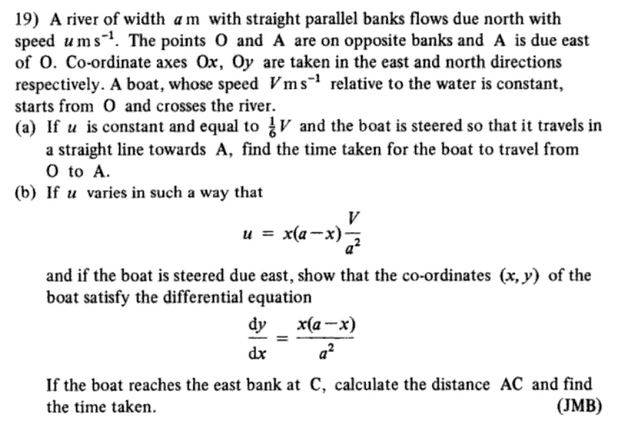
Could I please ask for help on the last part of this question:
river.JPG


So, part b, I get the right time but not the right distance.

Book answers are: distance = 1/6 and time = a/V.

Here's my (faulty?) reasoning (LaTeX isn't working for me):

The boat is steered due east and so would have a velocity of V east and 0 north but for the current of speed u = x(a-x)V / a^2 which will push it north, so velocity vector of boat is:

V i + ( x(a-x)V/a^2 ) j

Therefore the position vector of the boat at time t will be:

V t i + ( x(a-x)V t /a^2 ) j - Call this "Equation 1"

We can see that the j component is equal to x(a-x)/a^2 times the i component and so the gradient of this line is a(a-x)/a^2 as required.

So boat will have crossed river when Vt = a and so t = a/V as required.

Finally, to calculate the distance AC, I put this time into the y component of Equation 1 and this gives me y = x(a-x) / a

Not 1 / 6.

Thanks for any help,
Mitch.
 
Physics news on Phys.org
The N-S component of the velocity is variable. You have to integrate to get the distance, surely?
 
gnits said:
(faulty?) reasoning
faulty indeed. You can check yourself that this does not satisfy the given equation.

Cause: there is no motion with constant acceleration in the y direction. The river doesn't 'push' with a constant force !

You will have to solve that differential equation to obtain he given answer, which should not be ##1/6## but something with the dimension of length.

gnits said:
LaTeX isn't working for me
That is strange. For most others it works just fine. Do you enclose things in ## for in-line math and in $$ for displayed math ?
e.g. $$ \vec v = V \left ( {\bf\hat\imath } + {x(a-x)\over a^2 } {\bf\hat\jmath } \right ) $$ gives
$$ \vec v = V \left ( {\bf\hat\imath } + {x(a-x)\over a^2 } {\bf\hat\jmath } \right ) $$ (which is correct).
 
Your equation 1 is wrong. The i-component is correct but the j-component is wrong. To find the j-component correctly you have to integrate the velocity ##u##, first replace ##x=Vt## in the expression of ##u## and then integrate with respect to the time ##t##.

EDIT:I edited this post, integration with respect to x was a bad idea.
EDIT2: Well because there is linear relationship between x and t it turns out that the integral $$\int_0^a\frac{x(a-x)}{a^2}dx=\int_0^{\frac{a}{V}}\frac{Vt(a-Vt)}{a^2}Vdt=AC$$
 
Last edited:
Thanks all for your help. I see my error now. Thanks very much for the quick help.
 

Similar threads

Replies
23
Views
2K
  • · Replies 3 ·
Replies
3
Views
2K
  • · Replies 2 ·
Replies
2
Views
1K
  • · Replies 11 ·
Replies
11
Views
3K
  • · Replies 5 ·
Replies
5
Views
3K
  • · Replies 9 ·
Replies
9
Views
7K
  • · Replies 5 ·
Replies
5
Views
2K
  • · Replies 1 ·
Replies
1
Views
3K
  • · Replies 22 ·
Replies
22
Views
5K
Replies
31
Views
2K