Ross Hanna
- 2
- 0
Hi there, I am an engineering student studying my masters, but have run into a roadblock in my calculations. I know I'm missing something obvious but i just can't see it. Too close to the woods and all that!
Anyway, i have the rear end of a motorcycle. to calculatew the overall moments, i have to find the three individual moments acting on it. the first two I'm fine with, but the third I'm struggling.
I have a rear end of a motorcycle. The wheel has a sprocket/ gear rigidly attached. A chain connects this gear to another at a distance Lc centre to centre and angle eta with a tension T. Lc is constructed of a triangle with sides a (horizontal) and b (vertical). The wheel is attached to a swingarm with length L, and angle to the horizontal of phi. The gears have radius Rc and Rs. The front sprocket rotates at V rad/s and transmits a power P.
I have attached a diagram to help.
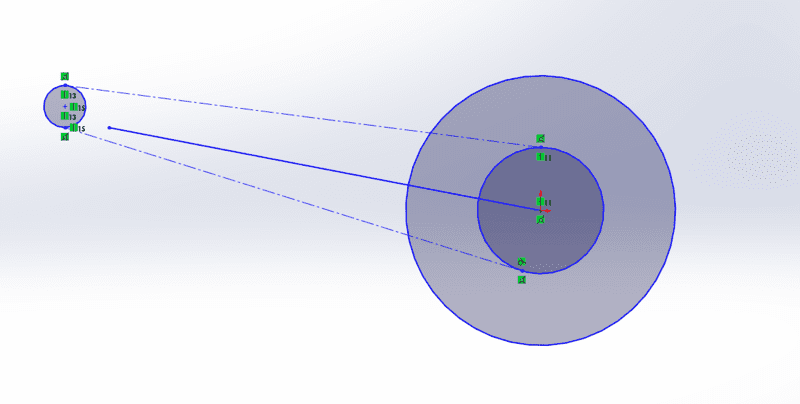 From research, the moment should be;
T*(Rc - L*sin(phi-eta))
I can get the equation by working backwards, but i don't understand how it works. The basics physics question is this. If i have a system such as below, how do i calculate the torque?
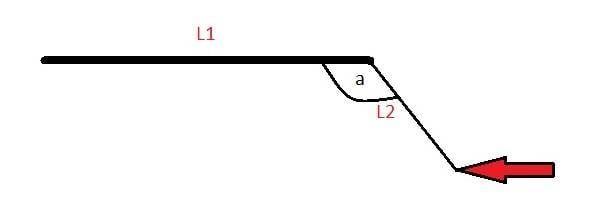
if the torque was applid to L1, i would just use T = F.r.sin(theta), but I'm unsure how to resolve the forces for this.
Thanks for any help
Ross
Anyway, i have the rear end of a motorcycle. to calculatew the overall moments, i have to find the three individual moments acting on it. the first two I'm fine with, but the third I'm struggling.
I have a rear end of a motorcycle. The wheel has a sprocket/ gear rigidly attached. A chain connects this gear to another at a distance Lc centre to centre and angle eta with a tension T. Lc is constructed of a triangle with sides a (horizontal) and b (vertical). The wheel is attached to a swingarm with length L, and angle to the horizontal of phi. The gears have radius Rc and Rs. The front sprocket rotates at V rad/s and transmits a power P.
I have attached a diagram to help.
T*(Rc - L*sin(phi-eta))
I can get the equation by working backwards, but i don't understand how it works. The basics physics question is this. If i have a system such as below, how do i calculate the torque?
if the torque was applid to L1, i would just use T = F.r.sin(theta), but I'm unsure how to resolve the forces for this.
Thanks for any help
Ross

