Calculating trajectory for a throw (Game-programming)

  • Context: Undergrad 
  • Thread starter Thread starter OyvindAndersson
  • Start date Start date
  • Tags Tags
    Programming Trajectory
Click For Summary

Discussion Overview

The discussion revolves around calculating the trajectory of a snowball thrown in a game, focusing on how to visualize the trajectory before the throw occurs. It involves concepts of projectile motion, game physics, and implementation challenges within a game engine.

Discussion Character

  • Exploratory
  • Technical explanation
  • Homework-related

Main Points Raised

  • One participant describes the need to visualize the trajectory of a snowball based on player input variables such as force and angle.
  • Another participant suggests reviewing projectile motion, indicating that the calculations for a trajectory without drag are straightforward.
  • A participant mentions the potential benefits of using a physics simulation engine to predict motion, including factors like drag and wind, and recommends consulting a forum specific to the game engine for additional functionality.
  • One participant expresses difficulty in implementing trajectory tracing due to limitations in the Unreal Engine 4 physics backend and confusion regarding the role of time in the calculations.

Areas of Agreement / Disagreement

Participants have not reached a consensus on the best approach to visualize the trajectory, and multiple views on how to handle the calculations and engine limitations remain present.

Contextual Notes

There are unresolved issues regarding the implementation of time in the trajectory calculations and the limitations of the physics backend in Unreal Engine 4.

OyvindAndersson
Messages
2
Reaction score
0
Hello, and +1 for this great forum!

I have encountered a small problem in my way of creating a small game. I have a snowball that is being thrown by the player. The dynamic variables from the input of the player are: Force and angle (between 90 : -90 degrees). At the moment I apply the force like so:
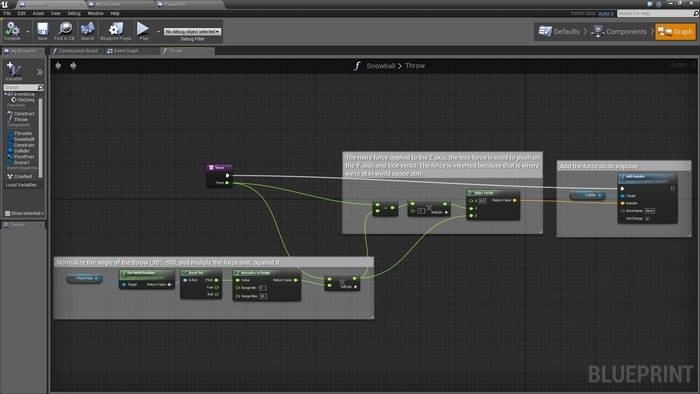
16007435626_603dba6405_o.jpg


The force is spent in 2 dimensions (Z and Y axes for up/down, left/right). Anyway, that is working quite well, and I'm happy with the result. But what I need is to draw some graphics on the screen to simulate the trajectory the ball will take before it is thrown. Not all the way, but an indication of how the trajectory will be.

If you know the game "Peggle" (perhaps angry birds also?), it is much like that.

Variables I have: Point of launch (vector), angle/direction, gravity vector, and the force that is divided between both the Z and Y axes and mass of the ball (kg).

If any of you could help me calculate the arc of the trajectory so that I could visualize a part of it, I would be very grateful. Alas my math skills does not stretch that far.Oyvind
 
Physics news on Phys.org
OyvindAndersson said:
If any of you could help me calculate the arc of the trajectory so that I could visualize a part of it
A trajectory with no drag is quite simple to compute, as shown in the wiki link.

But ideally that engine you use would support a background physics simulation, where you can add a virtual object to your world and simulate a few seconds of it, in every frame of your actual simulation, to plot it's predicted motion. That would encompass additional affects you might add to your game, like aero drag and wind. You should ask in a forum specific to that engine if there is a functionality like that.
 
Thanks a lot for the reference. I replaced my previous calculation of the impulse to the formula found on that wiki link.

@A.T.
I'm having some trouble implementing the tracing, however. The physics backend in Unreal Engine 4 is somewhat closed off, and the documentation for what is currently exposed is lacking. Therefore I have some trouble simulating the throw virtually.

The upside however, is that I have not - and will not - add in wind. The only thing affecting it is the gravity, initial velocity and the mass of the ball.

I tried to get the displacement at different lengths, but I must have borked the formula somehow. I think [time] is what is confusing me a bit. Since I'm not doing any simulations, how would I present time??Øyvind
 

Similar threads

  • · Replies 6 ·
Replies
6
Views
2K
  • · Replies 1 ·
Replies
1
Views
2K
  • · Replies 14 ·
Replies
14
Views
4K
Replies
5
Views
5K
  • · Replies 3 ·
Replies
3
Views
2K
  • · Replies 1 ·
Replies
1
Views
2K
  • · Replies 1 ·
Replies
1
Views
5K
  • · Replies 2 ·
Replies
2
Views
5K
  • · Replies 4 ·
Replies
4
Views
2K