Anakin Delabelle
- 2
- 0
Sometimes I get so bored that I just try to calculate certain experiments I've heard without know the solution. Like using the basic formula to calculate the speed of the moon around the Earth. This time I tried to calculate the differences between 2 clocks, on put on the highest building in the world (Burj Khalifa) with 828m of the ground and one in its basement so 0m.
First of all, I went searching for some variables I need to use :
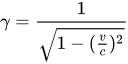
I also found the formula I needed to use :

To find the Velocity, I used the simple formula
 and
and

So, I'm trying to find the velocity of those 2 clocks relative to the center of the earth. And because one clock is further (as we see in the formula, if the angular speed is constant) it would have a faster velocity so it should go faster in time.
Velocity clock basement :

Velocity clock on top :

Then I chose for a timeframe of an hour = 3600s
That means I need to calculate the space they have done with their velocity :

 Now we should have all the variables for the formula I first mentioned, so let's fill it in :D
For the clock in the basement :


So 4.33192 nanoseconds faster than the center of the earth.
Now for the clock on top :


So 4.33329 nanoseconds faster than the center of the earth.There seems to be a theoretical a difference of 1.37 picoseconds after 1h on the clocks.
First of all, this is my first time trying to solve such a question, I just graduated high school. But I'm really interested in this field of physics.
If I made a mistake somewhere I would love to hear it, also English grammar mistakes will be visible, my apologize for those also.
Have a great day further.
First of all, I went searching for some variables I need to use :
- Rotation of the Earth = 23h 59min 04s = 86164 s
- Radius of Earth = 6378 x 103 m
- Speed of light = 299 792 458 m/s
I also found the formula I needed to use :
To find the Velocity, I used the simple formula
So, I'm trying to find the velocity of those 2 clocks relative to the center of the earth. And because one clock is further (as we see in the formula, if the angular speed is constant) it would have a faster velocity so it should go faster in time.
Velocity clock basement :
Velocity clock on top :
Then I chose for a timeframe of an hour = 3600s
That means I need to calculate the space they have done with their velocity :
For the clock in the basement :
So 4.33192 nanoseconds faster than the center of the earth.
Now for the clock on top :
So 4.33329 nanoseconds faster than the center of the earth.There seems to be a theoretical a difference of 1.37 picoseconds after 1h on the clocks.
First of all, this is my first time trying to solve such a question, I just graduated high school. But I'm really interested in this field of physics.
If I made a mistake somewhere I would love to hear it, also English grammar mistakes will be visible, my apologize for those also.
Have a great day further.
Attachments
-
 gif.latex?v_%7B1%7D%3D%5Cfrac%7B2.%5Cpi%7D%7B86164s%7D%20.6378.10%5E3m%20%3D%20465.gif1.5 KB · Views: 353
 -
 f.latex?v_%7B2%7D%3D%5Cfrac%7B2.%5Cpi%7D%7B86164s%7D%20.%286378.10%5E3m+828m%29%20%3D%20465.gif1.7 KB · Views: 376
 -
 gif.latex?x_%7B1%7D%3D%20465.0916379%5Cfrac%7Bm%7D%7Bs%7D.3600s%3D1674329.gif1.5 KB · Views: 390
 -
 gif.latex?x_%7B2%7D%3D%20465.1520167%5Cfrac%7Bm%7D%7Bs%7D.3600s%3D1674547.gif1.5 KB · Views: 401
 -
 5Cfrac%7Bm%7D%7Bs%7D%7D%7B%5Cleft%20%28%20299792458%5Cfrac%7Bm%7D%7Bs%7D%20%5Cright%20%29%5E2%7D.gif4.3 KB · Views: 344
 -
 gif.latex?3599%2C9999999956680s%20%3D%203600s%20-%204%2C33192.gif1.5 KB · Views: 379
 -
 5Cfrac%7Bm%7D%7Bs%7D%7D%7B%5Cleft%20%28%20299792458%5Cfrac%7Bm%7D%7Bs%7D%20%5Cright%20%29%5E2%7D.gif4.2 KB · Views: 354
 -
 gif.latex?3599%2C9999999956667s%20%3D%203600s%20-%204%2C33329.gif1.5 KB · Views: 398