Calculating voltage between two points using line integrals

8 replies · 3K views · last reply
lys04
Messages
144
Reaction score
5
Homework Statement
If the voltage between two points is the negative integral from A to B of Edl, then in a given problem where it asks me to find the voltage between two points, how do I know which is A and which is B? Will both a negative and positive answer be accepted since its relative, like for example point A is +2V compared to B but B might be -2V compared to A?
Relevant Equations
negative integral from A to B of Edl
^^
 
Attachments
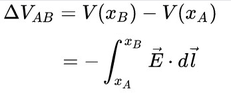
  • Equations: delta V_AB = V(x_B) - V(x_A), equal to minus the integral from x_A to x_B of E-vector dot dl-vector.
    voltage.png
    5.3 KB · Views: 201
"between" is symmetric. It does not imply a direction, so the answer would be a magnitude. But is that the word used in the question?
 
My usage of the word voltage, with which some PF users disagree, is to denote the absolute value of the potential difference between two points. If I want to refer to a quantity that could be positive or negative, i use "the electrostatic potential difference between from A to B".

When one writes ##Q=CV## for a capacitor, ##V## is called the voltage across the capacitor and is assumed to be always positive.
 
kuruman said:
"the electrostatic potential difference between from A to B"
Between? Did you mean "the electrostatic potential difference from A to B"?
 
haruspex said:
"between" is symmetric. It does not imply a direction, so the answer would be a magnitude. But is that the word used in the question?
No, I am just asking generally, it hasn't come up in a question. It just confused me tho. Does magnitude mean it's always positive?
 
haruspex said:
Between? Did you mean "the electrostatic potential difference from A to B"?
Idk, I saw a question online that was like find the potential difference between A and B so I got confused.
Handwritten worked solution: potential difference found as the negative integral of E dr from r0 = 1 m to rf = 8 m for E = 3r^2 + 5 V/m, giving ΔV = -546 V.
 
kuruman said:
My usage of the word voltage, with which some PF users disagree, is to denote the absolute value of the potential difference between two points. If I want to refer to a quantity that could be positive or negative, i use "the electrostatic potential difference between from A to B".

When one writes ##Q=CV## for a capacitor, ##V## is called the voltage across the capacitor and is assumed to be always positive.
:ok:That makes sense. Thanks.
 
haruspex said:
Between? Did you mean "the electrostatic potential difference from A to B"?
That's what I meant. I crossed out the superfluous "between". Thanks for the catch.
lys04 said:
No, I am just asking generally, it hasn't come up in a question. It just confused me tho. Does magnitude mean it's always positive?
The question in @haruspex's post #4 was addressed to me. It was a typo that I fixed. Sorry about the confusion.
 
But in circuit analysis you have to get the sign of the potential difference right. All these sign problems usually go away when you remember, how the corresponding quantities are derived from Maxwell's equations.
 
  • Like
Likes   Reactions: Lord Jestocost