Calculation of absorption spectra

Click For Summary
SUMMARY

The discussion focuses on the calculation of absorption spectra using spectrophotometric data, specifically transmittance (T) and reflectance (R). Two methods are evaluated: the first uses the relationship R + A + T = 1 to derive absorptance (A), while the second defines absorbance (A) as A = log10(1/T). The results from both methods differ significantly, raising questions about the correct approach for plotting absorption spectra. It is concluded that absorptance provides a more accurate representation of the material's absorption characteristics, particularly when comparing different samples.

PREREQUISITES
  • Understanding of spectrophotometric principles
  • Familiarity with the concepts of transmittance and reflectance
  • Knowledge of logarithmic functions and their applications in absorbance calculations
  • Basic grasp of optical characterization terminology
NEXT STEPS
  • Research the differences between absorptance and absorbance in optical measurements
  • Learn about internal transmittance and its calculation methods
  • Explore the implications of reflection losses in spectrophotometric data
  • Review the section on spectroscopic nomenclature in "Applied Spectroscopy" for clarity on terminology
USEFUL FOR

Researchers, chemists, and materials scientists involved in optical characterization and analysis of materials, particularly those working with spectrophotometric data and absorption spectra.

roam
Messages
1,265
Reaction score
12
I am trying to plot the absorption curve of a given sample using some spectrophotometric data. The data that I've collected are transmittance ##T## and reflectance ##R## – the ratios of transmitted and reflected light power to incident light power. However, using two different methods I got two very different answers:

(1) When radiation impinges on a material, we know that:

$$R+A+T=1 \tag{1}$$

Therefore, if we have obtained ##R## and ##T## using a spectrophotometer, then we can simply solve for ##A## and plot the results.

(2) Most textbooks define absorbance (sometimes called optical density, OD) as:

$$A=\log_{10}\left(\frac{1}{T}\right) \tag{2}$$

If we know ##T## using a spectrophotometer then we can plot absorption using Eq. 2.

Here are my results from both methods. The top curve is calculated using Eq. 1 (dashed/dotted lines are ##T## and ##R##). The bottom curve was calculated using Eq. 2 (but the answer had to be multiplied by 100 so that it appears as a percentage).
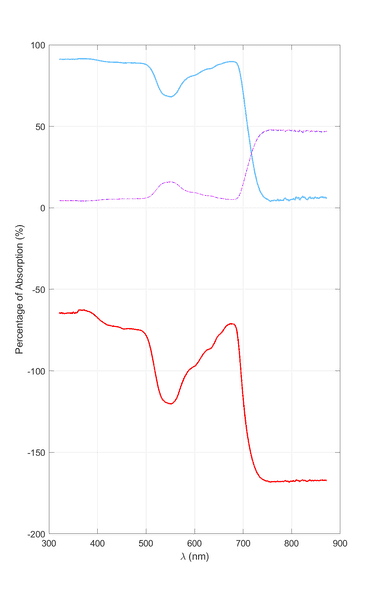
jbBdY1e.png


So, which is the correct method and why? :confused:

Also, using the second approach we get negative values for absorption (on the ordinate of the graph). How is this usually solved in the post-processing?

Any suggestions would be greatly appreciated.
 

Attachments

  • jbBdY1e.png
    jbBdY1e.png
    8.5 KB · Views: 765
Chemistry news on Phys.org
I see. So to plot an absorption spectrum one has to use absorptance (Eq. 1)?

Clearly, absorptance gives the actual amount that is deposited in the material (absorption) by subtracting all the transmitted/reflected/scattered light. I know that absorbance (Eq. 2) is derived by assuming an exponential attenuation. This quantity is described (e.g. in your link) as the density of the material or the amount of attenuation the light receives. Which method would be more appropriate for comparing the absorption characteristics of two different samples?
 
I would always prefer to compare "internal absorbances". The internal absorbance Aint is related to the internal transmittance Tint by
Aint = - log10(Tint).
The internal transmittance is defined as the ratio of the radiant power transmitted by the sample to the incident radiant power, fully corrected for reflection losses and any window absorption. Regarding the spectroscopic nomenclature have a look at Applied Spectroscopy Spectroscopic Nomenclature - SAGE Publishing
 
Last edited:
  • Like
Likes   Reactions: roam

Similar threads

Replies
11
Views
11K
Replies
5
Views
5K
  • · Replies 5 ·
Replies
5
Views
975
  • · Replies 1 ·
Replies
1
Views
2K
Replies
8
Views
5K
  • · Replies 3 ·
Replies
3
Views
15K
  • · Replies 1 ·
Replies
1
Views
2K
  • · Replies 8 ·
Replies
8
Views
2K
  • · Replies 22 ·
Replies
22
Views
4K
  • · Replies 7 ·
Replies
7
Views
3K