Calculation of the mass springs system

Click For Summary

Discussion Overview

The discussion revolves around the simulation of a mass-spring system in Simulink, specifically focusing on a configuration involving two compression springs and a mass subjected to a force. Participants are exploring the correct differential equations to model the system's behavior under various conditions, including the effects of spring compression and the application of force.

Discussion Character

  • Exploratory
  • Technical explanation
  • Debate/contested
  • Mathematical reasoning

Main Points Raised

  • One participant seeks assistance in formulating the correct equations for a mass-spring system with compression springs, indicating uncertainty about their current equation.
  • Another participant suggests that the initial differential equation is incorrect and advises drawing a free body diagram (FBD) and applying Newton's second law.
  • Some participants discuss the implications of using compression springs, noting that if the mass exceeds a certain displacement, one spring may exert no force.
  • There is a proposal to define the forces in each spring as piecewise functions based on the position of the mass, with specific equations provided for different displacement scenarios.
  • One participant expresses confusion regarding the application of Newton's second law and the correct formulation of forces in the FBD.
  • Another participant emphasizes the need for a piecewise definition of the spring forces, challenging the validity of the equations presented for certain displacement conditions.
  • Several participants engage in clarifying the conditions under which the springs operate and the effects of the applied force on the system.
  • One participant acknowledges the limitations of their understanding and seeks further clarification on the equations and concepts discussed.

Areas of Agreement / Disagreement

Participants do not reach a consensus on the correct formulation of the differential equation or the interpretation of the forces involved. Multiple competing views and uncertainties remain regarding the modeling of the system.

Contextual Notes

Participants note the complexity of the system due to the piecewise nature of the spring forces and the conditions under which each spring exerts force. There are unresolved questions about the initial conditions and the effects of the applied force on the system's dynamics.
pierre.sabiy
Messages
13
Reaction score
0
I want to simulate such a system in Simulink.
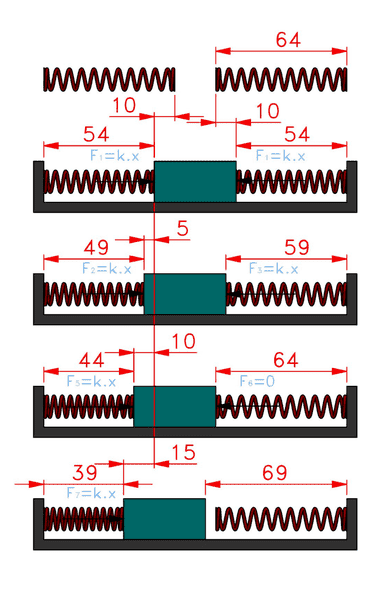
It is a system of mass between two compression, spring preload. Springs are compressed length of 64 mm to 54 mm. Acts on mass shock 50G for 10ms. The coefficient of spring constant is changed depending on the position and direction of movement mass.
But I can not deal with the equation.
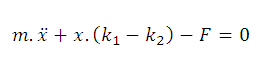
So far I only have such an equation, but probably not correct.
15mn19y.png

how to calculate such a system?
72evc9.png

 
Engineering news on Phys.org
You have the wrong differential equation. Simulink will be of no use until you get the correct DE.

Draw a FBD for the mass and apply Newtons 2nd law.
 
Hi, I have a thought that I have a bad differential equation. I do not know how to start, how do I calculate such a system, see. my picture.
Because if there were extension springs, it would be easy.
However, if used compression springs, so that's then I do not calculate.
 
First, a question: Are these springs attached to the block (so that they can apply tension as well as compression), or are they compression only?

If they apply compression only, then when the displacement of the block exceeds the initial compression, one of the springs will exert zero force. If they are attached to the block, then they can apply tension forces when the displacement would otherwise disengage them.

Start from the beginning by writing the force in each springs as a function of the position of the block. Then write Newton's 2nd law (Sum F = m*a) to get the differential equation.

(Sorry about the type face problems; the system has a mind of its own.)
 
I don't think you have ever said so, but I presume that the two springs are identical, and you did indicate that they operate in compression only. Your top figure shows each spring with a free length of 64 (mm?) and a equilibrium compressed length of 54 mm. Thus the initial compressive force in each spring is k*(10) = 10 k. Consider x to be measured to the right from the equilibrium position of the block. The spring forces are
For left spring ---
FL = k (x-10) for x <= 10
and
FL = 0 for x > 10
For right spring ---
FR = k (x+10) for x >= -10
and
FR = 0 for x < -10
Then the equation of motion is
m*(d2x/d2t) = FL - FR
where FL and FR are given by the piecewise descriptions above.

Notice that for abs(x)<=10, the stiffness is 2*k, for for abs(x)>10 the stiffness drops to simply k.
 
The springs are not permanently connected with the mass, see video

Are the compression springs.
Yes if the mass goes in one direction, a situation arises when one spring would not push the mass, and then vice versa, tells more about the video.
I sorry for having not know good English.
 
video is obviously abbreviated, thus mass will move until it reaches equilibrium, the initial position. for example. friction
 
pierre.sabiy said:
video is obviously abbreviated, thus mass will move until it reaches equilibrium, the initial position. for example. friction
I addressed the disconnection (when abs(x)>10 in my previous reply). Please read it and work through it.
 
Sorry, I do not understand what you wrote. You think this way?
1z5svwz.jpg
 
  • #10
To begin with, take x, d2x/d2t, and the force sum positive in the same direction (positive to the right is the usual convention).

Notice, however, that the spring forces can only be described piecewise, not by a single expression.

Notice also that there is no M.d2x/d2t force, so this should not appear in the FBD. Also, I don't recall there being an F in the original problem statement (no subscript), so this needs to be removed from the FBD as well (unless I have overlooked something).

The equation of motion is, as I wrote it above,
m*(d2x/d2t) = FL - FR
 
  • #11
So once again. Because I'm not even sure if I understand you.
Mass is between two compression springs. Force is applied on the system about the size of 50G for 10ms.
So the way it is right now?
sb0uac.jpg
 
  • #12
You seem to be quite confused on what Newton's Second Law says (have you been drinking d'Alembert?). Newton's Second Law says
M.a = sum of forces
What you have written looks like
M.a + sum of forces = 0 (that confusing d'Alembert stuff!, stay away from it!)
Do you see the difference?

Your FBD should not include an arrow labeled m.x-dot-dot. This is not a force! Only show forces on the FBD.

If you think m.x-dot-dot is a force, ask yourself where the reaction forces is. The third law says that for every force (action) there is an equal and opposite force (action) somewhere in the universe. Where is the reaction to the m.x-dot-dot term? There is not any, not to be found anywhere in the cosmos!

Also, you have written the forces in the form that is valid only for abs(x)<=10. This cannot be strictly correct because the forces require the piecewise definition I gave earlier.
 
  • #13
I edited fig. for better understanding. So the resulting equation is as follows?
34rccau.jpg
 

Attachments

  • 6_1.jpg
    6_1.jpg
    20.7 KB · Views: 591
Last edited by a moderator:
  • #14
Look at your equation and ask yourself, "How can this apply to the 4th figure down where the right-side spring has lost contact with the block?"
 
  • #15
It is true, the fourth image above equations will not apply because we get a negative value. Then what next?
 
  • #16
hi, can not someone help me? I will be grateful for any advice.
 

Similar threads

  • · Replies 1 ·
Replies
1
Views
3K
  • · Replies 2 ·
Replies
2
Views
2K
  • · Replies 2 ·
Replies
2
Views
2K
  • · Replies 4 ·
Replies
4
Views
2K
  • · Replies 16 ·
Replies
16
Views
4K
Replies
5
Views
3K
  • · Replies 4 ·
Replies
4
Views
6K
Replies
4
Views
2K
Replies
17
Views
2K
  • · Replies 9 ·
Replies
9
Views
2K