Calculation the resistance of a spherical shape

Click For Summary
SUMMARY

The discussion focuses on calculating the resistance of nested spherical shells using Ohm's law. The user references the microscopic form of Ohm's law, J = σ_q E, and derives the current I as I = (4πr²)(σ_q E). The potential V is expressed as V = C/r + D, where C and D are constants. The user successfully calculates the resistance R as R = (b-a)/(4πabσ), confirming the solution to their query.

PREREQUISITES
  • Understanding of Ohm's law and its microscopic form
  • Familiarity with electric fields and potential difference
  • Knowledge of spherical coordinates in physics
  • Basic calculus for integration
NEXT STEPS
  • Study the derivation of electric fields in spherical coordinates
  • Learn about the applications of Ohm's law in different geometries
  • Explore advanced topics in electrostatics, such as Gauss's law
  • Investigate the relationship between resistance and material properties in conductors
USEFUL FOR

Physics students, electrical engineers, and anyone interested in understanding the principles of resistance in spherical geometries.

green-fresh
Messages
14
Reaction score
0
hello there!
I was reading about ohm rule in a MIT physics course and they calculate the resistance of a nested spherical shells like this :
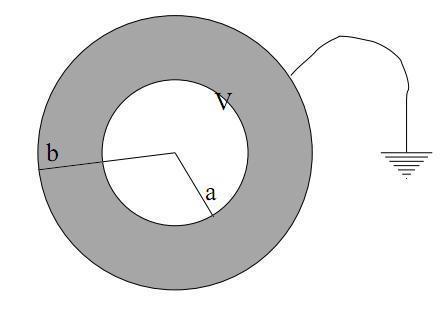
attachment.php?attachmentid=27628&stc=1&d=1282143758.jpg


and they but the microscopic form of ohm's law which is :
J=\sigma_q E
and
I=A J
so
I=(4 \pi r^2 ) (\sigma_q E)
and
E=-\frac{\partial V}{\partial r}
and he said that the potential must be like this form
V=\frac{C}{r}+D
where : C and D are constant .
so my question is what is this form and why he did that and i could calculate the potential easily :
V_{ab}=\int E . dr.
thank you
 

Attachments

  • EasyCapture1.jpg
    EasyCapture1.jpg
    8 KB · Views: 2,517
Physics news on Phys.org
For symmetry, the electric field is directed radially. Since there are no charges inside the conductor, the flux

\Phi=4\pi r^2 E

must be constant. The difference of potential between a and b is

\Delta V=\int_a^b\frac{\Phi dr}{4\pi r^2}=\frac{\Phi(b-a)}{4\pi ab}.

But, as you said, I=\sigma\Phi, so

\Delta V=\frac{I(b-a)}{4\pi ab\sigma}\equiv RI

and hence

R=\frac{(b-a)}{4\pi ab\sigma}
 
thank you i think it is solved now .
 

Similar threads

Replies
4
Views
2K
  • · Replies 2 ·
Replies
2
Views
2K
  • · Replies 19 ·
Replies
19
Views
3K
  • · Replies 3 ·
Replies
3
Views
2K
  • · Replies 1 ·
Replies
1
Views
2K
  • · Replies 3 ·
Replies
3
Views
546
Replies
44
Views
4K
  • · Replies 10 ·
Replies
10
Views
2K
  • · Replies 8 ·
Replies
8
Views
1K
  • · Replies 9 ·
Replies
9
Views
2K