Camshaft design from wanted torque

  • Thread starter Thread starter gogogsr
  • Start date Start date
  • Tags Tags
    Design Torque
Click For Summary
SUMMARY

The forum discussion centers on designing a camshaft for a test jig that simulates a train caliper, requiring precise torque at various degrees of rotation. The user is attempting to create a cam with an eccentric roller follower and die spring but is struggling with the pressure angle, which is significantly lower than expected, resulting in inadequate torque. The conversation highlights the importance of smooth cam profiles and suggests that the torque curve may need to be interpreted as a displacement diagram for the spring attachment point. A request for a sketch of the system is made to clarify the design challenges.

PREREQUISITES
  • Understanding of camshaft design principles
  • Knowledge of torque and pressure angle calculations
  • Familiarity with eccentric roller followers and die springs
  • Basic skills in mechanical system sketching
NEXT STEPS
  • Research camshaft design software tools for simulation
  • Learn about torque curve analysis and its application in cam design
  • Explore methods for ensuring smooth cam profiles
  • Investigate techniques for calculating pressure angles in cam mechanisms
USEFUL FOR

Mechanical engineers, designers of cam mechanisms, and anyone involved in the development of test jigs requiring precise torque control.

gogogsr
Messages
9
Reaction score
0
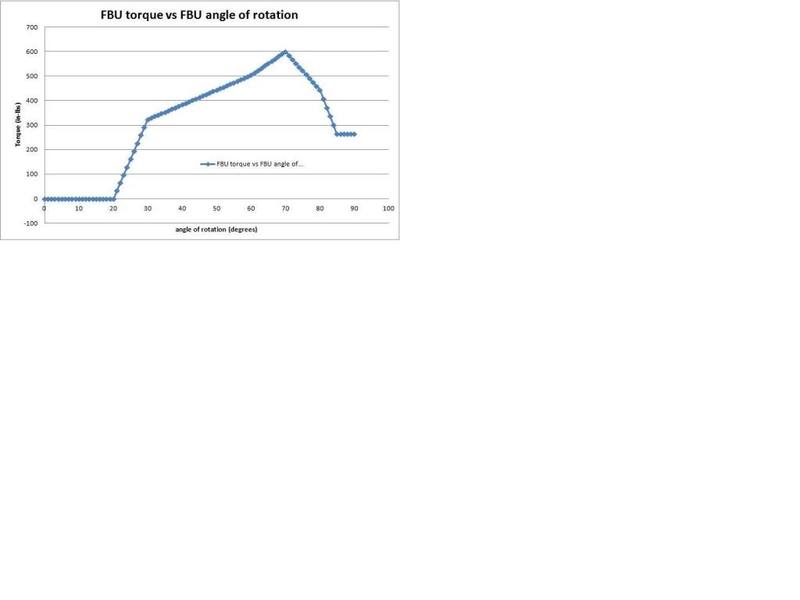
Hey guys, I'm making a test jig that needs to simulate a train caliper. The test jig consist of an arm that rotates 90 degrees. The jig must give a certain amount of torque at every degrees (see graph below). I was thinking on making a cam with an eccentric roller follower and die spring. The thing is I'm having a hard time to design the cam from the torque values. I've been able to simulate a sliding cam easily but when it comes to a radial cam its a lot more tricky, everything works with my calculations, except the pressure angle which is almost always 10 time smaller, so the torque is way less then wanted. I'm not sure if i need to determine the envelop of the cam depending on the previous point calculated or not.Any help would be appreciated.

Thanks guys
torquegraph.jpg
 
Engineering news on Phys.org
If I have read your message correctly, we make interpret the torque curve you gave as the required displacement for the spring attachment point on the cam follower since that will generate the strain in the spring to create the force. Thus, with a different scale, this is a cam displacement diagram, for some point on the cam follower.

This presents problems right away in looking at the curve because it has a discontinuous derivative a several locations. This is difficult to do with a cam; cams are inherently smooth devices.

May I suggest that you include a sketch of your entire system if you want further help? It is not very clear what you are trying to accomplish here.
 
i will try to post a sketch tomorrow, thanks for the reply
 

Similar threads

  • · Replies 9 ·
Replies
9
Views
5K
Replies
4
Views
1K
Replies
13
Views
2K
  • · Replies 9 ·
Replies
9
Views
2K
  • · Replies 2 ·
Replies
2
Views
1K
  • · Replies 58 ·
2
Replies
58
Views
8K
  • · Replies 5 ·
Replies
5
Views
5K
  • · Replies 19 ·
Replies
19
Views
12K
  • · Replies 9 ·
Replies
9
Views
5K
  • · Replies 2 ·
Replies
2
Views
2K