Can all bending moments be represented by force couples?

Click For Summary

Discussion Overview

The discussion revolves around whether all bending moments can be represented as force couples, particularly in the context of mechanics and structural engineering. Participants explore the definitions and implications of bending moments in both symmetric and non-symmetric members, as well as the mathematical underpinnings of these concepts.

Discussion Character

  • Debate/contested
  • Technical explanation
  • Mathematical reasoning

Main Points Raised

  • One participant notes that bending moments arise from uneven stress distributions and suggests that they can be represented as force couples, questioning the applicability of this representation to non-symmetric members.
  • Another participant asserts that any bending moment is equivalent to a couple, emphasizing that the internal nature of the moment does not alter this equivalence.
  • A reference to a Wikipedia page on couples in mechanics is provided, though its relevance is not elaborated upon.
  • A later reply introduces a distinction between different definitions of moments, arguing that not all moments are couples, particularly when considering their dependence on the origin.
  • This participant also raises a mathematical expression for bending moments in beams and posits that in this context, bending moments can indeed be considered true couples, implying origin independence.

Areas of Agreement / Disagreement

Participants express differing views on whether all bending moments can be classified as couples. While some assert that they can, others introduce conditions and definitions that complicate this assertion, indicating that the discussion remains unresolved.

Contextual Notes

The discussion highlights the dependence on definitions of moments and the implications of symmetry in members, which may affect the classification of bending moments as couples. There are unresolved mathematical considerations regarding the origin dependence of moments.

etotheipi
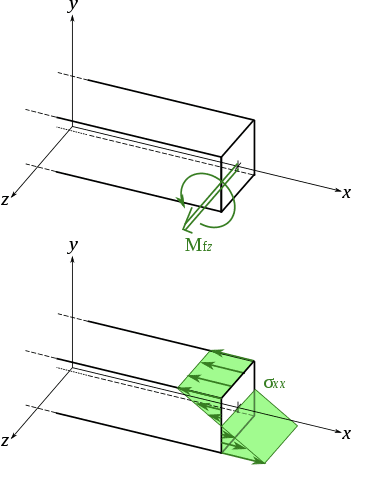
A bending moment about an axis passing through a cross section arises due to an uneven distribution of stress across the cross section, like so:
1589185055897.png


I have read that any given bending moment is equivalent to a force couple applied about that axis. That is to say that the curly moment arrow on a FBD represents a force couple producing a moment. The upshot is that the moment of a couple is the same about any parallel axis, which can be useful for problem solving.

However, one engineering reference page said this
Thus, the internal forces in any cross section of a symmetric member in pure bending are equivalent to a couple.

I don't see why the internal forces on a non-symmetric member would not be equivalent to a couple? I wondered if you would agree? Thanks!
 
Engineering news on Phys.org
A moment is a couple. The fact that the particular bending moment is internal to a member does not change that fact. Thus the answer is, yes, any bending moment is equal to a couple.
 
This thread is very old! However...
Dr.D said:
A moment is a couple.
depends on how you have defined 'moment'. A moment ##\mathbf{M} = \boldsymbol{x} \times \mathbf{F}## is not a couple (and it is origin dependent), whilst a moment ##\mathbf{M} = \boldsymbol{x}_1 \times \mathbf{F} + \boldsymbol{x}_2 \times (-\mathbf{F})## is a couple.

The question I think I was really asking is: the bending moment in a beam is given by$$M_y = \frac{E}{R} \int x^2 df$$and we wonder whether it is a true 'couple', i.e. whether it's origin independent. And I think the answer to that is in this case, for a bending moment a beam, yes.
 

Similar threads

  • · Replies 1 ·
Replies
1
Views
2K
  • · Replies 11 ·
Replies
11
Views
3K
Replies
5
Views
3K
Replies
2
Views
2K
  • · Replies 8 ·
Replies
8
Views
2K
  • · Replies 1 ·
Replies
1
Views
2K
  • · Replies 3 ·
Replies
3
Views
4K
  • · Replies 11 ·
Replies
11
Views
3K
  • · Replies 8 ·
Replies
8
Views
9K
  • · Replies 5 ·
Replies
5
Views
2K