Can anyone help check where I went wrong (Potential of electrodynamics)?

  • Thread starter Thread starter Tony Hau
  • Start date Start date
  • Tags Tags
    Electrodynamics
Click For Summary
SUMMARY

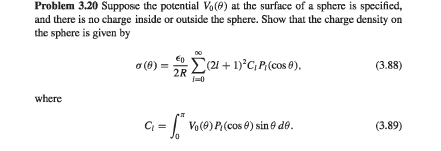
The forum discussion centers on a problem from Griffiths' book on electrodynamics regarding the calculation of electrical potential and charge density on a sphere. The user presented an incorrect solution for the surface charge density, $$\sigma(\theta) = \frac {\epsilon_0} {2R} \sum_{l=0}^\infty (2l+1)(-l-1)C_1P_l (cos \theta)$$, while the correct expression is $$\sigma(\theta) = \frac {\epsilon_0} {2R} \sum_{l=0}^\infty (2l+1)^{2}C_1P_l (cos \theta)$$. Key errors identified include the assumption that the potential inside the sphere is constant and the failure to apply the correct boundary conditions, which are crucial for determining the charge density accurately.

PREREQUISITES
  • Understanding of Griffiths' "Introduction to Electrodynamics" concepts
  • Familiarity with spherical harmonics and Legendre polynomials
  • Knowledge of boundary conditions in electrostatics
  • Proficiency in LaTeX for mathematical notation
NEXT STEPS
  • Study the derivation of the general expression for surface charge density in electrostatics
  • Learn about the application of boundary conditions in potential problems
  • Review the properties and applications of Legendre polynomials in physics
  • Practice writing complex equations in LaTeX to improve efficiency
USEFUL FOR

Students and professionals in physics, particularly those focusing on electrodynamics, as well as educators looking to clarify concepts related to electric potential and charge distribution on conductors.

Tony Hau
Messages
107
Reaction score
30
Summary:: So this is a question from Griffiths' book on electrodynamics. The topic is on electircal potential. I have come up with a solution to a problem; the solution is wrong but I cannot spot the mistake.

So here is the question:
1598277999661.png


My answer to this question is: $$\sigma( θ ) = \frac {\epsilon_0} {2R} \sum_{l=0}^\infty (2l+1)(-l-1)C_1P_l (cos \theta) \text { whereas the solution in the textbook is } \frac {\epsilon_0} {2R} \sum_{l=0}^\infty (2l+1)^{2}C_1P_l (cos \theta)$$
The step is as follows:

Potential outside the sphere is $$V_{out} =\sum_{l=0}^\infty \frac {B_l} {r^{l+1}} \ P_l (cos \theta) $$

Potential inside the sphere is equal to ##V_o(\theta)##, on the grounds that a metal conductor has a constant potential inside it.

At ##r=R##, $$V_{out} =\sum_{l=0}^\infty \frac {B_l} {R^{l+1}} \ P_l (cos \theta) = V_o(\theta) $$

Multiplying both sides by ##P_{l^{'}}cos(\theta)sin(\theta)d\theta## and integrate from ##0## to ##\pi##, we get $$\sum_{l=0}^\infty \frac {B_l} {R^{l+1}} \int_0^\pi P_{l^{'}}cos(\theta)P_{l}cos(\theta)sin(\theta)d\theta = \int_0^\pi V_o(\theta)P_{l^{'}}cos(\theta)sin(\theta)d\theta$$.

Because $$\int_0^\pi P_{l^{'}}cos(\theta)P_{l}cos(\theta)sin(\theta)d\theta =
\begin{cases}
0 & \text{if } l \neq l^{'} \\
\frac{2} {2l+1}\ & \text{if } l = l^{'}
\end{cases}
$$

$$B_{l} = \frac {(2l+1)R^{l+1}}{2}\ \int_0^\pi V_o(\theta)P_{l^{'}}cos(\theta)sin(\theta)d\theta$$.
Therefore, $$V_{out} =\sum_{l=0}^\infty \frac {(2l+1)R^{l+1}}{2r^{l+1}}\ \int_0^\pi V_o(\theta)P_{l^{'}}cos(\theta)sin(\theta)d\theta P_{l}cos(\theta)$$
$$ =\sum_{l=0}^\infty \frac {(2l+1)R^{l+1}}{2r^{l+1}}\ C_{1} P_{l}cos(\theta)$$

The charge density at the surface is given by: $$\sigma(\theta)\ = (\frac {\partial V_{out}} {\partial r} - \frac {\partial V_{in}} {\partial r})\epsilon_o \text{ }at \text{ } r=R$$

The derivative of ##V_{in}\text{ } is \text{ }0##. Therefore, $$\sigma(\theta)\ = \epsilon_o\sum_{l=0}^\infty \frac{\partial}{\partial r}\frac {(2l+1)R^{l+1}}{2r^{l+1}}\ C_{1} P_{l}cos(\theta)$$
$$= \epsilon_o\sum_{l=0}^\infty (-l-1)\frac {(2l+1)R^{l+1}}{2r^{l+2}}\ C_{1} P_{l}cos(\theta)$$
Therefore, at ##r=R##, $$\sigma(\theta)\ = \epsilon_o\sum_{l=0}^\infty (-l-1)\frac {(2l+1)R^{l+1}}{2R^{l+2}}\ C_{1} P_{l}cos(\theta)$$
$$ = \frac {\epsilon_0} {2R} \sum_{l=0}^\infty (2l+1)(-l-1)C_1P_l (cos \theta) $$

What is wrong with the steps?By the way, this is my first time using LaText. The process is time consuming and I do not understanding why simply uploading a picture of my steps is prohibited; I have to write in Latex, which has costed me more than an hour.[Moderator's note: Moved from a technical forum and thus no template.]
 
Last edited by a moderator:
Physics news on Phys.org
Correct me if I'm wrong but I think ##V_o(\theta)## is not one constant but a function that varies with theta but you set it as a constant value inside the whole sphere. Also, the problem doesn't state the sphere is metal and it can't be if the potential or charge varies across the surface.
 
  • Like
Likes   Reactions: Tony Hau
Tony Hau said:
By the way, this is my first time using LaText. The process is time consuming and I do not understanding why simply uploading a picture of my steps is prohibited; I have to write in Latex, which has costed me more than an hour.
Have you considered how much time a reader spends trying to decipher posted pictures with bad handwriting, tiny characters, poor contrast, badly lit, posted sideways, etc. etc? Now multiply this by a factor of 50 to 100 which is a typical number of views. I think you will get more than one hour for the collective wasted time. The bottom line is that people are less willing to help one if one's post is hard to read and understand. When you get used to it, you will be able to write equations in LaTeX much more quickly than now.
 
  • Like
Likes   Reactions: Delta2 and Tony Hau
Tony Hau said:
By the way, this is my first time using LaText. The process is time consuming and I do not understanding why simply uploading a picture of my steps is prohibited; I have to write in Latex, which has costed me more than an hour.
Pictures are usually: in the wrong orientation, must be downloaded and processed, are unreadable due to a bad hand writing, are unreadable due to lack of light, are unreadable due to flash light, are too small etc.

Choose one.

Most students have to learn LaTeX sooner or later anyway, and if someone posts more often, then there are a few tricks to speed up the process. And last but not least my favorite reason:

Why should anyone spend more effort in an answer than the questioner put into ask?
 
Last edited:
  • Like
Likes   Reactions: vela, hutchphd, Tony Hau and 1 other person
Factor in the cost of a tutor for an hour. What is it these days $50 to $100? At PF you get free tutoring in effect so be grateful...:smile:
 
bob012345 said:
Factor in the cost of a tutor for an hour. What is it these days $50 to $100? At PF you get free tutoring in effect so be grateful...:smile:
I think you are right. Thanks anyway!
 
What does it mean in the moderator's note? Can someone explain?
 
bob012345 said:
Correct me if I'm wrong but I think ##V_o(\theta)## is not one constant but a function that varies with theta but you set it as a constant value inside the whole sphere. Also, the problem doesn't state the sphere is metal and it can't be if the potential or charge varies e surface.
Thanks for your reply. May I ask where I have set ##V_o(\theta)## as a constant?
But anyway, I guess the assumption that ##\frac{\partial V_{out}}{\partial r} = 0## is invalid as it is not specifically stated that it is a metal sphere.
 
Last edited by a moderator:
Tony Hau said:
What does it mean in the moderator's note? Can someone explain?
Yes. I moved the thread from a technical forum to this homework forum which is what they are for: textbook exercises of all kind. However, the homework forum requires to fill out a template and show some own effort. As you did so, I could move it. But the design is different. My note in the first post should tell others that a mentor has had a look on it and it isn't necessary to "report" the thread because something doesn't look like it should. It also shall prevent other mentors from moving it back again, since some questions could be in either forum, so this moving game could go on forever. The note is meant to avoid this.
 
  • Like
Likes   Reactions: Tony Hau
  • #10
Tony Hau said:
Thanks for your reply. May I ask where I have set ##V_o(\theta)## as a constant?
Where you wrote;

"Potential inside the sphere is equal to ##V_o(\theta)## , on the grounds that a metal conductor has a constant potential inside it."

It seemed like you were making that assumption.
 
  • Like
Likes   Reactions: Tony Hau
  • #11
You also asserted that
Tony Hau said:
The derivative of ##V_{in}\text{ } is \text{ }0.##
Why is that? Assume that the surface charges are pasted on the sphere. You have to write the potential inside also and apply the correct boundary conditions.
 
  • #12
kuruman said:
You also asserted that

Why is that? Assume that the surface charges are pasted on the sphere. You have to write the potential inside also and apply the correct boundary conditions.
I thought it was a metal sphere. Therefore, the potential inside it should be constant and its derivative is 0. Of course, if it was not a metal sphere, I need to write down the boundary conditions to get the potential inside the sphere.
 
  • #13
Tony Hau said:
I thought it was a metal sphere. Therefore, the potential inside it should be constant and its derivative is 0.
If it were a metal sphere, the potential would indeed be constant on the surface and inside. We are told that the surface of the sphere is not an equipotential because the surface potential depends on angle ##\theta##. Therefore the sphere cannot be a conductor.
 
  • Like
Likes   Reactions: Delta2 and Tony Hau
  • #14
Here is the correct solution from the textbook:

The general equation of charge density ##\sigma## of a charged sphere with radius ##R## is: $$\sigma(\theta)=\epsilon_o \sum_{l=0}^\infty (2l+1)A_lR^{l-1}P_l(\cos\theta)$$

The general equation for the term ##A_l## is: $$A_l=\frac{2l+1}{2R^l}\int_{0}^{\pi}V_o(\theta)P_l(\cos\theta)\sin(\theta)d\theta$$

Substituting ##A_l## into ##\sigma(\theta)##, we get:$$\sigma(\theta)=\epsilon_o\sum_{l=0}^{\infty}\frac{(2l+1)^{2}R^{l-1}}{2R^l}\int_0^{\pi}V_o(\theta)P_l(\cos\theta)\sin(\theta)d{\theta}P_l(\cos\theta)$$
$$=\frac{\epsilon_o}{2R}\sum_{l=o}^{\infty}(2l+1)^2C_lP_l(\cos\theta)$$
 
  • Like
Likes   Reactions: bob012345
  • #15
I think you are confusing your generals a bit. This is what I would say.
The general expressions for the potentials inside and outside are $$V_{in}(r,\theta)=\sum_{l=0}^\infty A_lr^{l}P_l(\cos\theta)~;~~~V_{out}(r,\theta)=\sum_{l=0}^\infty \frac{B_l}{r^{l+1}}P_l(\cos\theta)$$ When one applies the boundary conditions $$V_{out}(R,\theta)=V_{in}(R,\theta)=V_0(\theta)~~\text{and}~~\left. \left(\frac{\partial V_{out}}{\partial r}-\frac{\partial V_{in}}{\partial r}\right)\right|_{r=R}=-\frac{\sigma(\theta)}{\epsilon_0},$$one gets the general expression for the surface charge density
$$\sigma(\theta)=\frac{\epsilon_0}{2R}\sum_{l=0}^{\infty}(2l+1)^2C_lP_l(\cos\theta)~~\text{where}~~C_l\equiv \int_0^{\pi}V_0(\theta')P_l(\cos\theta')\sin\theta'd{\theta'}.$$
 
  • Like
Likes   Reactions: Tony Hau and hutchphd
  • #16
kuruman said:
I think you are confusing your generals a bit. This is what I would say.
The general expressions for the potentials inside and outside are $$V_{in}(r,\theta)=\sum_{l=0}^\infty A_lr^{l}P_l(\cos\theta)~;~~~V_{out}(r,\theta)=\sum_{l=0}^\infty \frac{B_l}{r^{l+1}}P_l(\cos\theta)$$ When one applies the boundary conditions $$V_{out}(R,\theta)=V_{in}(R,\theta)=V_0(\theta)~~\text{and}~~\left. \left(\frac{\partial V_{out}}{\partial r}-\frac{\partial V_{in}}{\partial r}\right)\right|_{r=R}=-\frac{\sigma(\theta)}{\epsilon_0},$$one gets the general expression for the surface charge density
$$\sigma(\theta)=\frac{\epsilon_0}{2R}\sum_{l=0}^{\infty}(2l+1)^2C_lP_l(\cos\theta)~~\text{where}~~C_l\equiv \int_0^{\pi}V_0(\theta')P_l(\cos\theta')\sin\theta'd{\theta'}.$$
Thanks. Your explanation is super clear.
 
  • Like
Likes   Reactions: kuruman
  • #17
Tony Hau said:
Thanks. Your explanation is super clear.
Thank LaTeX for that. :oldsmile:
 
  • Like
Likes   Reactions: Tony Hau

Similar threads

Replies
6
Views
3K
  • · Replies 5 ·
Replies
5
Views
2K
  • · Replies 16 ·
Replies
16
Views
4K
Replies
6
Views
4K
Replies
10
Views
3K
Replies
13
Views
3K
Replies
3
Views
2K
Replies
2
Views
2K
  • · Replies 21 ·
Replies
21
Views
2K