Can Electromagnetic Fields Generate Net Thrust with a Metal Plate?

Click For Summary

Discussion Overview

The discussion centers around the possibility of generating net thrust using electromagnetic fields in conjunction with a metal plate, specifically exploring configurations involving solenoids and radiation pressure. The scope includes theoretical considerations of propulsion methods and the mechanics of electromagnetic interactions.

Discussion Character

  • Exploratory
  • Debate/contested
  • Technical explanation

Main Points Raised

  • Some participants reference radiation pressure and its potential application to propulsion, questioning whether a solenoid and metal plate can achieve net thrust.
  • One participant suggests that generating electromagnetic radiation directed away from a craft could function similarly to a photon rocket, emphasizing the need for momentum conservation.
  • Another participant provides calculations related to photon rockets, noting the low thrust-to-power ratio and the impracticality of such systems for propulsion.
  • A participant proposes a specific configuration where solenoids and metal plates are fixed together, questioning if a pulsating magnetic field could provide upward thrust.
  • Concerns are raised about the discussion of "Reactionless Drives," which are deemed a forbidden topic, indicating a boundary on the types of propulsion methods considered acceptable for discussion.

Areas of Agreement / Disagreement

Participants express differing views on the feasibility of using electromagnetic fields for propulsion, with some supporting the idea of photon rockets while others highlight the limitations and challenges. The discussion remains unresolved regarding the specific configurations proposed and their potential for generating thrust.

Contextual Notes

Limitations include the dependence on assumptions about the behavior of electromagnetic fields and the specific configurations of solenoids and plates. The discussion also reflects a lack of consensus on the validity of certain propulsion concepts, particularly those related to reactionless drives.

StoyanNikolov
Messages
50
Reaction score
0
while browsing for new propulsion methods I found the following interesting:
https://en.wikipedia.org/wiki/Radiation_pressure

"Radiation pressure (also known as light pressure) is the mechanical pressure exerted upon any surface due to the exchange of momentum between the object and the electromagnetic field.
This includes the momentum of light or electromagnetic radiation of any wavelength that is absorbed, reflected, or otherwise emitted (e.g. black-body radiation) by matter on any scale (from macroscopic objects to dust particles to gas molecules)."
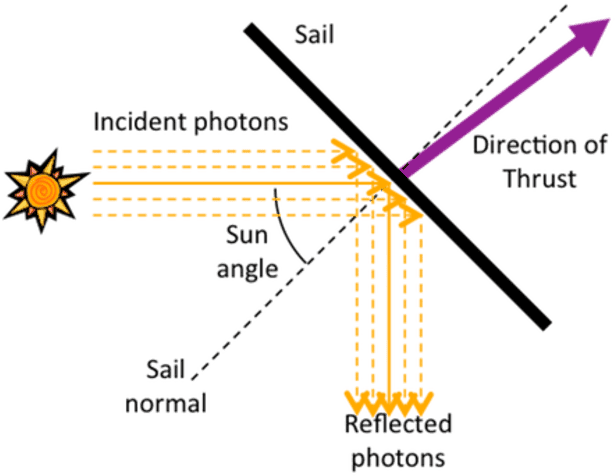
g3clC.png
So my question is: If a solenoid and a metal plate are attached together and they replace the light with an electromagnetic field from a solenoid, is it possible to have net thrust as shown in picture below? (Eddy current Repulsion Magnetic field from Solenoid and Metal Plate):
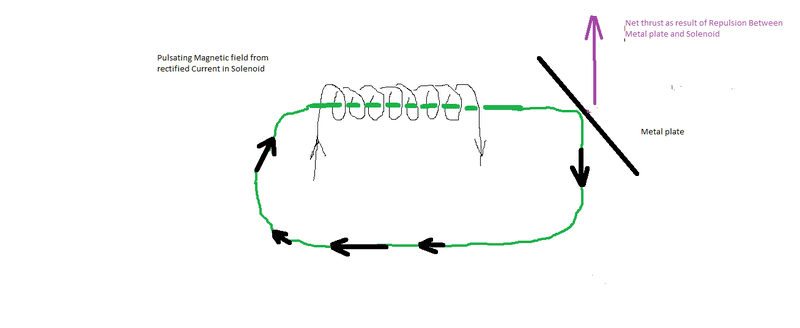
yCXsT.png


Perhaps it is better to Consider 2 cases :
Case 1 : Source of Light and Reflector plate attached together . Will there be Net Unidirectional thrust ?
Case 2 : Source of Magnetic field or Antenna and Metal reflector plate attached together . Will there be Net Unidirectional thrust ?
 
Physics news on Phys.org
If you generate EM and direct it away from the craft (whether it bounces off the metal plate in the process or not), you effectively have a Photon Rocket:

https://en.wikipedia.org/wiki/Photon_rocket

If you generate an oscillating magnetic field that generates Eddy Currents in the plate, you are losing energy to heating the plate and the plate will do a poor job of reflecting that oscillating EM energy.

Note that in these schemes, the photons/EM have to leave the craft, so that momentum is conserved in providing propulsion to the craft. If you do all of this inside the craft and no photons/EM leave the craft, then by Conservation of Momentum there can be no net thrust. Discussions and debunking of such "Reactionless Drives" are not allowed at PF.
 
Last edited:
Your Case 1 describes a photon rocket. When you emit light, there is a reaction force. A mirror changes the direction of the force, but not the magnitude. We can do a simple calculation to find the usefulness of a photon rocket.

Sunlight at 1 AU has radiation pressure of 4.5 microNewtons per square meter, and a power of 1.3 kW per square meter. We need about 4.5 kW to generate that much light, so a photon rocket would get about 1 microNewton of thrust per kilowatt of power. Or 1 milliNewton per megawatt. Or 1 Newton per gigawatt.

A one gigawatt nuclear power plant takes up one square mile of land, and weighs many thousands (or more likely millions) of tons. All that to generate one newton of thrust, and explains why nobody has built a photon rocket.

I'm sure that a similar calculation applies to a directional radio beam, but will leave that for somebody that actually knows how to do the calculation.
 
  • Like
Likes   Reactions: Astronuc and berkeman
How about the configuration on the attached Picture.
Please consider Both Metal plates and Both Solenoids are attached together, so there is no possible movement between them.
They can move only as a whole/attached together.

The magnetic field from Current carrying Solenoids is Pulsating , but
The North poles of Both Solenoids are always Pointing toward Metal plates (Please consider them to be perfect conductor).

In this case the Pulsating magnetic field/EM field will be the "Propellant".

Will there be "upward" (On the attached picture) net thrust ?
Thank you.
Propulsion.png
 
Thread is closed for Moderation...
 
StoyanNikolov said:
How about the configuration on the attached Picture.
Please stop trying to post about Reactionless Drive configurations. You know by now that the subject is considered a Forbidden Topic at PF. Please re-read Post #2 above.

This thread will remain closed. Have a nice day.
 
Last edited:
  • Like
Likes   Reactions: Bystander

Similar threads

  • · Replies 2 ·
Replies
2
Views
2K
  • · Replies 45 ·
2
Replies
45
Views
11K
  • · Replies 2 ·
Replies
2
Views
2K
  • · Replies 14 ·
Replies
14
Views
3K
  • · Replies 8 ·
Replies
8
Views
4K
Replies
1
Views
2K
  • · Replies 2 ·
Replies
2
Views
2K
Replies
1
Views
2K
  • · Replies 22 ·
Replies
22
Views
4K
Replies
6
Views
4K