Can Energy Conservation Solve the Angular Velocity Problem?

6 replies · 2K views · last reply
nafisanazlee
Messages
20
Reaction score
2
Homework Statement
A 10g small ball with negligible radius is moving with a constant velocity of 9m/s. there is a disk with center O that can move freely relative to the center. The small ball is moving in a line which has a perpendicular distance of 2m from the center O. Eventually the ball hits the disk and sticks to it. The disk has a mass of 40g and radius of 3m. What's the angular velocity of the disk after the collision?
Relevant Equations
Initial angular momentum= Final angular momentum
Let the mass of the ball m₁ and the disk m₂
m₁vrsinθ = I₁ω + Ι₂ω
I₁ = m₁r² and I₂ = ½m₂r², r=3m, rsinθ = 2m.
Is this a correct approach? if not, what is? Can this be solved using energy conservation?
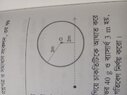
 
Angular momentum conservation is the correct approach. Energy conservation is not because the collision is perfectly inelastic. What angle is ##\theta##? Please provide a diagram should you need additional help.
 
  • Like
Likes   Reactions: nafisanazlee
kuruman said:
Angular momentum conservation is the correct approach. Energy conservation is not because the collision is perfectly inelastic. What angle is ##\theta##? Please provide a diagram should you need additional help.
no theta is given, that's just the perpendicular distance 2m. Can you check if my solution is correct?
 
Attachments
  • Diagram of a circle with centre O, a radius of 3 m drawn to the rim, and a horizontal dashed line with an arrow at the right and a dot below. A perpendicular distance of 2 m is marked from O to the dashed line.
    17243378780078259566468749810071.jpg
    32.7 KB · Views: 114
nafisanazlee said:
no theta is given, that's just the perpendicular distance 2m. Can you check if my solution is correct?
Thank you for your diagram. I will be happy to check your solution when you provide it. The problem is asking you for the angular velocity of the disk after the collision. I don't see an equation in the form ##\omega = \dots~~## in what you have posted so far.
 
Last edited:
kuruman said:
Thank you for your diagram. I will be happy to check your solution when you provide it. The problem is asking you for the angular velocity of the disk after the collision. I don't an equation in the form ##\omega = \dots~~## in what you have posted so far.
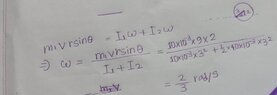
here's the solution I came up with
 
Attachments
  • Handwritten derivation of angular velocity: m1 v r sinθ = I1 ω + I2 ω, then ω = m1 v r sinθ / (I1 + I2), substituted with 10×10⁻³×9×2 over 10×10⁻³×3² + ½×40×10⁻³×3², giving ω = 2/3 rad/s, with a struck-out line below.
    IMG_20240822_221238.jpg
    15.9 KB · Views: 102
That looks correct. If you plan to post here often, please use LaTeX for your equation. To learn how, click on "LaTeX Guide", lower left above "Attach files."
 
  • Like
Likes   Reactions: nafisanazlee
kuruman said:
That looks correct. If you plan to post here often, please use LaTeX for your equation. To learn how, click on "LaTeX Guide", lower left above "Attach files."
Thanks so much!