Can I get a clarification on my misunderstanding of SR?

  • Context: Undergrad 
  • Thread starter Thread starter funnyman634
  • Start date Start date
  • Tags Tags
    Sr
Click For Summary

Discussion Overview

The discussion centers around a participant's misunderstanding of special relativity (SR), particularly regarding the constancy of the speed of light across different reference frames. The scope includes theoretical reasoning and mathematical reasoning related to time dilation and the Lorentz transformation.

Discussion Character

  • Exploratory
  • Technical explanation
  • Debate/contested
  • Mathematical reasoning

Main Points Raised

  • One participant describes a scenario involving three objects to illustrate the constancy of the speed of light and questions why their calculations yield a different time than expected from the Lorentz factor.
  • Another participant challenges the initial setup, suggesting that the full Lorentz transform should be used instead of shortcuts, indicating that the participant's reasoning may be flawed.
  • Some participants point out the omission of distance contraction in the moving frame, suggesting that this is crucial for arriving at the correct answer.
  • There is a suggestion to consider the scenario from the perspective of the moving object (B) rather than remaining in the stationary frame (A).
  • One participant expresses a desire to rely on intuition rather than formal transformations, leading to a discussion about the nature of intuition in learning physics.
  • Another participant argues that intuition can lead to false conclusions, emphasizing the importance of studying actual physics rather than relying solely on intuitive reasoning.
  • There is a debate about the relevance of pop science in the context of the discussion, with some participants asserting that the OP's approach is not based on pop science but rather on a genuine attempt to understand SR.
  • One participant critiques the idea of starting with intuition, arguing that intuition develops through repeated practice and experience, rather than being an initial starting point.

Areas of Agreement / Disagreement

Participants express differing views on the use of intuition versus formal methods in understanding special relativity. There is no consensus on the best approach to resolve the misunderstanding, and multiple competing views remain regarding the application of the Lorentz transformation and the role of intuition in learning physics.

Contextual Notes

Some participants highlight the importance of considering different reference frames and the implications of distance contraction, which may not have been fully addressed in the initial reasoning. The discussion reflects a variety of assumptions and interpretations regarding the principles of special relativity.

funnyman634
Messages
2
Reaction score
1
When I think of the speed of light being constant for all reference frames, I imagined the scenario in the picture below to exemplify it. Object A is always at rest, object B is moving at half the speed of light along the only given axis, and object C is a light particle moving at the speed of light along the only given axis. The objects are placed at different heights in the image only for visual clarity, so a 1D scenario. The frame on the left is t = 0 (say t is for object A and t' for object B) the objects are all at rest (I know object C can never be at rest if it's a light particle, but then let's just assume it comes into existence the moment the scenario begins). We start the simulation and then freeze it after a second has past, t = 1, the frame on the right. I solve for t' (the amount of time object B felt has passed) based on what has occurred. Why do I get 0.5 seconds and not what the Lorentz factor says I should get, 0.86602540378 seconds ? (1 / gamma or 1 / 1.15470053837925)
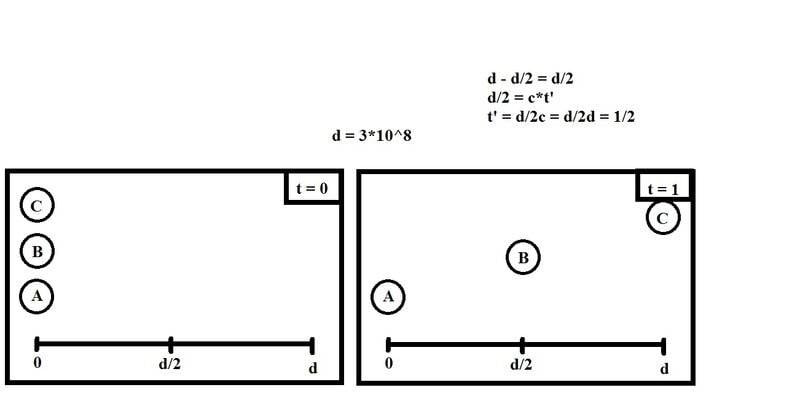
Lorentz factor.jpg
 
Physics news on Phys.org
funnyman634 said:
Why do I get 0.5 seconds and not what the Lorentz factor says I should get, 0.86602540378 seconds ?
Where did you come up with ##d/2=ct’##? That isn’t right.

You should use the full Lorentz transform at first. Only use shortcuts once you understand the full transform.
 
You forgot distance contraction in B's rest frame. In this problem, as you've set it up, that's all you need to get the right answer.
 
funnyman634 said:
Those two diagrams are drawn in the reference frame of A. Why not draw two diagrams in the reference frame of B?
 
Dale said:
Where did you come up with ##d/2=ct’##? That isn’t right.

You should use the full Lorentz transform at first. Only use shortcuts once you understand the full transform.
I do not want to use the Lorentz transform, I want to see where my intuition goes, and then see why the intuition is wrong, and then alter the intuition and try again with only intuition.

##d/2## is the distance between B and C in A's frame after 1 second in A's frame. If we know in general that ##distanceTraveled = timePassed * velocity## and I know the distance between B and C to be ##0## when ##t = 0## and ##d/2## when ##t = 1## in A's frame, and I also assume ##c## is constant, why can't I setup the equation as shown, which shows ##t'## to be .5 after the algebra?
 
funnyman634 said:
##d/2## is the distance between B and C in A's frame after 1 second in A's frame. If we know in general that ##distanceTraveled = timePassed * velocity## and I know the distance between B and C to be ##0## when ##t = 0## and ##d/2## when ##t = 1## in A's frame, and I also assume ##c## is constant, why can't I setup the equation as shown, which shows ##t'## to be .5 after the algebra?
The simple answer is that you haven't transformed the scenario to the frame of B. You've done it only half-heartedly - keeping all your diagrams in A's frame; using measurements in A's frame; and, only grudgingly, given any consideration to what B might measure!

If I were B I might object that you have been very reluctant to abandon A's point of view! You're not looking at it sufficiently from B's point of view!
 
funnyman634 said:
I do not want to use the Lorentz transform, I want to see where my intuition goes, and then see why the intuition is wrong, and then alter the intuition and try again with only intuition.

##d/2## is the distance between B and C in A's frame after 1 second in A's frame. If we know in general that ##distanceTraveled = timePassed * velocity## and I know the distance between B and C to be ##0## when ##t = 0## and ##d/2## when ##t = 1## in A's frame, and I also assume ##c## is constant, why can't I setup the equation as shown, which shows ##t'## to be .5 after the algebra?
Because, per B, the event of B coinciding with the midpoint (d/2) in your diagram has involved A moving ##d/2\gamma## at a speed of c/2. This leads to a time of ##1/\gamma## for B. I already pointed out the omission of distance contraction in an earlier post, which you completely ignored.
 
funnyman634 said:
I want to see where my intuition goes
In both cosmology (the very large) and quantum mechanics (the very small) our "intuition" / "common sense" is generally worse than worthless, it actually can lead to false conclusions that are hard to back out of. Best study actual physics. Pop science presentation can be very entertaining, but that's what they are --- ENTERTAINMENT. They are NOT education.
 
  • Skeptical
Likes   Reactions: ergospherical
phinds said:
In both cosmology (the very large) and quantum mechanics (the very small) our "intuition" / "common sense" is generally worse than worthless, it actually can lead to false conclusions that are hard to back out of. Best study actual physics. Pop science presentation can be very entertaining, but that's what they are --- ENTERTAINMENT. They are NOT education.
I'm struggling a little to see the relevance of that!
 
  • Like
Likes   Reactions: ergospherical
  • #10
PeroK said:
I'm struggling a little to see the relevance of that!
The relevance of phinds' comment?
It was in direct response to the OP saying he's trying to use his intuition!
 
  • Like
Likes   Reactions: phinds
  • #11
DaveC426913 said:
The relevance of phinds' comment?
It was in direct response to the OP saying he's trying to use his intuition!
Nevertheless, post #1 looks like a decent attempt at the problem.
 
  • Like
Likes   Reactions: ergospherical
  • #12
PeroK said:
Nevertheless, post #1 looks like a decent attempt at the problem.
My comment was meant in a more general sense rather than as a specific response to THIS problem. Why else would I have mentioned quantum mechanics?

Do you disagree w/ my statement that pop-sci is entertainment, not education?
 
  • #13
phinds said:
Do you disagree w/ my statement that pop-sci is entertainment, not education?
Okay, but where's the pop-science in this thread? The OP has diagrams, coordinates and a genuine attempt at a coordinate transformation.
 
  • #14
phinds said:
Do you disagree w/ my statement that pop-sci is entertainment, not education?
That statement of yours is not wrong, it's just irrelevant to this thread, since, as @PeroK has pointed out, there is no pop science in this thread. The OP trying to use his intuition is not the same as the OP trying to learn SR from pop science sources. That's not to say trying to use one's untrained intuition is a good way to learn; just that it's not the same non-good way to learn as trying to learn from pop science sources.
 
  • Like
Likes   Reactions: phinds
  • #15
PeroK said:
Okay, but where's the pop-science in this thread? The OP has diagrams, coordinates and a genuine attempt at a coordinate transformation.
Good point. I was focused on the "intuition" about which I believe my statement was true but you are @PeterDonis are correct that my comment was a bit misplaced for this thread.
 
  • Like
Likes   Reactions: PeroK
  • #16
funnyman634 said:
I do not want to use the Lorentz transform, I want to see where my intuition goes, and then see why the intuition is wrong, and then alter the intuition and try again with only intuition.
That isn't how intuition works. Intuition works by doing something many times until you begin to mentally internalize it. Neural pathways are established through repetition, and serve as shortcuts so that things which required attention and effort become automated. Once you have internalized it, then the resulting experience becomes intuitive. You cannot start with intuition, intuition comes only from experience. That is why physics classes involve lots of practice problems. The purpose is to build that intuition since it cannot come first.

Your approach is doomed to fail. The correct approach is to

1) identify the events of interest with coordinates in the unprimed frame:
All objects together at the origin: ##\mathbf{O}=(t_O,x_O)=(0,0)##
Object A alone at the left: ##\mathbf A = (t_A,x_A)=(1,0)##
Object B alone at the middle: ##\mathbf B = (t_B,x_B) = (1,0.5)##
Light pulse C alone at the right: ##\mathbf C = (t_C,x_C) = (1,1)##

2) transform all events to the primed frame:
All objects together at the origin: ##\mathbf{O}=(t'_O,x'_O)=(0,0)##
Object A alone at the left: ##\mathbf A = (t'_A,x'_A)=(1.15,-0.577)##
Object B alone at the middle: ##\mathbf B = (t'_B,x'_B) = (0.866,0)##
Light pulse C alone at the right: ##\mathbf C = (t'_C,x'_C) = (0.577,0.577)##

So B's clock does indeed read 0.866, and according to B that is not the same time as the time when C reached the right end. According to B, light reached the end when B's clock read 0.577. The main problem with your intuition is that time ##t=1## in the unprimed frame is not any single ##t'## in the primed frame.

To get that type of intuition requires solving it right many times, and that requires a little mathematical rigor and a lot of repetition. Your current approach runs the risk of repeating something wrong, and thereby getting wrong intuition established. Any action, wrong or right, can be repeated until it becomes intuitive.
 
Last edited:
  • Like
Likes   Reactions: weirdoguy, Motore, Sagittarius A-Star and 1 other person
  • #17
PAllen said:
You forgot distance contraction in B's rest frame. In this problem, as you've set it up, that's all you need to get the right answer.
+ Relativity of simultaneity
abc.png
 
  • #18
Sagittarius A-Star said:
+ Relativity of simultaneity
View attachment 293451
I demonstrated that to answer what t’ is for B being at d/2, you only need length contraction. To get t’ for other events, you need other factors, but I interpreted the question narrowly to this one value of t’.
 
Last edited:
  • #19
PAllen said:
I demonstrated that to answer what t’ is for B being d/2, you only need length contraction. To get t’ for other events, you need factors, but I interpreted the question narrowly to this one value of t’.

Yes, but the OP argued in the following way:
funnyman634 said:
##d/2## is the distance between B and C in A's frame after 1 second in A's frame. If we know in general that ##distanceTraveled = timePassed * velocity## and I know the distance between B and C to be ##0## when ##t = 0## and ##d/2## when ##t = 1## in A's frame, and I also assume ##c## is constant, why can't I setup the equation as shown, which shows ##t'## to be .5 after the algebra?

He makes use of the fact, that B meets x=d/2 at the same time as C meets x=d in A's frame and misses, that these events are not synchronous in B's frame, besides missing the length contraction.
 
  • Like
Likes   Reactions: Dale
  • #20
Sagittarius A-Star said:
Yes, but the OP argued in the following way:He makes use of the fact, that B meets x=d/2 at the same time as C meets x=d in A's frame and misses, that these events are not synchronous in B's frame, besides missing the length contraction.
Right, I was choosing to ignore the OP argument altogether, and get the result with an argument that is both simpler and correct (I agree with your picture, by the way).
 
  • Like
Likes   Reactions: Dale
  • #21
As an added point, it is easy to directly derive when, per B, C reaches position d in A's frame. One imagines a ruler of length d at rest with respect to A. Per B, it has length ##d/\gamma##, and is moving to the left at c/2. Meanwhile (by lightspeed invariance), C is moving to the right at c relative to B. Thus, the closing speed of C with respect to the ruler end (per B) is 1.5c. Computing ##(d/\gamma)/1.5c## gives ##2/3\gamma##, which agrees with what @Dale got via Lorentz transform. And, of course, this is well before the d/2 ruler mark reaches B, per B (which is ##1/\gamma##, by my prior argument)

[edit: Thus, combining my two arguments we derive that B arriving at d/2 and C arriving at d are not simultaneous per B, rather than using this fact in either argument.]
 
Last edited:
  • Like
Likes   Reactions: Sagittarius A-Star and Dale
  • #22
funnyman634 said:
Why do I get 0.5 seconds and not what the Lorentz factor says I should get, 0.86602540378 seconds ? (1 / gamma or 1 / 1.15470053837925)

You should regard all four:
  • length contraction
  • relativity of "same location"
  • time dilation
  • relativity of "same time"

##
\require{color}
x' = \color{blue}\gamma \color{black}(x\color{red}-vt\color{black})##
##t'= \color{green} \gamma \color{black}(t \color{orange}-\frac{v}{c^2}x\color{black})##
 
  • Like
Likes   Reactions: vanhees71

Similar threads

  • · Replies 20 ·
Replies
20
Views
2K
  • · Replies 16 ·
Replies
16
Views
2K
  • · Replies 105 ·
4
Replies
105
Views
6K
  • · Replies 27 ·
Replies
27
Views
3K
  • · Replies 18 ·
Replies
18
Views
2K
  • · Replies 6 ·
Replies
6
Views
1K
  • · Replies 25 ·
Replies
25
Views
2K
  • · Replies 33 ·
2
Replies
33
Views
2K
  • · Replies 20 ·
Replies
20
Views
4K
  • · Replies 15 ·
Replies
15
Views
3K