Can Mass be Found Using Surface Integral and Density?

Join the discussion
Registration is free. Ask a follow-up in this thread, or start your own.
3 replies · 2K views
chetzread
Messages
798
Reaction score
1
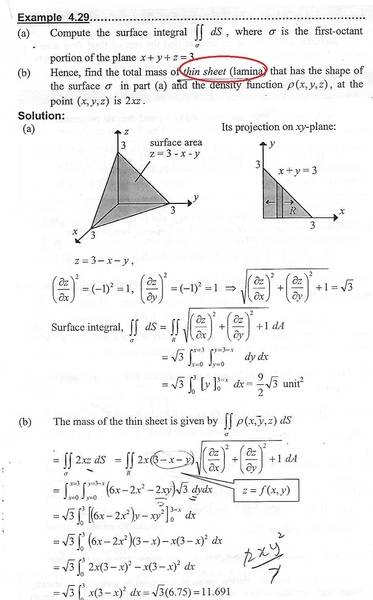
in part b , we can find mass by density x area ?
is it because of the thin plate, so, the thickness of plate can be ignored?
N7jdECp.jpg
 
Physics news on Phys.org
There is no ignoring the thickness going on. The density function is a function of only two variables (*), so it provides mass/area, not mass/volume.

(*) as pointed out with the z=f(x,y) callout
 
  • Like
Likes   Reactions: chetzread
BvU said:
There is no ignoring the thickness going on. The density function is a function of only two variables (*), so it provides mass/area, not mass/volume.
BvU said:
There is no ignoring the thickness going on. The density function is a function of only two variables (*), so it provides mass/area, not mass/volume.

(*) as pointed out with the z=f(x,y) callout

(*) as pointed out with the z=f(x,y) callout
BvU said:
There is no ignoring the thickness going on. The density function is a function of only two variables (*), so it provides mass/area, not mass/volume.

(*) as pointed out with the z=f(x,y) callout
BvU said:
There is no ignoring the thickness going on. The density function is a function of only two variables (*), so it provides mass/area, not mass/volume.

(*) as pointed out with the z=f(x,y) callout
so, z=f(x,y) provide info that density depends on 2 variables only?
 
Yes $$\rho(x,y,z) = \rho(x,y,3-x-y) = \rho(x,y) $$it is multiplied with something of dimension length2 so ##\rho## has the dimension mass/area
 
  • Like
Likes   Reactions: chetzread