Discussion Overview
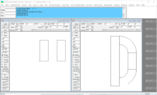
The discussion revolves around the geometric coincidence issue encountered when modeling a semi-cylinder within a cuboid using MCNP (Monte Carlo N-Particle Transport Code). Participants explore the challenges of defining shapes and their intersections in the context of Constructive Solid Geometry.
Discussion Character
- Technical explanation
- Debate/contested
- Mathematical reasoning
Main Points Raised
- One participant raises a question about solving the geometric coincidence problem when fitting a semi-cylinder into a cuboid, indicating it is geometrically problematic.
- Another participant mentions that MCNP uses Constructive Solid Geometry, suggesting that shapes should intersect and that the user must specify which volumes correspond to different parts of the problem.
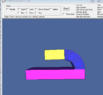
- A participant describes an issue where only two out of four cubes are displayed, questioning why the expected cuboids are not visible in the model.
- Discussion includes a technical clarification about cell definitions, where positive surfaces indicate areas above or outside, while negative surfaces indicate below or inside, with a specific example provided regarding cell definitions.
- One participant acknowledges a mistake in the X-axis orientation affecting the surface definitions, indicating a correction was made.
- Despite correcting the X-axis error, another participant notes that a modeling problem persists in cell card 1, questioning why cell card 1 and cell card 2 are defined similarly when only one causes an issue.
- A participant observes that MCNP appears to function correctly, while a tool called VisEd does not seem to display the model as expected, suggesting that VisEd may have issues with comments in the model.
Areas of Agreement / Disagreement
The discussion contains multiple competing views and unresolved issues regarding the geometric modeling in MCNP, with participants expressing differing experiences and interpretations of the software's behavior.
Contextual Notes
Participants express uncertainty about the correct definitions and configurations of surfaces and cells, indicating potential limitations in their understanding of the software's requirements for geometric modeling.