Can someone check my work for this problem I thought of?

  • Context: Graduate 
  • Thread starter Thread starter zeromodz
  • Start date Start date
  • Tags Tags
    Check my work Work
Click For Summary

Discussion Overview

The discussion revolves around a self-posed problem regarding the calculation of angular velocity (theta) of a spaceship's orientation relative to a planet as it passes by. The scope includes theoretical considerations of motion, angular momentum, and the slingshot effect, with participants evaluating the proposed mathematical approach and its implications.

Discussion Character

  • Exploratory
  • Technical explanation
  • Debate/contested
  • Mathematical reasoning

Main Points Raised

  • The original poster presents a mathematical model for calculating the change in angular velocity (theta) as a spaceship approaches a planet, using initial velocity and gravitational parameters.
  • Some participants argue that the approach contains errors, particularly regarding the treatment of time intervals and the inclusion of initial velocity in the change of velocity equations.
  • Concerns are raised about the assumption of constant distance (R) and its impact on the accuracy of the results.
  • There is a suggestion that a more comprehensive understanding of the problem requires calculus to account for the full motion and behavior over time.
  • One participant proposes an engineering perspective, suggesting that the equations could be used iteratively in a programming context, such as MATLAB, to approximate the solution.
  • Another participant emphasizes the importance of maintaining correct units in calculations to identify potential mistakes in the model.
  • Participants discuss the implications of choosing time intervals for summing changes in theta, noting that inappropriate choices could lead to significant errors in the final result.

Areas of Agreement / Disagreement

Participants generally disagree on the validity of the original approach, with multiple competing views on the correct treatment of variables and the methodology required to solve the problem accurately. The discussion remains unresolved regarding the best approach to take.

Contextual Notes

Limitations include the assumption of constant R, the treatment of time intervals, and the potential for incorrect units leading to errors in the calculations. The need for a more rigorous mathematical framework is also noted.

zeromodz
Messages
244
Reaction score
0
Okay, let me clarify this isn't for homework or anything. Purely something I thought of when I was driving home. I am not sure if there is already a solution to this problem, there probably is but I want to see how correct my solution is.

The problem is the following. Suppose I am traveling in a spaceship and I am passing by some planet. I want to know the rate of change of theta (angular velocity) of my orientation to this planet as I pass it. You can say I am "above the planet" in the sense that if I pass and I look some angle below my horizontal I see it. The ultimate goal is to calculate how far the planet will change my directional velocity. If you could also give some input about how this relates to the slingshot effect.

Here is a picture to help illustrate what I am saying.
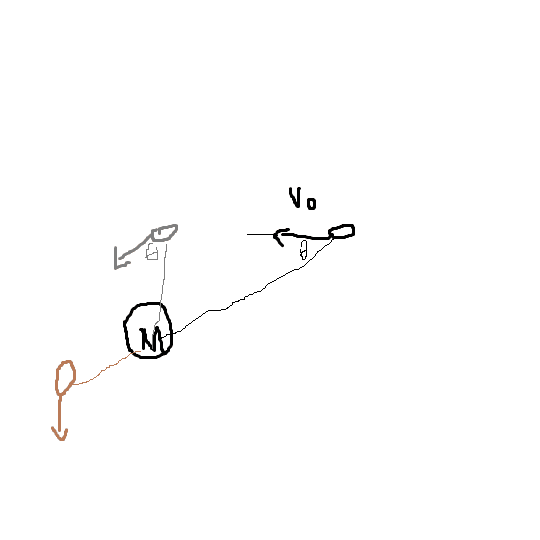
physics_example.png


Here is my approach

This spaceship only has an x direction initial velocity so
Vx = Vo + ATcosѲ = Vo + GMTcosѲ/ R^2
Vy = ATsinѲ = GMTsinѲ/ R^2

Let us suppose a change in velocities. For the purpose for the calculation we will neglect how R changes with time.

ΔVx = Vo + GMΔTcosѲ/ R^2
ΔVy = GMΔTsinѲ/ R^2

Now a consider

tan(ΔѲ) = (ΔVy/ΔVx) = ((GMΔTsinѲ/ R^2)/(Vo + GMΔTcosѲ/ R^2))
This reduces to
tan(ΔѲ) = ((GMΔTsinѲ)/ (VoR^2 + GMΔTcosѲ))

Solving for theta and allow ΔT to be change in one second.
ΔѲ = arctan((GMsinѲ)/ (VoR^2 + GMcosѲ))

since ΔT is equal to one we can say that ΔѲ = w (radpersec)

So the final equation becomes
w = arctan((GMsinѲ)/ (VoR^2 + GMcosѲ))

This makes sense to me in many ways because the only way w goes to zero is if Vo or R go to infinity or if Ѳ is initially zero which would just means the object is going straight towards the planet. Also notice, if Vo is zero the object will just approach the planet at Ѳ which also makes sense.

Let me know what you guys think. Thanks.
 
Last edited:
Astronomy news on Phys.org
There are a lot of errors. You should not say the change in time is "1", you should look for ratios of changes in V to changes in time, because otherwise you get expressions with the wrong units and it will cover mistakes. For example, the initial V_o should not appear in an expression for the change in V_x. Also, taking R as constant will always make the results only approximate, and would have to be done with more care. Finally, it's not clear that solving for the rate of change of theta at any given moment will be enough to piece together the whole behavior, that really requires calculus. The solution you are looking for is given in many orbital mechanics textbooks, around places where the slingshot effect is treated. The ultimate goal is to determine the total change in theta over the full motion in the frame where the planet is stationary, and that's what you need to get the slingshot effect when you change back into a frame where the planet is moving.
 
  • Like
Likes   Reactions: berkeman
Ken G said:
There are a lot of errors. You should not say the change in time is "1", you should look for ratios of changes in V to changes in time, because otherwise you get expressions with the wrong units and it will cover mistakes. For example, the initial V_o should not appear in an expression for the change in V_x. Also, taking R as constant will always make the results only approximate, and would have to be done with more care. Finally, it's not clear that solving for the rate of change of theta at any given moment will be enough to piece together the whole behavior, that really requires calculus. The solution you are looking for is given in many orbital mechanics textbooks, around places where the slingshot effect is treated. The ultimate goal is to determine the total change in theta over the full motion in the frame where the planet is stationary, and that's what you need to get the slingshot effect when you change back into a frame where the planet is moving.

You are right to say that this would be incorrect from a physicists point of view because of the methodology. However, I guess I was looking at it from an engineering point of view (myself being an engineering student in college). Let me respond in the following way.

I understand that a change in Vx shouldn't have a Vo in it. However, maybe we can see these change in V's more as additions for every second. Also, I don't see why we can't allow t to equal one. This will give us a change in theta for every incremental second. I feel like we would use this equation in a computer program that could solve the problem iteratively. I use the program called MATLAB and use this equation to incrementally solve the problem using for loops and adding up all the changes in theta. The only problems I see is making an approximation by holding R as a constant and that maybe as you pointed out that summing up all the changes in theta may not actually produce the final theta.
 
zeromodz said:
I understand that a change in Vx shouldn't have a Vo in it.
Yet it does-- so that's going to be wrong.
However, maybe we can see these change in V's more as additions for every second.
There still shouldn't be a Vo.
Also, I don't see why we can't allow t to equal one.
The units aren't right. You can say 1 second, but then you keep the "second" in all the formulas. Since you end up dividing by 1 second when you get the omega, it wouldn't matter, except that it would have shown you why the Vo doesn't belong there. That's one of the most important reasons to keep correct units-- to help you find mistakes.
The only problems I see is making an approximation by holding R as a constant and that maybe as you pointed out that summing up all the changes in theta may not actually produce the final theta.
If you want to build up a theta by summing changes in theta, you need to choose the timestep intelligently. It may be that 1 second is way too long, and will introduce errors, or it may be that it is way too short, and will have you doing too many iterations in the code. I recommend that you never, never, replace a time interval by a "1."
 

Similar threads

  • · Replies 12 ·
Replies
12
Views
3K
  • · Replies 86 ·
3
Replies
86
Views
8K
  • · Replies 16 ·
Replies
16
Views
1K
  • · Replies 8 ·
Replies
8
Views
2K
  • · Replies 13 ·
Replies
13
Views
2K
  • · Replies 4 ·
Replies
4
Views
1K
  • · Replies 7 ·
Replies
7
Views
896
  • · Replies 4 ·
Replies
4
Views
2K
  • · Replies 9 ·
Replies
9
Views
2K
Replies
3
Views
2K