Can someone explain this answer "in layman's terms"?

  • Context: Undergrad 
  • Thread starter Thread starter iwantcalculus
  • Start date Start date
  • Tags Tags
    Explain Terms
Click For Summary
SUMMARY

The curve defined by the implicit equation X*Y^3 + x^3*Y = 4 has no horizontal tangent. To determine this, one must differentiate the equation using implicit differentiation to find dy/dx. The analysis shows that dy/dx = 0 only when the numerator of the derivative equals zero, which leads to the conclusion that y must equal zero. However, substituting y = 0 into the original equation does not satisfy it, confirming that no points exist where the curve has a horizontal tangent.

PREREQUISITES
  • Understanding of implicit differentiation
  • Familiarity with polynomial functions
  • Knowledge of calculus concepts such as derivatives and horizontal tangents
  • Ability to solve equations involving multiple variables
NEXT STEPS
  • Study implicit differentiation techniques in calculus
  • Learn how to identify horizontal tangents in polynomial curves
  • Practice solving similar implicit equations to find tangents
  • Explore the concept of critical points in multivariable calculus
USEFUL FOR

Calculus students, educators, and anyone seeking to deepen their understanding of implicit differentiation and the behavior of polynomial curves in relation to horizontal tangents.

iwantcalculus
Messages
15
Reaction score
1
The question is :

Show that the curve defined implicitly by the equation

X*Y^3 + x^3*Y = 4

has no horizontal tangent.The answer is :
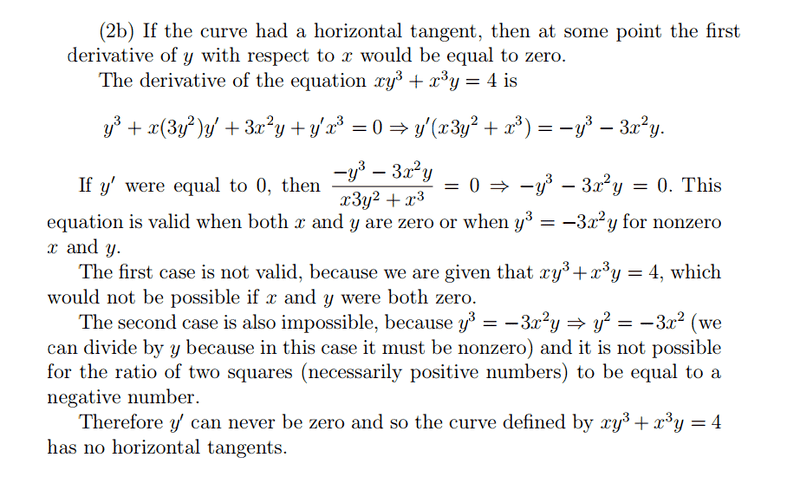

4546765calcyyyyyyyyyyyyyyyyy.png
Can someone please explain what steps are used in order to obtain the answer in a simple way for a calculus beginner? This answer is not helping me understand the question and how to answer the question ( It is too complicated and gets me confused).

And if you have similar questions, please show me them so I can practice on them after I understand this question in order to be comfortable with this type of questions.
 
Physics news on Phys.org
A curve is given ##f(x,y) = c ##. To see if there are any horizontal tangents, you need to get ##y' = \frac{dy}{dx} ##. So then you take the derivative of both sides of the equation ##f(x,y) = c ## resulting in some other true equation ##f'(x,y) = 0 ##. You can obtain ##f'## by implicit differentiation. Now somewhere in ##f'## there will be a ##dy/dx## aka ##y'##. You need to extract that somehow and solve for it. How you do this will depend on the the function you were given. In this case ##y'## is that that ratio of two polynomials.

To find if the function has a horizontal tangent we solve ##dy/dx = 0##. In our case ##dy/dx## is a fraction of two things $$y' = \frac{a(x,y)}{b(x,y)} = 0$$ can only be true if ##a(x,y)= 0##. So to find solutions set the numerator to zero (note however that ##a(x,y) = 0 ## and ##b(x,y) = 0## is a special case). Finally one goes on to see if there is a solution to ##dy/dx= y' = 0##. One finds in this case that there isn't but in general there might be.
 
Last edited:
iwantcalculus said:
The question is :

Show that the curve defined implicitly by the equation

X*Y^3 + x^3*Y = 4

has no horizontal tangent.The answer is :


4546765calcyyyyyyyyyyyyyyyyy.png
The above is not "the answer." It is the explanation of why the curve xy3 + yx3 = 4 doesn't have a horizontal tangent. The explanation seems pretty straightforward to me. What part of the explanation seems confusing to you?
iwantcalculus said:
Can someone please explain what steps are used in order to obtain the answer in a simple way for a calculus beginner? This answer is not helping me understand the question and how to answer the question ( It is too complicated and gets me confused).

And if you have similar questions, please show me them so I can practice on them after I understand this question in order to be comfortable with this type of questions.
 
Perhaps a little bit simpler: a "horizontal tangent" is where y'= dy/dx= 0. Differentiating both sides of xy^3+ x^3y= 4 with respect to x,
y^3+ 3xy^2y'+ 3x^2y+ x^3y'= 0.

At any point where y'= 0, that becomes y^3+ 3x^2y= y(y^2+ 3x^2)= 0. That is only true where y= 0 or y^2+ 3x^2= 0 which, again, requires that y= 0. But if y= 0 then xy^3+ x^2y= 0, not 4. That curves does not contain any point where y= 0 so no point where y'= 0.
 
I think that the original explanation is pretty good and thorough, step-by-step. It uses a lot of fundamental facts. You should look at it carefully step-by-step and ask about the specific steps that are a problem.
 
  • Like
Likes   Reactions: Mark44

Similar threads

  • · Replies 3 ·
Replies
3
Views
3K
  • · Replies 5 ·
Replies
5
Views
2K
  • · Replies 53 ·
2
Replies
53
Views
3K
  • · Replies 14 ·
Replies
14
Views
2K
  • · Replies 7 ·
Replies
7
Views
2K
  • · Replies 1 ·
Replies
1
Views
3K
  • · Replies 22 ·
Replies
22
Views
5K
  • · Replies 2 ·
Replies
2
Views
2K
  • · Replies 2 ·
Replies
2
Views
3K
  • · Replies 11 ·
Replies
11
Views
3K