Can someone me understand Norms in number theory?

Click For Summary

Homework Help Overview

The discussion revolves around understanding norms in number theory, particularly in the context of matrices associated with linear operators and their representations in different bases. The original poster expresses confusion regarding the construction of a specific matrix related to complex embeddings and norms.

Discussion Character

  • Exploratory, Conceptual clarification, Mathematical reasoning

Approaches and Questions Raised

  • Participants explore the construction of the matrix Aα and its relation to the coefficients of a given equation. Questions arise about the conventions used in the lecture notes, particularly regarding matrix transposition and the implications for calculating norms.

Discussion Status

Some participants have provided clarifications regarding the conventions used in the matrix representation and the properties of norms. There is ongoing exploration of the implications of these conventions on calculations, with some participants correcting their previous misunderstandings and seeking validation for their revised calculations.

Contextual Notes

Participants note that the norms of nonzero elements cannot be zero, and there is discussion about specific calculations involving roots of unity. The examples discussed are framed within the context of specific bases and their properties, which may influence the calculations being performed.

Firepanda
Messages
425
Reaction score
0
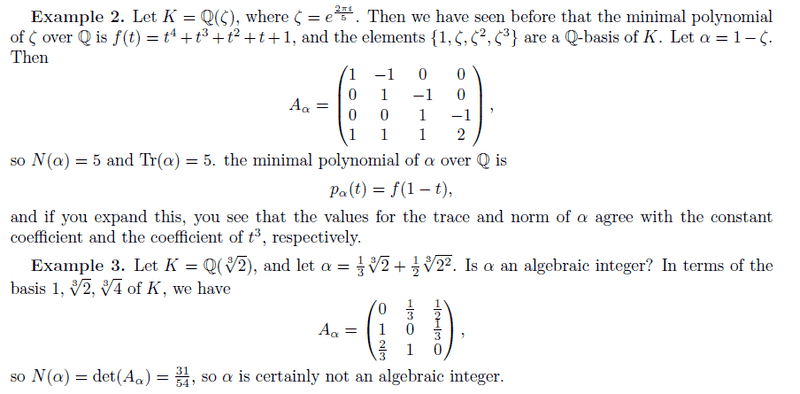
Here is a section of examples from my lecture notes.
sq11qe.png


Basically I have NO idea how the lecturer created the matrix Aα, and it's not clear anywhere in the lecture notes.

I think it's something to do with complex embeddings but I'm not sure. Does anyone know?

I'm sure once I know how the matrix was created I can work out the Norms, but so far I'm completely stuck!
 
Physics news on Phys.org
not sure how to create it either but the first row looks like the coefficients of the alpha = equation namely 0 * 1 + 1/3 * 2^(1/3) + 1/2 4^(1/3) ==> 0, 1/3, 1/2
 
Your lecturer seems to be following an unusual convention. The matrices he's written down really ought to be transposed. What's going on here is that [itex]A_\alpha[/itex] is the multiplication-by-[itex]\alpha[/itex] linear operator on the Q-vector space K. The given matrices are simply the (transposes) of the matrices of [itex]A_\alpha[/itex] with respect to the given bases.

In the first example, we have
[tex]\begin{align}<br /> A_\alpha 1 &= 1 - \zeta \\<br /> A_\alpha \zeta &= \zeta - \zeta^2 \\<br /> A_\alpha \zeta^2 &= \zeta^2 - \zeta^3 \\<br /> A_\alpha \zeta^3 &= \zeta^3 - \zeta^4 = \zeta^3 - (-1 - \zeta - \zeta^2 - \zeta^3) = 1 + \zeta + \zeta^2 + 2\zeta^3\end{align}[/tex] so the matrix of [itex]A_\alpha[/itex] with respect to the basis [itex]\{1,\zeta,\zeta^2,\zeta^3\}[/itex] is the transpose of the first matrix in your notes. (At least, according to the usual convention of writing down matrices of linear maps wrt given bases. Your lecturer seems to be writing down the entries of the matrix as rows instead of columns. In any case, this doesn't affect the value of the norm or trace, because [itex]N(\alpha) = \det A_\alpha = \det A_\alpha^t[/itex] and similarly [itex]\text{Tr}\,(\alpha) = \text{trace}\, A_\alpha = \text{trace}\, A_\alpha^t[/itex].)
 
Awesome thanks! I think I get it now

Say for the first example if I had
[itex]\alpha = \zeta + \zeta^2[/itex]

so the matrix of [itex]A_\alpha[/itex] with respect to the basis [itex]\{1,\zeta,\zeta^2,\zeta^3\}[/itex]

would be

[itex]A_\alpha[/itex] = [0 1 1 0 ; 0 0 1 1 ; -1 -1 -1 0 ; 1 0 0 0]

Correct? (per the way my lecturer is doing it)

I calculate this as having a norm of 0, is this ok?
 
No - you have a mistake. The give-away is that the norm of a nonzero [itex]\alpha[/itex] can never be zero. (Because [itex]N(\alpha)N(\alpha^{-1})=1[/itex].)

Your first [STRIKE]two[/STRIKE] three rows are right, but your last [STRIKE]two[/STRIKE] one isn't. Note that [itex]\zeta^5=1[/itex].
 
Last edited:
morphism said:
No - you have a mistake. The give-away is that the norm of a nonzero [itex]\alpha[/itex] can never be zero. (Because [itex]N(\alpha)N(\alpha^{-1})=1[/itex].)

Your first [STRIKE]two[/STRIKE] three rows are right, but your last [STRIKE]two[/STRIKE] one isn't. Note that [itex]\zeta^5=1[/itex].

Yep sorry, mistake in my calculation, i was focusing on calculating [itex]\zeta^5=1[/itex] and forgot about my [itex]\zeta^4[/itex] term

My last row should be [0 -1 -1 -1]

So my norm should be -1 and trace is -2? Are negatives ok?

A quick way of calculating the rows (or columns in your case) seems to be by shifting them to the right providing there is a 0 to shift into, when there isn't a 0 in the row then a new pattern starts, is that how it is? Seems like that so far!
 
Firepanda said:
Yep sorry, mistake in my calculation, i was focusing on calculating [itex]\zeta^5=1[/itex] and forgot about my [itex]\zeta^4[/itex] term

My last row should be [0 -1 -1 -1]

So my norm should be -1 and trace is -2? Are negatives ok?
Yup, looks good.

A quick way of calculating the rows (or columns in your case) seems to be by shifting them to the right providing there is a 0 to shift into, when there isn't a 0 in the row then a new pattern starts, is that how it is? Seems like that so far!
Unfortunately that's not how it is in general. The examples here are nice for two reasons: 1) the given bases are "power bases" (i.e. bases of the form {1,x,x^2,...,x^n} for some x), and 2) the given [itex]\alpha[/itex]'s are written in terms of the respective bases.
 

Similar threads

  • · Replies 2 ·
Replies
2
Views
1K
Replies
5
Views
2K
Replies
2
Views
1K
  • · Replies 2 ·
Replies
2
Views
1K
Replies
2
Views
1K
Replies
8
Views
3K
  • · Replies 1 ·
Replies
1
Views
3K
  • · Replies 2 ·
Replies
2
Views
4K
Replies
3
Views
1K
  • · Replies 1 ·
Replies
1
Views
2K