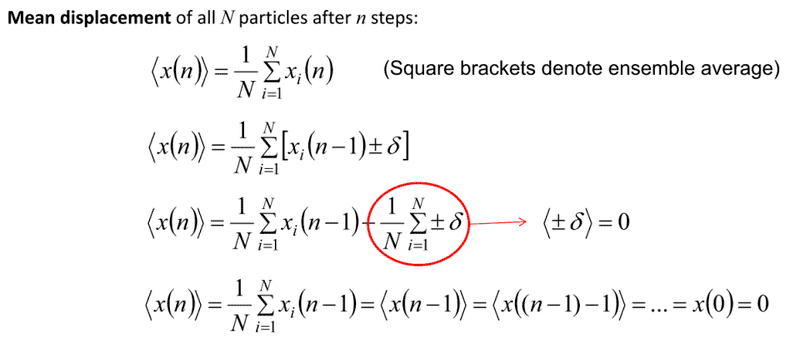
Can someone retrace this easy random walk calculation?

Click For Summary
SUMMARY

This discussion focuses on the mathematical concepts surrounding random walks, specifically addressing the notation and implications of expressions involving particle positions after a series of steps. The participants clarify that the minus sign in the equation does not affect the average outcome, as the sum of positive and negative displacements averages to zero. Additionally, they confirm that the expression x((n-1)-1) simplifies to x(n-2), emphasizing the iterative nature of the random walk calculations.

PREREQUISITES
  • Understanding of random walk theory
  • Familiarity with mathematical notation and averages
  • Basic knowledge of particle physics concepts
  • Ability to interpret mathematical expressions involving sequences
NEXT STEPS
  • Study the principles of random walk theory in depth
  • Explore mathematical notation in physics, focusing on averages and expectations
  • Learn about the implications of particle displacement in one-dimensional systems
  • Investigate the concept of ensemble averages in statistical mechanics
USEFUL FOR

Mathematicians, physicists, and students studying stochastic processes or random walks will benefit from this discussion, particularly those looking to deepen their understanding of particle behavior in random systems.

SansaStark
Messages
15
Reaction score
0
Okay, it's not easy for me but probably for you ;)

Hello first of all!

I have two questions:
1. Why is there a minus before the expression in the red circle?
2. How did the x((n-1)-1) in the last line come to be?
More precise: I understand the first parts. It's the random walk and x signifies the position of a particle after n steps. Then (n-1) ist the position of the particle having moved to either the left or right side (this is 1-dimensional) and the δ is the distance the particle has travelled. But why is there a minus in the third line before the second 1/N? I mean how do I imagine that visually? I kind of have a notion but I can't really grasp it. And then in the last line why is the [x(n-1)] the same as [x((n-1)-1)]? Huh? oO

Okay, here is the equation:
upload_2016-1-15_18-37-49.png


Thanks a lot already!

Vera
 
Physics news on Phys.org
Okay I've looked up the answer to the first question in a book and there it says plus before the term encircled. So maybe it's not minus? Or might be that both are right? Ummm... anyone in the mood for some random walk? ;)
 
Ahh... now I get the second question also! HAHA...

So if anyone should care:

In the second equation the author simply plugged in a 1 for the δ meaning that the particles (or the particle) are at zero after 1 step (actually have averaged out each other)! I reckon...

Would be cool if some math guru would leave a comment o my math monologue ;)
 
The way I interpret what they do:
SansaStark said:
1. Why is there a minus before the expression in the red circle?
Don't think it matters, as on average ##\displaystyle \sum_{i=1}^n \pm \delta = 0##
SansaStark said:
2. How did the x((n-1)-1) in the last line come to be?
In the last line, they get ##\displaystyle \langle x(n) \rangle=\frac{1}{N}\sum_{i=1}^n x_i(n-1)##, but that is equal to ##\langle x(n-1) \rangle## (see the first formula). And then they repeat the same process down to ##\langle x(0) \rangle=0##.
 
Okay, I guess I got number one where the minus is simply based on the knowledge of +/- δ being zero thus having no further meaning.

And to the second problem: So does x(0) actually mean n is equal to the value which is substracted from n?
And does (n-1)-1 simply mean n-2?

Thanks!
 
SansaStark said:
Okay, I guess I got number one where the minus is simply based on the knowledge of +/- δ being zero thus having no further meaning.

And to the second problem: So does x(0) actually mean n is equal to the value which is substracted from n?
And does (n-1)-1 simply mean n-2?

Thanks!
I think the ##x(0)## should have been ##\langle x(0) \rangle##.
And yes, ##(n-1)-1=n-2##. They wrote it that way to emphasize that they are repeating the previous step.
In the last line, they first get ##\langle x(n) \rangle=\langle x(n-1) \rangle##. As this hold for any ##n##, it can be applied to ##n-1##, yielding ##\langle x(n-1) \rangle=\langle x((n-1)-1) \rangle=\langle x(n-2) \rangle## and so on ...
 
Oh I guess I have it now. Thanks lot!
 
Probably <x(0)> = x(0) = 0 is also true. The ensemble average on nothing (empty sum) results in nothing.
 
  • Like
Likes   Reactions: SansaStark

Similar threads

  • · Replies 8 ·
Replies
8
Views
2K
Replies
6
Views
2K
  • · Replies 10 ·
Replies
10
Views
2K
  • · Replies 2 ·
Replies
2
Views
2K
  • · Replies 3 ·
Replies
3
Views
691
  • · Replies 11 ·
Replies
11
Views
2K
  • · Replies 7 ·
Replies
7
Views
3K
  • · Replies 6 ·
Replies
6
Views
1K
  • · Replies 3 ·
Replies
3
Views
2K
  • · Replies 9 ·
Replies
9
Views
4K